Genesis 50
I tnalù dwata · Tap a verse to see its cross-references.
I kagu ale Dyosif di kalbangla i maan
1Di kfati Dyékob, lkaf Dyosif i maan, na nalakan na mngel kenen. 2Kafnge ani, dek Dyosif i dad saligan i too fulung mulung, mulung i laweh i maan, du fye léét balok. Taman i dad to fulung mulung bnulungla i lawehan. 3Na i klola mulung i laweh maan gafat di fat falò duh, du ani gal i klo i kbulung i laweh i dad mati. Na i dad to di Idyif flidù i nawala klo i fitu falò duh.
4Na di kafto i dad butang i kaflidùla di kfati Dyékob, man Dyosif di dad salig i harì, “Ku kandoyu agu, tugadyu di ku Faraon i mangu ani. Manyu di kenen, 5‘Di kagu màgu mati, fakanggu di kenen lbanggu kenen ditù di gulambang tafalan fatlagad aye di Kanaan. Taman, ku fakay di ge moon, salu agu ditù du lambang agu ku Mà, na lê agu sa samfulê dini.’ ”
6Na di kgadè Faraon i snalek Dyosif, tnimelan kenen, manan, “Hae, salu ge ditù na lbangam i maam. Dnohoam i tafakangam di kenen.”
7Taman tamdà Dyosif du lambang i maan. Na i kdee dad ganlal Faraon, na i dad saligan di bong gumnean, na dademe to nun dengeg di banwe Idyif mti magin ku Dyosif. 8Na magin kenen i malayan, i dad flanekan, na i dad malay i maan. Alò i dad malnak dad ngàla, dad bilibilila, dad kambingla, na i dad bakala là magin, bay mtagak di Gosén. 9Nun dademe i magin smakay dad kudà, na dademe smakay i snakay fadyol i kudà. Too dee dad to magin ku Dyosif du lambang i maan.
10Di kakella di gal gumlék fali di Atad, di faltù i yéél Dyordan, mlanu ale. Na ditù flidù Dyosif i nawan di maan, klo fitu duh. 11Na di kite i dad to di Kanaan i kaflidùla déén di gumlék fali di Atad, manla, “I dad to di Idyif too ale mlidù.” Taman i banwe gumimòla dun ani dnagitla Abél Misraim na i gumtatekan dunan, “I guflidù i dad to di Idyif.” Gumimòla ani di faltù di yéél Dyordan.
12Too dnohò i dad ngà Dyékob i katedan dale. 13Hae, du nebela i lawehan di tanà ditù di Kanaan, na lbangla di ilib di Makféla i banwe mdadong di Mamri gsen di gusut i duh. Na ilib na tanà ani bnayad Abraham mdà di ku Ifron, to di Hiti, du nimoan gal gulambang. 14Na di kafnge Dyosif lambang i maan, samfulê kenen di Idyif, demen mulê i dad flanekan, na i kdee dademe dad to magin kenen lambang i maan.
I kaflehew Dyosif i dad flanekan
15Na du tamati nan Dyékob, stulen i dad flanek Dyosif, manla, “Fadê ken nun fa ksasè fandam Dyosif gito, na ani ken malas gito du mdà di sasè mgimoito di kenen di muna.”
16Taman nun ftugadla i talùla di ku Dyosif, manla, “Di là fa mati Mà, 17katedan gami, ku gami tmulen di ge i gmanan, na ani manan, ‘Begam nlifet i salà i dad flanekam mgimòla di ge di muna.’ Taman tabyà, begam nlifet i salà mgimòmi di ge, gami dad salig i Dwata, Dwata i maam.” Na di kaklinge Dyosif i kmanla, mngel kenen.
18Kafnge én, salu i dad flanekan di kenen, na lkuad ale di kenen. Na manla, “Tadini gami nan, du fye nimoam gami dad lifanam.”
19Kabay man Dyosif di dale, “Nang gamu likò, du ise deg mukum gamu, du alò Dwata fakay mukum. 20Du balù i knayèyu ku fansasèyu agu di muna, bay too fye kfagu Dwata, du fye dnohoan baling i knayean, fye là mati i dee dad to di kalnusla, na én duenan mto ito fa ani. 21Taman nang gamu likò. Nifatta gamu na i dad ngàyu.” Na ani kfagu Dyosif i taluan, du nlalan na flehewan i nawa i dad flanekan lagi.
I kfati Dyosif
22Na Dyosif na i malay i maan fadlug mnè di banwe Idyif. Na tamlatu sfalò falin di kfatin. 23Di là fa mati kenen, teenan fa i dad ngà i dad fuan, i dad fù Ifraim. Na léan teen i dad ngà Makir, i tingà Manasas, na di ksutla gagotan ale fa.
24Na satu duh, man Dyosif di dad flanekan, “Na mdadong nan i bang kfatigu, bay là gamu fbayà i Dwata. Hae, dnohoan i fakangan di dad gutambulito Abraham, Isaak, na Dyékob, du tnabengan gamu na neben gamu kadang, mdà di banwe ani salu di banwe tafakangan i dad belito.”
25Kafnge én, nun kated Dyosif i dad dademe bel di Israél, manan, “Di kebe Dwata gamu samfulê di Kanaan, fnakangyu agu nebeyu mulê kadang balù i dad tulangu.” 26Na déén nan gumati Dyosif, na tamlatu sfalò i falin. Na bnulungla i lawehan, du fye léét balok, na fkahla kenen di lungunan déén di Idyif.
Did you know?
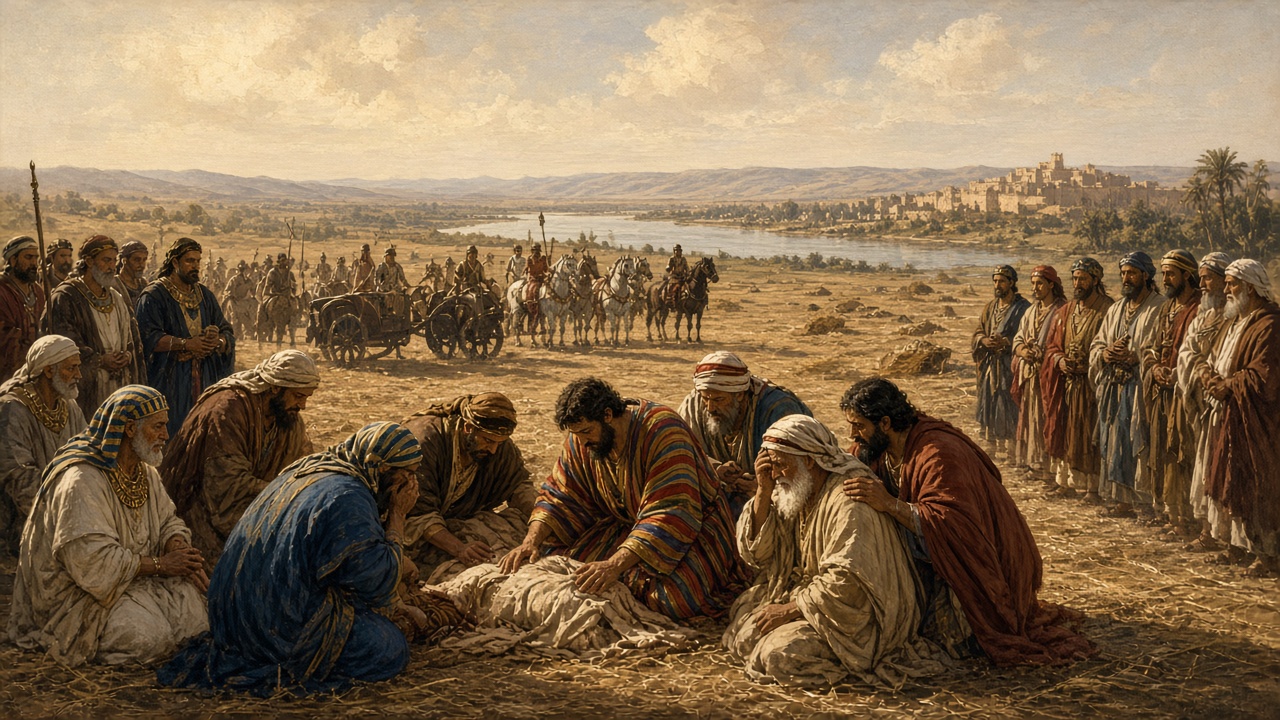
The Burial of Jacob and the Death of Joseph
- The threshing floor of Atad, where the company wailed loudly for seven days across the Jordan, takes its name from a word meaning buckthorn. The Canaanites who saw the mourning called the place Abel-mizraim, 'meadow of Egypt' or 'mourning of Egypt.' Easton's Bible Dictionary places Abel-mizraim west of the Jordan and says its site is unknown, while describing Atad as probably near Hebron.Sources: the Bible text itself
- Jacob's sons buried him in the cave of Machpelah, in the field near Mamre, the burial site Abraham had bought from Ephron the Hittite. Easton's Bible Dictionary identifies Ephron as the son of Zohar and records the price as four hundred shekels of silver.Sources: the Bible text itself
- Joseph remained in Egypt and lived to the age of one hundred and ten, long enough to see Ephraim's sons to the third generation. The sons of Machir, son of Manasseh, were brought up on Joseph's knees—a phrase the Revised Version renders 'born upon Joseph's knees,' which Easton's Bible Dictionary explains as adoption from birth. He told his brothers that God would bring them up to the land promised to Abraham, Isaac, and Jacob, and he made the sons of Israel swear to carry his bones up from Egypt; when he died, they embalmed him and placed him in a coffin there.Sources: the Bible text itself
Notes written with AI assistance from open sources (Theographic Bible Metadata, CC BY-SA 4.0; Easton’s Bible Dictionary, public domain) and reviewed before publishing.
Places in this chapter
- Canaan · 32.767, 35.333 · verses 5, 13
- Egypt · 30.129, 31.308 · verses 7, 14, 22, 24, 26
- Goshen · Today: Goshen 1 · 30.799, 31.834 · verse 8
- Atad · Today: near the mouth of the Jordan River · 31.915, 35.530 · verses 10, 11
- Jordan · Today: Jordan River · 31.761, 35.558 · verses 10, 11
- Machpelah · Today: Cave of the Patriarchs · 31.525, 35.111 · verse 13
Only places identified with high confidence are shown (90% or more according to the scholarly sources compiled by OpenBible). Period map: DARE (Digital Atlas of the Roman Empire), CC BY 4.0; modern map: © OpenStreetMap contributors; places: OpenBible.info (CC BY 4.0).
Credits and license for this translation
I tnalù dwata
New Testament in Blaan, Sarangani
copyright © 1998 Wycliffe Bible Translators, Inc.
Language: Sarangani Blaan (Blaan, Sarangani)
Translation by: Wycliffe Bible Translators
Contributor: Wycliffe Bible Translators, Inc.
Copyright Information
© 1998, Wycliffe Bible Translators, Inc. All rights reserved.
This translation text is made available to you under the
terms of the Creative Commons License: Attribution-Noncommercial-No Derivative Works.
( http://creativecommons.org/licenses/by-nc-nd/3.0/ )
In addition, you have permission to port the text to different file formats, as long as you
do not change any of the text or punctuation of the Bible.
You may share, copy, distribute, transmit, and extract portions
or quotations from this work, provided that you include the above copyright
information:
You must give Attribution to the work.
You do not sell this work for a profit.
You do not make any derivative works that change any of the actual words or punctuation of the Scriptures.
Permissions beyond the scope of this license may be
available if you contact
us with your request.
The New Testament
in Blaan, Sarangani
© 1998, Wycliffe Bible Translators, Inc. All rights reserved.
This translation is made available to you under the terms of the
Creative Commons Attribution-Noncommercial-No Derivatives license 4.0.
You may share and redistribute this Bible translation or extracts from it in any format, provided that:
You include the above copyright and source information.
You do not sell this work for a profit.
You do not change any of the words or punctuation of the Scriptures.
Pictures included with Scriptures and other documents on this site are licensed just for use with those Scriptures and documents.
For other uses, please contact the respective copyright owners.
2015-03-17
Source: http://ebible.org/bps/ · eBible.org