Genesis 37
I tnalù dwata · Tap a verse to see its cross-references.
I dad kna Dyosif i tingà Dyékob
1Na Dyékob tamnè di Kanaan, i banwe i gumnè i maan. 2Na ani i santulen gablà i dad ngà Dyékob.
Na tasfalò fitu fali Dyosif, na tnabengan i dad twegen mifat i dad lmanaf i màla. Na dad twegen ani dad ngà di dademe yaan Dyékob dunan Bilha na Silfa. Satu duh, salu Dyosif di maan, du tulenan kenen gablà di sasè nimò i dad flanekan.
3Na Israél, dunan Dyékob, di kdee dad ngaan, Dyosif i toon kando, du silang sut Dyosif di tatoo tua. Taman fimoan i too fye baweh tahà klaweh ku Dyosif, gal lafin di tah saulan. 4Na di kgadè dad flanek Dyosif, too kenen kando i màla mdatah fa di kakdon dale, mnang nawala kenen, na landè fye ktalùla di kenen.
5Di satu butang, kamna Dyosif. Na di ktulenan i dad flanekan lagi gablà di knan, too lumban fa i knang nawala kenen, 6du manan, “Fanlingeyu gablà di knagu. 7Kdee ito mimò di nligo, na bnatangito dad fali tamgateh. Na makto tadag i deg bnatang, na i gamu bnatang samlibut i deg bnatang, na lkuad ale du nafèla.”
8Na man i dad flanekan lagi, manla, “Tay, man nawam kè ku ge kadang i ulu magot gami?” Na too matnù i knang nawala kenen, du mdà di knan na i ktulenan dun di dale.
9Na satu butang lêman kamna Dyosif, na tulenan di dad flanekan lagi, manan, “Fanlingeyu, lêman agu kamna. Na ani knagu, i duh, bulen, na sfalò satu blatik lkuad di munagu, du nafèla agu.”
10Di ktulenan i knan di maan, nngak kenen i maan Dyékob manan, “Tan kè i gumtatek i knam ani? Kayeam man kè ku agu, na yéam, na i dad flanekam, slame gami kadang lkuad di munam du mafè ge?” 11Na dad flanek Dyosif ani, too mingà nawala kenen, bay i maan fadlug faldam ku tan i gumtatek i knan.
I kafablila Dyosif
12Na satu duh, salu dad flanek Dyosif mdadong di Sikim, du ftebla dad lmanaf i màla. 13Na talù Dyékob di ku Dyosif, manan, “Tò, ditù i dad flanekam di Sikim, du guftebla i dad lmanaf. Laloam ale du nlauyam.” Tmimel Dyosif manan, “Hae mà, fakay sa.” 14Na man Dyékob, “Toom ale nlauy, du neyem ku fye kagkahla.” Na neyem fa i dad lmanaf nifatla. Kafnge én, samfulê ge du fye gadègu i kagkahla. Taman mdà Dyosif di banwe Hibron salu di Sikim. Na di kakelan di Sikim, 15nun to mite kenen lamngab di gal gufteb i dad lmanaf, du fanngabalan i dad flanekan. Na snalek i to ani Dyosif, manan, “Tan i fanngabalam?”
16Na tmimel Dyosif, manan, “Fanngabalgu i dad flanekgu. Gadeam kè ku nè gusablà guftebla i dad lmanaf?” 17Man i to én, manan, “Dini ale di muna, bay lingegu i manla mili ale kun di banwe Dotan.” Di kaklinge Dyosif ani, fadlug kenen salu di Dotan, na ditù gumiten i dad flanekan. 18Na balù mawag fa Dyosif, tateen kenen i dad flanekan, na fandamla ku tan kibòla mati kenen. 19Na stulen ale manla, “Tadéén i to gal kamna. 20Faflal ito, fnatiito kenen na ftatek di satu mngalam sol landè yéél. Manito kadang fnati i lmanaf di bnas. Hae, neyeito sa kun, ku gdohò i dad knan.” 21Kaklinge Rubén i gman i dademe dad flanekan, kayean ku tnabengan Dyosif. Taman manan, “Nangito fnati. 22Nangito fatduk. Tatiito alò ftatek di gumngalam sol landè yéél dini di banwe landè to.” Na man Rubén ani, du kayean falwà kadang Dyosif, na neben mulê di maan.
23Taman di kakel Dyosif di dad flanekan atù gine, ktusla i too fye baweh klaweh lafinan di tah. 24Kafnge én, nebela kenen di mngalam sol landè yéél, na ftatekla kenen di lam.
25Kafngela mimò dun ani, di slengla kmaan, teenla dad to sbayad i dad bel Ismaél, mlius déén fdu di banwe Galaad. Na nun lulenla dad fablila di tah dad kamélla, dad anag, na dad bulung mdà di kayu, du nebela di banwe Idyif.
26Na man Dyuda di dad dademe flanekan, manan, “Ku fnatiito na buniito, landè sa kagweito. 27Kabay fye fa, ku fabliito di dad bel Ismaél atù. Là sa fakay ku fnatiito, du kenen sa flanekito na alò satu maito.” Na masnagin i nawala di fandam Dyuda.
28Taman di kakel i dad to sbayad, i mnè di banwe Midian, i dad flanek Dyosif mlakun kenen di tah, na fablila kenen. Alò lwe falò batu salafì i kbayad i dad bel Ismaél kenen. Na di kafablila kenen, fagin i dad to sbayad di Idyif. 29Du là gakuf Rubén di kafablila ku Dyosif, taman salu di mngalam sol, du fanan falwà Dyosif, bay landè teenan to ditù di lam. Taman knaséan i saulan, du mdà di sasè kliduan. 30Na salu kenen di dad flanekan, na manan, “Là sa déén Dyosif. Tan i kibògu?”
31Kafnge én, fnatila i kambing na lnabla i klaweh Dyosif di litè kambing ani gine. 32Na nebela i too fye klaweh Dyosif ani mulê di màla, na manla, “Teenmi i klaweh ani. Ise kè klaweh Dyosif?” 33Na dilè Dyékob i klaweh én, na manan, “Hae, ku Dyosif ani. Nun kè beg lmanaf di bnas mati kenen, na sankan i lawehan.” 34Na knasè Dyékob i klawehan na dmaféng i saku, du gufiten i too sasè klidù nawan ku Dyosif. Na too mlo là gwe di nawan i kliduan. 35Na i kdee dad ngaan lagi na libun, salu di kenen du mlala kenen du fye magwè klidù i nawan. Kabay balingan man, “Du tamati sa Dyosif, là magwè di nawagu i klidùgu kel di kfatigu.” Taman fadlug mngel Dyékob ku Dyosif.
36Na samfuleito di ku Dyosif na i dad to mdà di Midian. Di kakella di banwe Idyif, fablila Dyosif di ku Fotifar i satu ganlal Faraon, i harì di banwe Idyif. Na Fotifar ani ulu di dad sundalu gal munung i bong gumnè Faraon.
Did you know?
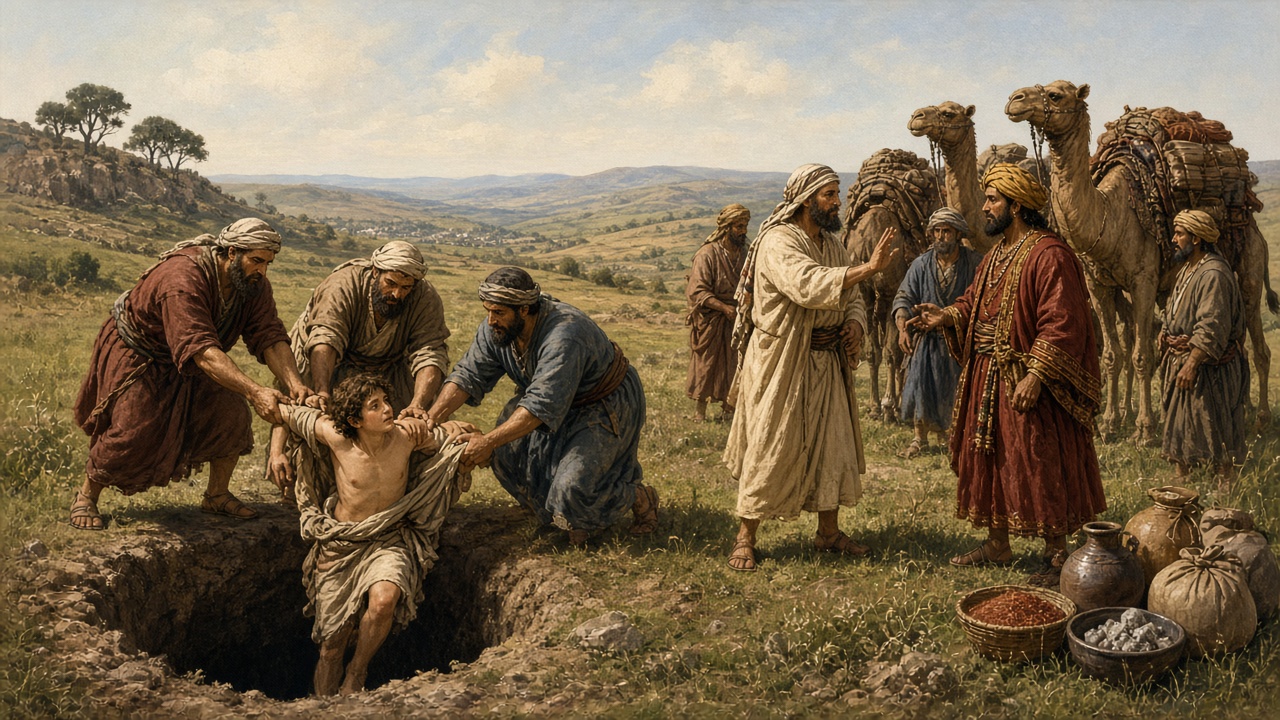
Joseph Sold by His Brothers
- Israel loved Joseph more than his other sons because he was the child of his old age, and he made him a robe of many colors. Easton's Bible Dictionary (1897) reads the Hebrew of Genesis 37:3 as a long, full garment with sleeves, the kind worn by the children of nobles. When the brothers saw that favor, they hated him and could not speak a kind word to him.Sources: Joseph (son of Jacob) · the Bible text itself
- Jacob sent seventeen-year-old Joseph from the Valley of Hebron to see how his brothers and the flocks were faring; they had pastured near Shechem and then gone on to Dothan. Easton's Bible Dictionary (1897) calls Dothan a famous pasture ground with two wells, identified with modern Tell-Dothan about twelve miles north of Samaria among the hills of Gilboa, and says it is mentioned on monuments in 1600 BC. There the brothers saw a caravan of Ishmaelites coming from Gilead, their camels carrying spices, balm, and myrrh on the way down to Egypt.Sources: Dothan · Gilead · the Bible text itself
- Reuben, Jacob's eldest son by Leah, tried to save Joseph from death and planned to return him to their father. Judah then persuaded the brothers to sell Joseph to the Ishmaelites rather than shed his blood. In Egypt the Midianites sold him to Potiphar, an officer of Pharaoh and captain of the guard; Easton's Bible Dictionary (1897) explains that name as 'dedicated to Ra,' the sun-god, and takes the title to mean, probably, chief of the state police, with a margin reading 'chief of the executioners.'Sources: Reuben · Judah (patriarch) · Potiphar · the Bible text itself
Notes written with AI assistance from open sources (Theographic Bible Metadata, CC BY-SA 4.0; Easton’s Bible Dictionary, public domain) and reviewed before publishing.
Places in this chapter
- Canaan · 32.767, 35.333 · verse 1
- Shechem · Today: Tell Balatah · 32.214, 35.282 · verses 12, 13, 14
- Valley of Hebron · 31.525, 35.102 · verse 14
- Egypt · 30.129, 31.308 · verses 25, 28, 36
- Gilead · Today: Gilead 1 · 32.187, 35.692 · verse 25
Only places identified with high confidence are shown (90% or more according to the scholarly sources compiled by OpenBible). Period map: DARE (Digital Atlas of the Roman Empire), CC BY 4.0; modern map: © OpenStreetMap contributors; places: OpenBible.info (CC BY 4.0).
Credits and license for this translation
I tnalù dwata
New Testament in Blaan, Sarangani
copyright © 1998 Wycliffe Bible Translators, Inc.
Language: Sarangani Blaan (Blaan, Sarangani)
Translation by: Wycliffe Bible Translators
Contributor: Wycliffe Bible Translators, Inc.
Copyright Information
© 1998, Wycliffe Bible Translators, Inc. All rights reserved.
This translation text is made available to you under the
terms of the Creative Commons License: Attribution-Noncommercial-No Derivative Works.
( http://creativecommons.org/licenses/by-nc-nd/3.0/ )
In addition, you have permission to port the text to different file formats, as long as you
do not change any of the text or punctuation of the Bible.
You may share, copy, distribute, transmit, and extract portions
or quotations from this work, provided that you include the above copyright
information:
You must give Attribution to the work.
You do not sell this work for a profit.
You do not make any derivative works that change any of the actual words or punctuation of the Scriptures.
Permissions beyond the scope of this license may be
available if you contact
us with your request.
The New Testament
in Blaan, Sarangani
© 1998, Wycliffe Bible Translators, Inc. All rights reserved.
This translation is made available to you under the terms of the
Creative Commons Attribution-Noncommercial-No Derivatives license 4.0.
You may share and redistribute this Bible translation or extracts from it in any format, provided that:
You include the above copyright and source information.
You do not sell this work for a profit.
You do not change any of the words or punctuation of the Scriptures.
Pictures included with Scriptures and other documents on this site are licensed just for use with those Scriptures and documents.
For other uses, please contact the respective copyright owners.
2015-03-17
Source: http://ebible.org/bps/ · eBible.org