Genesis 32
I tnalù dwata · Tap a verse to see its cross-references.
Fatlagad Dyékob smitong ku Isaw
1Na fadlug ale Dyékob magu samfulê di banwen, na klo Dyékob magu nun smitong kenen dad kasaligan Dwata. 2Na di kiten dale, manan, “Ani sa i gumnè i dad sundalu Dwata.” Na dnagitan i gumnè ani dunan Mahanaim.
3Na nun dekan muna di flanekan Isaw déén di banwe Idom. 4Na mdek Dyékob, manan, “Di kakelyu kadang, ani manyu di flanekgu Isaw i nafègu, manyu, ‘Deg sa Dyékob i lifanam. Di klon ani, ditù gumnègu di saféd i fàta Laban, na là agu gulê di banweta kel ani. 5Sadni too dee dad bakagu, dad dongki, dad bilibili, na dad kambing, na nun fa dee dad lifangu. Na fgadègu di ge kdee ani i flanekgu, du fye kandom agu na too ge lehew moon smite deg.’ ”
6Na di kasfulê i dad to dek Dyékob, manla di kenen, “Tasalu gami ditù di flanekam Isaw. Na tadéén kenen smitong ge, na faginan fat latu dad lagi.”
7Na di kaklinge Dyékob i santulenla ani, too sè klikoan na too msamuk i nawan. Taman nalelan i dad to magin kenen di lwe lumbuk, na nalelan i dad bilibilin, dad kambingan, dad bakan, na i dad kamél di lwe lumbuk. 8Du i fandam Dyékob, “Ku fanngayu Isaw i slumbuk, ken galwà i satu lumbuk.”
9Kafnge én, dmasal Dyékob di Dwata, manan, “Ge sa Dwata fnangamfù i fùgu Abraham, na i màgu Isaak. E, Dwata i Amu, tagmanam di deg samfulê agu di banwegu na di dad gakedgu, na fakangam deg nun blém deg kafye. 10Deg sa i lifanam. Là agu gablà dmawat i kafye tagablém deg, i kifatam na i kakdom landè kgilin. Di muna fa, di kilagu di banwegu na mifal agu i yéél Dyordan, landè nebegu galwà di tugadgu. Kabay ani, fye knègu du di kulêgu ani nun lwe lumbuk i dad lmanafgu na i dad ngàgu na i dad yaangu. 11Fakdogu di ge Dwata, begam agu falwà di falel i flanekgu Isaw. Too agu likò, du kenan gami fanngayu, na kenan agu fnati gakuf i dad yaangu na i dad ngàgu. 12Kabay tafankangam di deg banlém agu kafye, na toom fdee i belgu gambet i falak di kilil mahin i là gse.”
13Di kdasal Dyékob di Dwata, déén gukudangan di kilil yéél Dyabok di butang én. Na di kwalan, nalékan i dademe di dad lmanafan, du fye nun dad blén kadang di flanekan Isaw. 14Na i tanalékan dunan, lwe latu libun kambing, na lwe falò i lagi, lwe latu libun bilibili, na lwe falò i lagi, 15tlu falò libun kamél gagin i dad ngàla, fat falò libun baka na sfalò i lagi, lwe falò libun dongki na sfalò i lagi. 16Na faslumbuk Dyékob i dad lmanaf ani, na nun dad lifanan fifatan i kat lumbuk. Na manan di dad lifanan ani, “Gamu i muna, na kat lumbuk stadol, bay beg gamu sawag.”
17Na manan di lifanan gsen muna di kdee, manan, “Di kagsitongyu i flanekgu Isaw, na ku snalekan gamu ku simto i uluyu, na nè gusaluyu, na simto mfun i dad lmanaf nebeyu, 18tooyu tnimel kadang manyu, ‘I dad lmanaf ani nfun i lifanam Dyékob. Feben i kdee ani du blén ge. Na tadéén i flanekam Dyékob di fulé.’”
19Na kafnge én i gmanan gine di satu lifanan, én sa manan di kdee dademe dad lifanan i gamtadaol déén i dad mebe i dad lmanaf atù, manan, “Di kagsitongyu i flanekgu kadang, 20ani tooyu man di kenen, ‘I lifanam Dyékob tadéén di fulé!’” Ani sa i kated Dyékob dale gine, du man i nawan, “I kdee blégu i febegu muna, gaflaneb moon i nawan. Na di ksitemi kadang, nlifetan moon i salàgu di kenen.” 21Taman dek Dyékob muna i dad lifanan mebe i dad blén di flanekan, bay mnè kenen fa déén di butang én.
Dwata i deme Dyékob sbunù
22Di butang én, tafifal Dyékob di yéél Dyabok lwe yaanan, lwe lifanan libun, na i sfalò satu dad ngaan lagi. 23Takifalla, fifalan fa kdee nfunan. 24Kabay kenen laan fa mifal, aloan satu ftagak déén. Kafnge én, nun msut di ku Dyékob, na nagotan kenen, na sbunù ale kel i fan mayè mwal. 25Di kgadè i to atù laan gagan misan ku Dyékob, nagotan di fangkulan na mbaling masléhê. 26Na man i to én, “Kaham agu du fan mwal.” Kabay tmimel Dyékob, manan, “Silangta ge kah, ku funa ge mlé deg kafye.”
27Na smalek i to én, manan, “Simto dagitam kè?” Na man Dyékob, “Agu sa Dyékob.”
28Na man i to én, “Mdà ani ise ku Dyékob i katlo ge, bay Israél, du tasbunù ge Dwata na i dad to, na là ge gfisan.”
29Man Dyékob, “Begam tulen deg ku simto ge kè?” Kabay tmimel i to atù, manan, “Kan kè smalek ge deg ku simto agu.” Kafnge én, banlén kafye Dyékob.
30Taman dnagit Dyékob i banwe én dunan Finyél, du manan, “Tateengu baweh Dwata, bay knean là agu mati.”
31Di ksut i duh, mdà Dyékob di Finyél na magu dà sag, du masléhê i fangkulan. 32Ani duenan, balù kel ani i bel Israél là kmaan i kalngat i fangkul i dad lmanaf knatêla, du déén gumagot Dwata ku Dyékob.
Did you know?
At the Jabbok, on the Way to Esau
- Mahanaim means “two camps.” Jacob gave that name to the place near the Jabbok, beyond the Jordan, when the angels of God met him and he said, “This is the camp of God.” There he also divided his people, flocks, herds, and camels into two camps, hoping one might escape if Esau attacked the other.Sources: Mahanaim · the Bible text itself
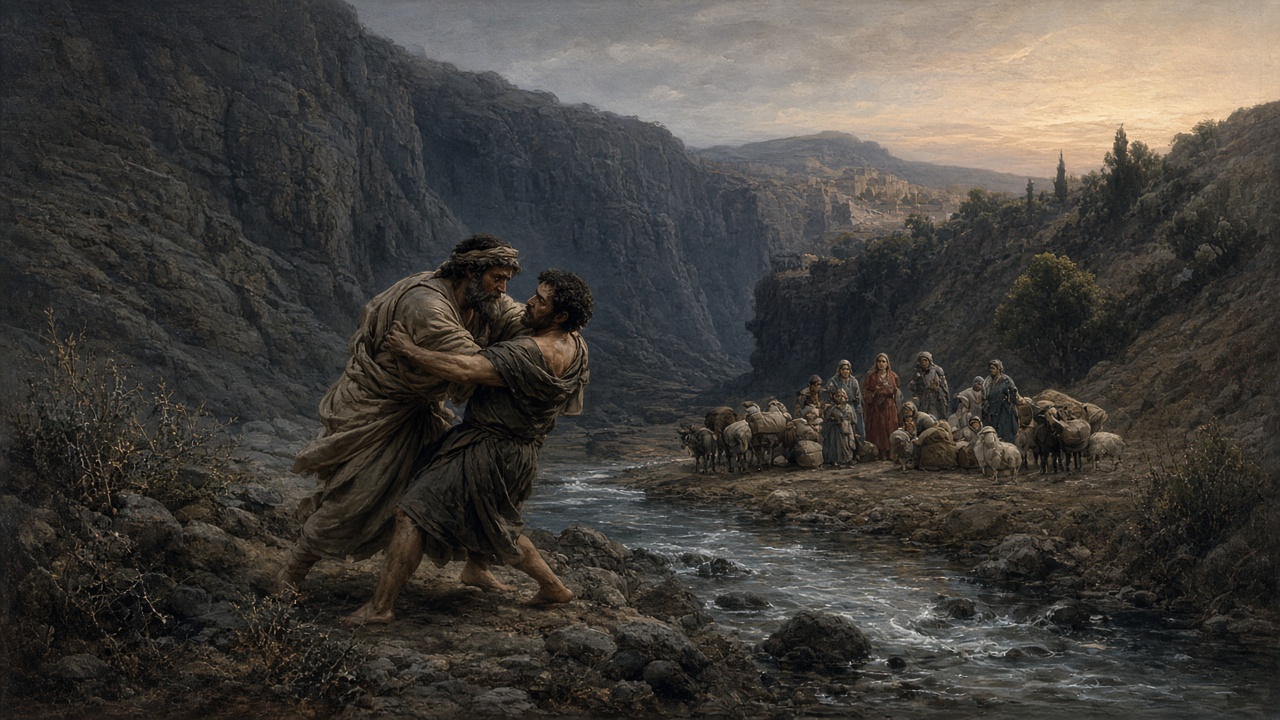
- The Jabbok, whose name is explained as “a pouring out, or a wrestling,” is a stream east of the Jordan. It joins the Jordan about midway between the Sea of Galilee and the Dead Sea, after a course of about 65 miles through a wild, deep ravine. At its ford Jacob sent his two wives, two maidservants, eleven sons, and all he owned across, then remained alone and wrestled with a man until daybreak.Sources: Jabbok · the Bible text itself
- Jacob sent messengers to Esau in the land of Seir, the country of Edom, calling him lord and himself a servant. Seir is a mountainous region along the east side of the Arabah, from the southeastern end of the Dead Sea toward Akabah, the eastern branch of the Red Sea; the Edomites occupied it, and it was allotted to Esau’s descendants. Esau, the firstborn twin and a hunter, had sold his birthright for red lentil stew and was also called Edom, “red,” while Jacob—whose name means “one who follows on another’s heels,” or “supplanter”—had conspired with his mother to deceive Isaac.Sources: the Bible text itself · Seir · Esau (Edom) · Jacob (Israel)
Notes written with AI assistance from open sources (Theographic Bible Metadata, CC BY-SA 4.0; Easton’s Bible Dictionary, public domain) and reviewed before publishing.
Places in this chapter
- Edom · 30.746, 35.604 · verse 3
- Jordan · Today: Jordan River · 31.761, 35.558 · verse 10
- Jabbok · Today: Zarqa River · 32.115, 35.543 · verse 22
Only places identified with high confidence are shown (90% or more according to the scholarly sources compiled by OpenBible). Period map: DARE (Digital Atlas of the Roman Empire), CC BY 4.0; modern map: © OpenStreetMap contributors; places: OpenBible.info (CC BY 4.0).
Credits and license for this translation
I tnalù dwata
New Testament in Blaan, Sarangani
copyright © 1998 Wycliffe Bible Translators, Inc.
Language: Sarangani Blaan (Blaan, Sarangani)
Translation by: Wycliffe Bible Translators
Contributor: Wycliffe Bible Translators, Inc.
Copyright Information
© 1998, Wycliffe Bible Translators, Inc. All rights reserved.
This translation text is made available to you under the
terms of the Creative Commons License: Attribution-Noncommercial-No Derivative Works.
( http://creativecommons.org/licenses/by-nc-nd/3.0/ )
In addition, you have permission to port the text to different file formats, as long as you
do not change any of the text or punctuation of the Bible.
You may share, copy, distribute, transmit, and extract portions
or quotations from this work, provided that you include the above copyright
information:
You must give Attribution to the work.
You do not sell this work for a profit.
You do not make any derivative works that change any of the actual words or punctuation of the Scriptures.
Permissions beyond the scope of this license may be
available if you contact
us with your request.
The New Testament
in Blaan, Sarangani
© 1998, Wycliffe Bible Translators, Inc. All rights reserved.
This translation is made available to you under the terms of the
Creative Commons Attribution-Noncommercial-No Derivatives license 4.0.
You may share and redistribute this Bible translation or extracts from it in any format, provided that:
You include the above copyright and source information.
You do not sell this work for a profit.
You do not change any of the words or punctuation of the Scriptures.
Pictures included with Scriptures and other documents on this site are licensed just for use with those Scriptures and documents.
For other uses, please contact the respective copyright owners.
2015-03-17
Source: http://ebible.org/bps/ · eBible.org