Genesis 3
I tnalù dwata · Tap a verse to see its cross-references.
I to gamsalà di Dwata
1Na di kdee dad mlayal lmanaf mgimò Dwata i Amu, i ulad i too fulung mgaw. Taman satu duh man i ulad di libun, “Too glut kè, fnang gamu Dwata kmaan i balù tan bunge di dad kayu di dad fule ani?”
2Na tmimel i libun di ulad, manan, “Fakay gami sa kmaan bunge i dad kayu ani. 3Kabay man Dwata nun satu kayu di gutngà i dad fule ani, i bungen làmi fakay knaan, na fnangan gami magot i bungen, du ku ani nimòmi mati gami.” 4Kabay man i ulad, “Bong là, là gamu sa mati. 5Én gman Dwata di gamu, du gadean ku kmaan gamu bunge i kayu atù, mbaling gamu fulung faldam, na mbaling gamu salngad kenen, du balù gamu gmadè ku tan i fye na ku tan i sasè.”
6Kafnge én, di kite i libun i bunge i kayu én too gablà knaan, na too fye bawehan, na fandaman fye ku mbaling kenen fulung faldam, taman nlifoan bunge i kayu én na knaanan. Na blén i dademe di yaanan, na knaanan. 7Di kakaanla bunge i kayu én, mbaling ale fulung faldam, na dilèla ale flaweh. Taman mwè ale dad doon i kayu fig, na nilolla na labédla di lawehla.
8Di fan kasdaf i duh lingela lduk i Amula Dwata magu di lam dad fule. Taman salbuni ale di lam i dad kayu. 9Kabay Amula Dwata, tlon i lagi, manan, “Tanè ge?”
10Na tmimel i lagi, manan, “Lingegu i ldukam magu di lam i dad fule ani, na too agu likò, du flaweh agu, taman salbuni agu.”
11Na snalek Dwata kenen, manan, “Simto kè mangman flaweh ge? Kmaan ge kè bunge i kayu fnangta ge?”
12Na tmimel i lagi, manan, “I libun blém di deg, kenen sa mlé deg bunge i kayu én, na knaangu.”
13Na Amula Dwata, snalekan i libun, manan, “Tan kè i duenam mimò ani?”
Tmimel i libun, manan, “Hae, du fangaw agu i ulad, taman gamkaan agu.”
14Taman man Dwata i Amu di ulad, “Fanlayamta ge du mdà di sasè nimoam ani. Di kdee dad lmanaf, i dad mnalam, na i dad mlayal, alò ge magu di kaflayam ani. Mdà ani, fulu ge di tanà, na too ge kmaan kfung di tanà kel di kfatim. 15Sanduengu gamu, ge na i libun, na i dad belan, na i dad belam, na mbaling gamu snang nawa kel di atuan. I belan ndakan kadang i ulum, na nakétam i takadan.”
16Na man Dwata di libun, “Tananùgu i kaflayamam fagu di ksut i dad ngaam. Di ksut i dad ngaam, too sasè katduk i lyom. Kabay balù fa ani i kaflayamam, knean là mgili i knayeam di yaanam. Na yaanam i mebe ge.”
17Na manan di lagi dnagit ku Adam, “Du flinge ge di yaanam, na kmaan ge bunge i kayu i fnangta ge, i tanà ani fakufgu di kaflayam. Kel di kfatim, too ge fgal mimò di tanà, du fye nun gablà knaanyu. 18Na dad samfinit na dademe sabat nun sual gal tmabò na lamnok di tanà. Na toom fanngabal kadang dademe kakaanyu i dad tmabò di bnas. 19Too ge fadlug mimò kel di kaloh i tum, du fye i dad fulem di tanà tmabò na lamnok, na ani i nimoam kel di kasfuléam di tanà i gufdum. Hae, du mgimò ge mdà di tanà, na kadang satu duh lêman ge sa mbaling tanà.”
20Di kagman Dwata kdee ani gine, dnagit Adam i yaanan, dunan Iba, du kenen mbaling yê di kdee dad to.
21Na mimò Dwata i Amu klaweh ale Adam na Iba mdà di kindal i dad lmanaf na kanlawehan ale.
Falwà Dwata Adam na Iba di banwe Idén
22Na man Dwata i Amu, “I dad to ani tambaling ale salngad deg, du tagmadè ale i fye na i sasè. Taman là fakay ku nwèla i bunge i kayu mlé nawa landè sen, du ku gkaanla là ale mati kel di landè sen.” 23Taman falwà ale Dwata di banwe Idén i gunun fule, du fimoan di tanà, i tanà gumdàla.
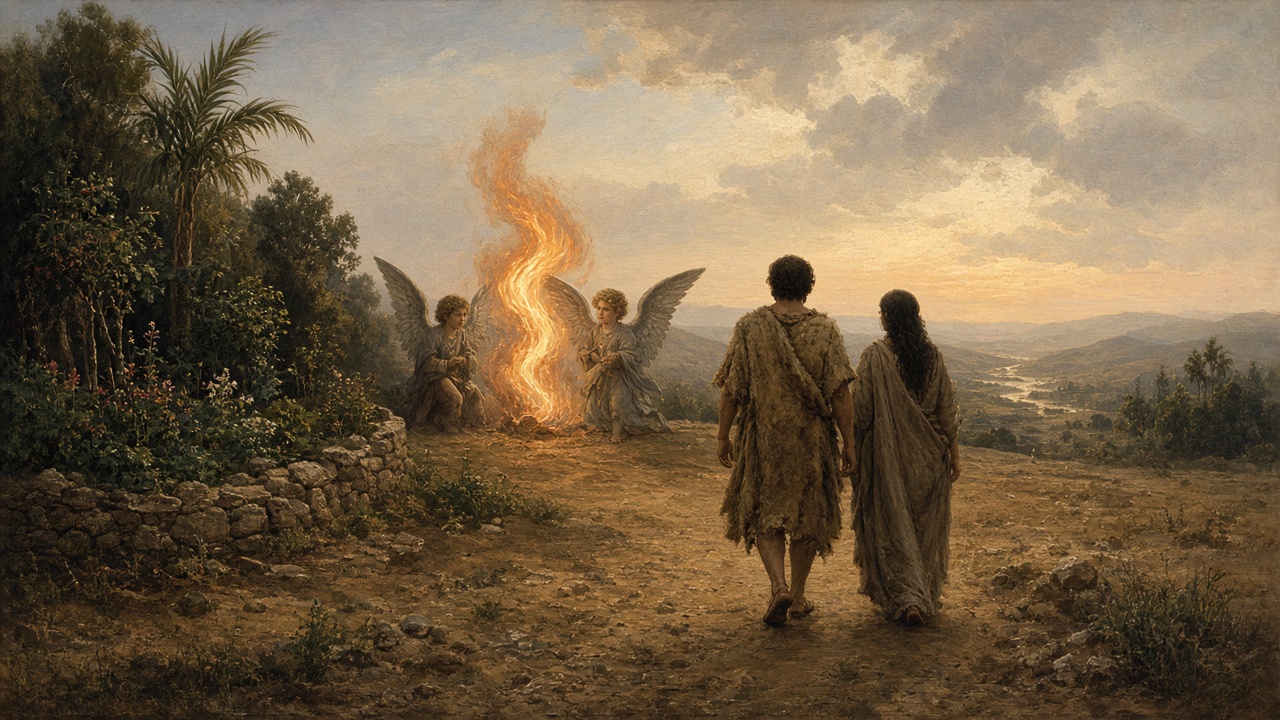
24Di kafalwà Dwata dale, dekan dad gambet kasaliganan gsen di gumsut i duh di banwe Idén, na fkahan sundang di gufusuk. Fadlug dminè i sundang na gal fatbiling flibut. Én i munung i dalan salu di kayu mlé nawa, du fye landè fakay fdadong déén.
Did you know?
The Fall and Exile from Eden
- A traditional reference explains Adam as “red,” a Babylonian word used as the generic name for man, with the same meaning in Hebrew and Assyrian, and links the name to his being formed from the dust of the earth. In this chapter that origin returns in the judgment: he will toil for his food until he returns to the ground, for he is dust and to dust he will return, and he is sent to work the soil from which he was taken.Sources: Adam · the Bible text itself
- In this chapter Adam gives his wife the name Eve, meaning “life” or “living,” because she would be the mother of all the living.Sources: Eve · the Bible text itself
- The site of the garden of Eden, from which the man is driven in this chapter, has been much discussed and placed in Armenia, west of the Caspian Sea, in Media, near Damascus, in Palestine, in southern Arabia, and in Babylonia. A traditional geographical note looks for it along the Tigris and the Euphrates, in the land of Shinar, or Babylonia.Sources: Eden · the Bible text itself
Notes written with AI assistance from open sources (Theographic Bible Metadata, CC BY-SA 4.0; Easton’s Bible Dictionary, public domain) and reviewed before publishing.
Credits and license for this translation
I tnalù dwata
New Testament in Blaan, Sarangani
copyright © 1998 Wycliffe Bible Translators, Inc.
Language: Sarangani Blaan (Blaan, Sarangani)
Translation by: Wycliffe Bible Translators
Contributor: Wycliffe Bible Translators, Inc.
Copyright Information
© 1998, Wycliffe Bible Translators, Inc. All rights reserved.
This translation text is made available to you under the
terms of the Creative Commons License: Attribution-Noncommercial-No Derivative Works.
( http://creativecommons.org/licenses/by-nc-nd/3.0/ )
In addition, you have permission to port the text to different file formats, as long as you
do not change any of the text or punctuation of the Bible.
You may share, copy, distribute, transmit, and extract portions
or quotations from this work, provided that you include the above copyright
information:
You must give Attribution to the work.
You do not sell this work for a profit.
You do not make any derivative works that change any of the actual words or punctuation of the Scriptures.
Permissions beyond the scope of this license may be
available if you contact
us with your request.
The New Testament
in Blaan, Sarangani
© 1998, Wycliffe Bible Translators, Inc. All rights reserved.
This translation is made available to you under the terms of the
Creative Commons Attribution-Noncommercial-No Derivatives license 4.0.
You may share and redistribute this Bible translation or extracts from it in any format, provided that:
You include the above copyright and source information.
You do not sell this work for a profit.
You do not change any of the words or punctuation of the Scriptures.
Pictures included with Scriptures and other documents on this site are licensed just for use with those Scriptures and documents.
For other uses, please contact the respective copyright owners.
2015-03-17
Source: http://ebible.org/bps/ · eBible.org