1 Corinthians 15
I Falami Kasafnè (New Testament) · Tap a verse to see its cross-references.
Gablà di kték Krayst di fati
1E dad flanekgu, lêgu man fafaldam gamu i Fye Tulen ta tdògu di gamu, na ta dnawatyu, dunan i gumdàyu mbagal di kaftoo. 2Na mdà dì Fye Tulen ta tdògu di gamu, galwà gamu ku tooyu fnè di nawayu. Silang là galwà gamu, ku lo tah nawayu i kaftooyu.
3Yé too mabtas tdògu di gamu, dunan i ta fgadè Dwata di do, na dunan ani: Mati Krayst du falwàan ato di dad salàto du yé man di Tnalù Dwata. 4Na kafngen mati, lbang, bay di gatlun du, ta lê nték Dwata kenen mdà di fati du yé man di Tnalù Dwata. 5Na di kafngen mték mdà di fati, ta fiten i kton di ku Piter na di dad sfalò lwe to galan dek. 6Na kafnge ayé, di satu du, ta lêan fite i kton di mlukas lime latuh dad to ftoo di kenen. Na i gudee dad to ayé, sana knèla di bang ani, bay ta mati i dademe. 7Na kafnge ayé, ta lêan fite i kton di ku Dyém, na klon di kdee dad to galan dek.
8Na di gusenan, ta fiten i kton di do, bay di kfiten di do, yé kafdamgu dun, salngad agu ngà sut muhad, du landè fandam i dad to ku mbaling agu ftoo. 9Ani duen-gu man ayé du do i too mdanà di kdee dad to dek Dyisas Krayst, na là gablà agu matlo “Satu to dek Dyisas Krayst,” du falnayamgu i dad to nfun Dwata. 10Bay mdà di kafye Dwata, ta ani nan kagkahgu, na ta nun ulê i kafyen di do du ta baling bong i do nimò di nimò i dademe dad to dek Dyisas Krayst. Bay di kaglutan, ise ku do i mimò dun, bay Dwata, du mdà di kafye tabengan di do. 11Taman, là mabtas ku simto gulmingeyu dun, mdà di do, ku demen mdà di dale, bay yé mabtas i tdòmi, na i kaftooyu dun.
Gablà di kték i dad to ftoo di ku Dyisas Krayst
12Yé tdòmi ta nték Dwata Krayst di fati. Na kan ku nun di gamu man dun na là nték Dwata kadang di fulé du i dad to ta mati? 13Kaflingenta dun, ku là mték i dad to ta mati, yé kayèan man là fa mték Krayst kenen. 14Kaflingenta dun, ku là mték Krayst di fati, yé kayèan man ta landè gukel i katdòmi, na landè gukel i kaftooyu. 15Na ise ku lo ayé, bay ta tmulen gami kéng gablà di Dwata, du yé manmi ta ntékan Krayst. Bay ku là ntékan i dad to ta mati, là fa ntékan Krayst. 16Du ku là ntékan i dad to mati, là ti ntékan Krayst. 17Ku là mték Krayst di fati, landè gukel i kaftooyu, na sana knèyu di salà. 18Ku là mték Krayst, landè dalan i dad to ta mati galwà di kaflayam. 19Ku lo yé knun fandento di ku Krayst di knèto dini di tah tanà, gito i dad to too magakdo.
20Bay di kaglutan, ta sana nték Dwata Krayst di fati. Na yé gugmadèto dun, i dad to ta mati, lêan ale nték kadang di fulé du. 21Du mdà di sasè nimò i satu to, gafat i fati di kdee dad to, na mdà di fye nimò i satu to, yé gumdà i kdee dad to mték. 22I kdee dad to sdulê mati du mdà di ksasatula di ku Adan. Na salngad ayé, i kdee dad to ta masasatu di ku Krayst, banlén ale nawa landè sen. 23Ani kastadol i kték. Krayst i ta muna mték di fati, na di kasfulê Krayst, ntékan i dad to nfunan. 24Na yé kloto mite gusen i kalbong kdee du falmo Krayst i kdee dad dmuen kenen di bang ani, dunan i kdee dad nun glal, na i kdee dad sasè tulus. Na kafnge ayé, fulêan di Màan i ktoon magot i kalbong kdee. 25Bay di laman là kel i kdee ayé, Krayst i magot kalbong kdee kel di kagfisan i kdee dmuen kenen du mtin ale falmo. 26Yé too sangal fnisanan i fati. 27Du ta gman di Tnalù Dwata, “I Dwata, fnisanan i kalbong kdee du fye fagotan i kdee di ku Krayst.” Bay gadèto lo Dwata i là glam di kdee dad nagot Krayst. 28Na ku ta fagot Dwata i kalbong kdee di ku Krayst, fagot Krayst i kton di Màan, dunan i fagot di kenen i kdee. Na mdà déé, Dwata i magot kalbong kdee.
29Ku là mték i dad to ta mati, dét gukmamu kafbunyag i dad to man nawala tlas laweh i dademela ta mati? 30Na ku là mték i dad to ta mati, landè gukmamu i kafagtayudmi di dad klimah gal mkel di gami. 31E dad flanekgu, kat du galyalogu ta mdadong i kfatigu. Gadè Dwata na galgu dag i kaftooyu di Amuto Krayst Dyisas. 32Too sè klimahgu dini di Ifisu, du i dad to dmuen do, salngad ale i labè lmanaf. Ku là mték i dad to ta mati, landè gukmamu i kafagtayudgu di dad klimah ani. Yé baling fye nimen-gu i man dad to, “Yé loto nimò, kmaan na minum du keng fayah mati ato, na ta gusenan.”
33Bay too gamu fgeye tà gamu mafgaw, du “Ku yé dademeyu sgalak i dad to sasè, malmo i kafye adatyu.” 34Fgulit gamu, na ta nang gamu lê fagsalà. Nun dademe déé di gamu là glut kgadèla i Dwata, na yé duen-gu man ani du fye myà gamu.
I kagkah i laweh i dad to ta mték
35Bay keng nun smalek ku dét kibò Dwata mték i dad to ta mati, na ku dét kibò kagkah i lawehla. 36Kulang kaglabat i to smalek ayé. Salngad di bnê, silang tmabò i bnê ku ta balok i klafutan. 37Ku mlah gamu trigo, ku demen dademe bnê, yé flahyu i bengen, ise ku i lawehan. 38Banlé Dwata laweh i bnê mdà di knayèan. Ku dét klasi bnê, yé klasi lawehan.
39Na i kdee dad nimò Dwata i nun nawa, slame sahal i ungadla. I dad to, nun dale ungad, i dad lmanaf, nun dale ungad, i dad anuk, nun dale ungad, na i dad nalaf, nun dale ungad. 40Na nun laweh i dad mnè ditù di langit, na lê nun laweh i dad mnè dini di tah tanà. Mahal i kafye baweh i dad mnè di langit, na mahal i kafye baweh i dad mnè dini di tah tanà. 41Sahal kafye baweh i du, na i bulen, na i dad blatik. Na balù di kdee blatik, sahal i kafye bawehla.
42Na salngad ayé ku ta mték i dad to ta mati. Ku ta mati i lawehto ani, lbang na fles balok. Bay ku ta mték ato, nun falami lawehto. Ta là matin, na là balokan. 43Ku ta lbang i lawehto, sasè baweh meye dun, na landè galan. Bay ku ta mték, fye baweh i falami lawehto, na ta kamgis. 44I lawehto ani mdà di tanà, na lê mulê di tanà. Bay ku ta mték ato, mdà i falami lawehto, fakay mnè di langit. Du nun lawehto mnè dini di tah tanà, lê nun lawehto mnè ditù di langit. 45Du ani man i Tnalù Dwata, “I tnanin to, dunan Adan, banlé Dwata nawa du fye mnè dini di tah tanà.” Bay Krayst, yé katlo dun sangal Adan. Kenen maltulus mlé nawa. 46Yé munato gdawat i btal laweh mnè di tah tanà ani, na tmadol i laweh fakay mnè di langit. 47I tnanin to, mdà di tanà, bay i galwen mdà di langit. 48I kdee bel Adan, salngad kagkahla di kenen, du nimò Dwata mdà di tanà. Na salngad ayé, i kdee dad to ta sasatu di ku Krayst, salngad i kagkah di kenen, du yé gumdàan di langit. 49Ku dét kasalngadto di to mdà di tanà, yé lêto kasalngad i mdà di langit.
50Ani kayègu man, dad flanekgu. I lawehto ani, nun ungadan na nun litèan, là ti gfusukan di Kagot i Dwata. Na i laweh mati, là gaganan nfun nawa landè sen.
51Too gamu flinge du tulen-gu di gamu i là fgadè Dwata di muna. Gito dad to ftoo, là ti sdulê ato mati, bay sdulê matlas i lawehto. 52Too mlal matlas i lawehto, salngad di lo sulê udaf, du salngan di kuni i sangal bong féw, nték Dwata i kdee dad to ftoo ta mati, na tanlasan i lawehla, laweh là mati. 53Du i laweh balok, tanlas laweh là balok. Na i laweh mati, tanlas laweh là mati. 54Taman, ku ta matlas i lawehto balok di là balokan, na ku ta matlas i lawehto mati di là mati, gdohò i man Tnalù Dwata,
“Ta landè mati du ta fnge fnisan Dwata i fati.
55Ta landè gagan i fati, na ta landè alasan.”
56Yé gumdà alas i fati di salà, na silang dilè i salà, kanto kel i uldin. 57Bay salamat di Dwata du kenen mlé gito kgagan matu fagu di Amuto Dyisas Krayst.
58Taman, dad flanek toogu kanbong nawa, too gamu fbagal di kaftooyu du fye landè gamgingok dun. Too gamu falgad di fimò i Amuto gamu, du ta gadèyu i kdee nimòyu di kenen, slame nun ulêan.
Did you know?
The Resurrection of the Dead
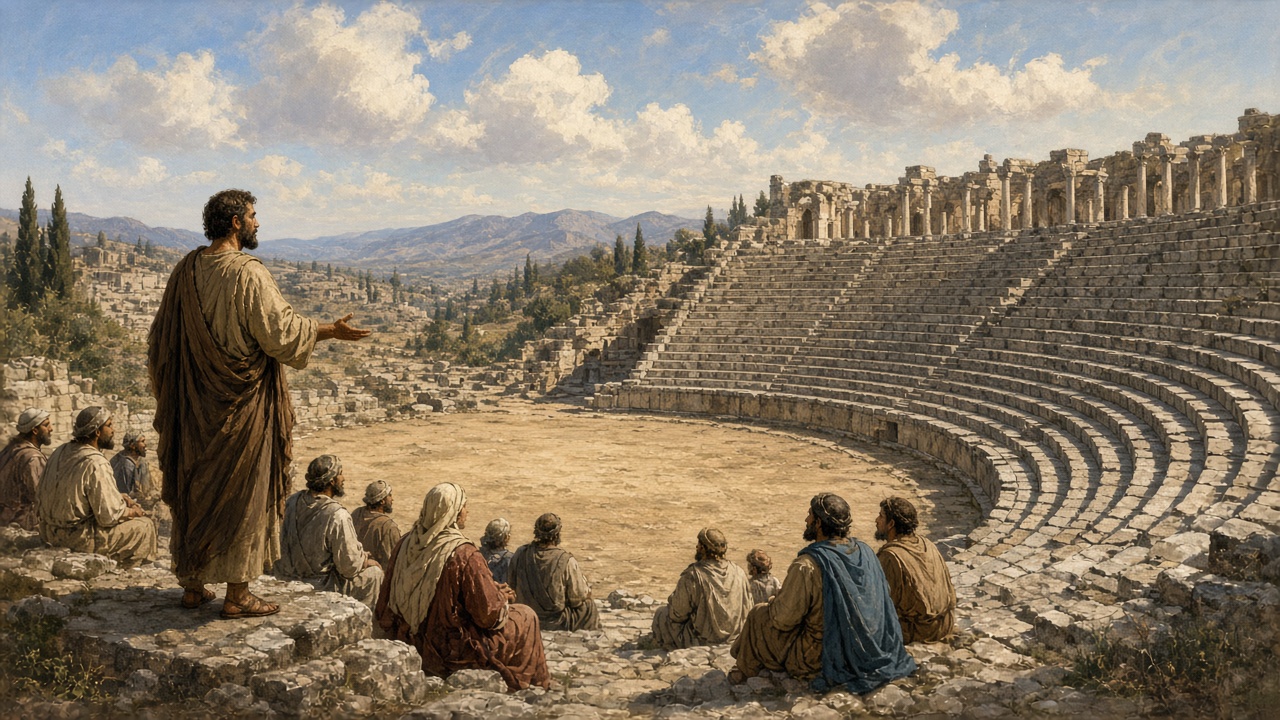
- When this chapter asks what was gained by fighting wild beasts in Ephesus, it names a city that Easton's Bible Dictionary calls the capital of proconsular Asia, known for an open-air theatre—the largest in the world, able to hold 50,000 spectators—where fights of wild beasts and of men with beasts were staged.Sources: Ephesus · the Bible text itself
- Easton's Bible Dictionary explains that Adam, a Babylonian word meaning red and the ordinary name for man in Hebrew and Assyrian, was the first man, formed from the dust of the earth, which is why he received that name. This chapter takes up that picture: death came through a man, the first man was of the dust, and the last Adam is a life-giving spirit.Sources: Adam · the Bible text itself
- Easton's Bible Dictionary (1897) identifies the James to whom Christ appeared after the resurrection, as this chapter records, as the brother or near kinsman of Jesus, also called James the Less, and says that he later headed the church in Jerusalem.Sources: James (Brother of Jesus) · the Bible text itself
Notes written with AI assistance from open sources (Theographic Bible Metadata, CC BY-SA 4.0; Easton’s Bible Dictionary, public domain) and reviewed before publishing.
Places in this chapter
- Ephesus · 37.939, 27.341 · verse 32
Only places identified with high confidence are shown (90% or more according to the scholarly sources compiled by OpenBible). Period map: DARE (Digital Atlas of the Roman Empire), CC BY 4.0; modern map: © OpenStreetMap contributors; places: OpenBible.info (CC BY 4.0).
Credits and license for this translation
I Falami Kasafnè (New Testament)
New Testament in Blaan, Koronadal
copyright © 1995 Wycliffe Bible Translators, Inc.
Language: Koronadal Blaan (Blaan, Koronadal)
Translation by: Wycliffe Bible Translators, Inc.
Copyright Information
© 1995, Wycliffe Bible Translators, Inc. All rights reserved.
This translation text is made available to you under the
terms of the Creative Commons License: Attribution-Noncommercial-No Derivative Works.
( http://creativecommons.org/licenses/by-nc-nd/3.0/ )
In addition, you have permission to port the text to different file formats, as long as you
do not change any of the text or punctuation of the Bible.
You may share, copy, distribute, transmit, and extract portions
or quotations from this work, provided that you include the above copyright
information:
You must give Attribution to the work.
You do not sell this work for a profit.
You do not make any derivative works that change any of the actual words or punctuation of the Scriptures.
Permissions beyond the scope of this license may be
available if you contact
us with your request.
The New Testament
in Blaan, Koronadal
© 1995, Wycliffe Bible Translators, Inc. All rights reserved.
This translation is made available to you under the terms of the
Creative Commons Attribution-Noncommercial-No Derivatives license 4.0.
You may share and redistribute this Bible translation or extracts from it in any format, provided that:
You include the above copyright and source information.
You do not sell this work for a profit.
You do not change any of the words or punctuation of the Scriptures.
Pictures included with Scriptures and other documents on this site are licensed just for use with those Scriptures and documents.
For other uses, please contact the respective copyright owners.
2014-08-06
Source: http://ebible.org/bpr/ · eBible.org