Matthew 3
A Nitana Vure · Tap a verse to see its cross-references.
E Ioanes a Mari ni Vahilolo
1Na tahuna iea, e Ioanes, a mari ni vahilolo, i tubu ni leho, i vara na tabeke i ngeki o Iudea. 2I vara maea, “Mu pulo a vilone mua, a vuhuna a harikianga na hunu i tabukoi ge bele.” 3Re Ioanes, a propet e Isaia i vakalongo muga vona, i ta maea,
“A lohona viri i gale dagi na tabeke i ngeki, i ta maea,
‘Mu pelekadoa a dala ne Bakovi Dagi.
Mu pelekadoa a dala ge laho vona ge kiripiripi.’”
4A varakia ne Ioanes ni rata na vuna kamel. I rea tata ia na palabele ni rata na kulina meme. I kani a koa, a ame na robo. 5E huriki lobo o Ierusalem, e huriki lobo na tabeke ne Iudea, e huriki lobo tabukoi na naru e Iordan ri lokovonga maia. 6Ri taki tala a naro hale ne ria, lakea i vahilolo ria na naru e Iordan.
7Pali na tahuna i matai e huriki a Pariseo, a Sadusi ri valai mai ia ge vahilolo ria, i taki ria, i ta maea, “Mua a tuna mata! E rei i taki mua mu gu ha vona a rongova ne Bakovi Dagi? 8Mu rata a naro ge vakasiri mu pulo a narone mua. 9Naha ni luhoi mua, ge mua a hamone Abraham, mu gu malamala pali. Naha ni luhoi mavonga, a vuhuna a Vure i kara ni pulo a kedo nga, ge ria e huriki a hamone Abraham. I vai a kanena narone mua? Mu rata taro a naro kamumu ge vakasiri mua mu pulo muholi a vilone mua. 10A kira i tabuli tabukoi pali na vuhuna kai. A kai i uka kanena kamumu, bara ni tolo puru, ni rungani.
11“Iau a vahilolo mua na naru a vuhuna mu pulo a vilone mua. Pali a bakovi tara bara i luve muri nau i tuhaka hateka nau. Iau i uka ma a bakovi kamumu ga bole polo a vahapolo vona. Na tahuna i valai, bara i vahilolo mua na Hanu Kiripiripi, a kanono. 12Ngane i tabukoi bara i kalipida e huriki a bakovi kamumu, a bakovi hale, i manga a bakovi i leho na hania na vit i kalipida a vit, a luluna. Bara i bole e huriki a bakovi kamumu, i ru ria na tanga kamumu, i manga a bakovi i leho na hania i ru kadolu a vit pololilo na roho na vit. Pali bara i bole e huriki a bakovi hale, i voro rike ria na kanono, i manga a bakovi i leho na hania na vit i bole a luluna vit, i voro rike na kanono. A kanono iea, i uka a nilobona.”
E Isu Ni Vahilolo
13Muri e Isu i pea e Galili i lakea na naru e Iordan, e Ioanes ge vahiloloa. 14Pali e Ioanes i hehe, i ta maea, “I navai ga vahilolo ioe? Ioe a viri bara o vahilolo iau.”
15Pali e Isu i koli, “O rata kunanea, a vuhuna i kamumu tu gu rata lobo a maki e Bakovi Dagi i taki tu gu rata.” Lakea e Ioanes i longo, i vahiloloa.
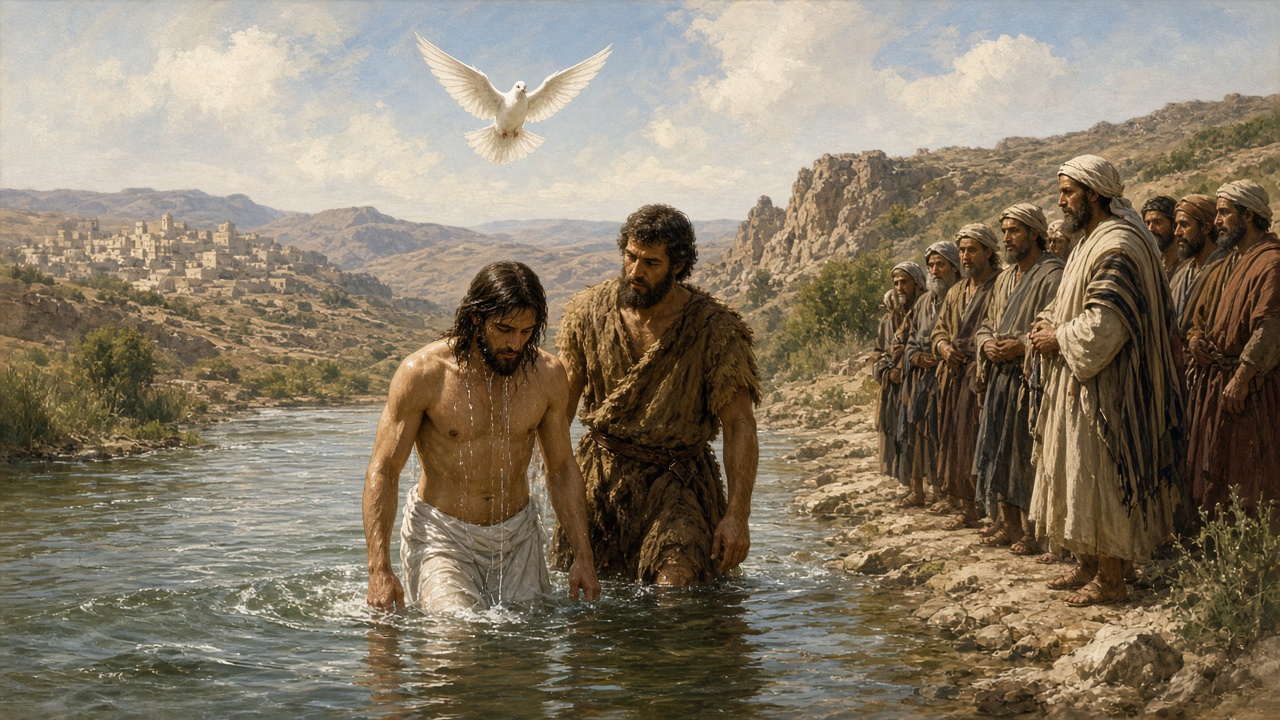
16E Ioanes i vahilolo loboa e Isu, lakea e Isu i malaviriri kunana i pea a naru. A hunu i mata ka, lakea i masia a Hanuna Vure i puru valai manga a balu, i toka langa vona. 17Lakea a lohona viri i ta valai na hunu, i ta maea, “Iea e tugu a hategu. A vivi hateka vona.”
Did you know?
Repentance and Baptism at the Jordan
- Matthew identifies John the Baptist as the one spoken of through the prophet Isaiah: a voice calling in the wilderness, “Prepare the way for the Lord.” Easton's Bible Dictionary (1897) records that John’s mission was the subject of prophecy, citing this passage, Isaiah 40:3, and Malachi 3:1, and that he was of priestly descent—his father Zacharias a priest of the course of Abia, and his mother Elisabeth of the daughters of Aaron. A chronology dates both the beginning of John’s ministry and his baptism of Jesus to AD 26.Sources: the Bible text itself · John the Baptist · John the Baptist Begins Ministry · John Baptizes Jesus
- John came preaching in the wilderness of Judea, and people went out to him from Jerusalem, all Judea, and the whole region around the Jordan, confessing their sins and being baptized in the Jordan River. Easton's Bible Dictionary (1897) notes that under the Romans, in the time of Christ, Judea denoted the southernmost of the three divisions of Palestine, as distinguished from Galilee and Samaria, and included the territories of Judah, Benjamin, Dan, Simeon, and part of Ephraim. Jesus came from Galilee—called Galil by the Jews—to the Jordan to be baptized by John.Sources: the Bible text itself · Judea · Galilee
- John warned the Pharisees and Sadducees not to rely on the claim, “We have Abraham as our father,” saying that God could raise up children for Abraham from the stones. Easton's Bible Dictionary (1897) explains the name Abraham as “father of a multitude” and describes him as the son of Terah, named before his older brothers because he was the heir of the promises.Sources: the Bible text itself · Abraham
Notes written with AI assistance from open sources (Theographic Bible Metadata, CC BY-SA 4.0; Easton’s Bible Dictionary, public domain) and reviewed before publishing.
Places in this chapter
- Judea · Today: Judea 1 · 31.777, 35.234 · verses 1, 5
- Jerusalem · 31.777, 35.234 · verse 5
- Jordan · Today: Jordan River · 31.761, 35.558 · verses 5, 6, 13
- Galilee · 32.760, 35.527 · verse 13
Only places identified with high confidence are shown (90% or more according to the scholarly sources compiled by OpenBible). Period map: DARE (Digital Atlas of the Roman Empire), CC BY 4.0; modern map: © OpenStreetMap contributors; places: OpenBible.info (CC BY 4.0).
Credits and license for this translation
A Nitana Vure
Genesis, Exodus, Leviticus, Numbers, Deuteronomy, Joshua, Ruth, Jonah, and the New Testament in the Bola language of Papua New Guinea
Sampela hap Buk Baibel long tokples Bola long Niugini
copyright © 2011 Wycliffe Bible Translators, Inc.
Language: Bola
Translation by: Wycliffe Bible Translators
This translation is made available to you under the terms of the
Creative Commons Attribution-Noncommercial-No Derivatives license 4.0.
You may share and redistribute this Bible translation or extracts from it in any format, provided that:
You include the above copyright and source information.
You do not sell this work for a profit.
You do not change any of the words or punctuation of the Scriptures.
Pictures included with Scriptures and other documents on this site are licensed just for use with those Scriptures and documents.
For other uses, please contact the respective copyright owners.
2014-12-03
Source: http://png.bible/bnp/ · eBible.org