Genesis 46
A Nitana Vure · Tap a verse to see its cross-references.
E Iakop i Lakea o Egipto
1E Israel i ru palupu lobo a maka mahala vona, i bole e huriki a kabu vona ri vano ri bele vona a tanga e Bersiba. Muri i bolea a sipsip a bulmakau i rabalaki, i habi na Vure ne tamana e Isak. 2Na rodo i vurena vona a Vure i bele vona i galea, “Iakop! Iakop!”
E Iakop i ta maea, “Iau ieni.”
3Lakea a Vure i ta maea, “Iau a Vure, a Vure ne tamamu. Naha ni mangenge ni puru o Egipto. Ga rata ioe ge ioe a vuhuna kabu dagi tara. 4Ga puru turamu o Egipto, muri ga taparaki mule ioe. Na tahuna o mate, e Iosep ge tanu ioe.”
5E huriki e tune Israel, ri vakarike na karis e tamane ria turana e huriki e tune ria, e girihine ria. A maka karis nga, i rudu sike e Parao, ge bole ria. Ngane e Iakop i pea e Bersiba. 6Ri vakamariu lakea o Egipto a maka sipsip a bulmakau, a mahala ra ri vakabele o Kenan. 7E Iakop i mariu lakea o Egipto turana e huriki e tuna bakovi, e tuna ngatavine, e tubuna mai.
8A rane e huriki a hamone Israel ri puru o Egipto ra nga: E Iakop turana e Reuben, a tabua vona. 9E huriki e tune Reuben a bakovi ra nga: e Hanok, e Palu, e Herson, e Karmi.
10E huriki e tune Simion a bakovi ra nga: e Iemuel, e Iamin, e Ohad, e Iakin, e Sohar, e Saul. E Saul, e kinana a ngatavine o Kenan.
11E huriki e tune Levi a bakovi ra nga: e Gerson, e Kohat, e Merari.
12E huriki e tune Iuda a bakovi ra nga: e Er, e Onan, e Sela, e Peres, e Sera. E Er rua e Onan ru mate na robo e Kenan.
E tune Peres a bakovi ra nga: e Hesron, e Hamul.
13E huriki e tune Isikar a bakovi ra nga: e Tola, e Puva, e Iob, e Simron.
14E huriki e tune Sebulun a bakovi ra nga: e Sered, e Elon, e Ialil.
15E huriki tune Iakop nga i poda e Lea o Padan-Aram. E Daina e kurabane ria, ia tara ni poda vonga. E huriki a hamone Iakop rua e Lea ri ala ravulu tolu a polona i tolu.
16E huriki e tune Gad a bakovi ra nga: e Sipion, e Hagi, e Suni, e Esbon, e Eri, e Arodi, e Areli.
17E huriki e tune Aser a bakovi ra nga: e Imna, e Isva, e Isvi, e Beria. E kurabane ria a rana e Sera.
E tune Beria a bakovi ra nga: e Heber e Malkiel. 18Re huriki nga ri ala ravulu a polona i polotara, a hamone Iakop rua e Silpa. Ra ngatavine iea, e Leban i habia ne Lea, ga vorakato vona.
19E Iosep e Bensamin, e kinane rua e Resel, re girihine Iakop tara. 20Na tahuna e Iosep i made o Egipto, i parangi vona e Asenat, e tuna prister tara a rana e Potipera na tanga e Heliopolis. E Asenat i poda e Epraim rua e Manase.
21E huriki e tune Bensamin a bakovi: e Bela, e Beker, e Asbel, e Gera, e Naman, e Ehi, e Ros, e Mupim, e Hupim, e Ard. 22Re huriki a bakovi nga, a hamone Iakop rua e Resel, ri ala ravulu a polona i va.
23E tune Dan a bakovi i taku kunana. A rana e Husim.
24E huriki e tune Naptali a bakovi: e Iasiel, e Guni, e Ieser, e Silem. 25Re huriki a bakovi nga, a hamone Iakop rua e Bila, ra ngatavine e Leban i habia ne Resel ga vora vona. Ni gi palupu, ri ala polorua.
26E huriki a hamone Iakop, ra ri lakea o Egipto, ri ala ravulu polo tara a polona i polotara (66). I uka ma ni gi e huriki e girihine ria. 27Ni gi turane tune Iosep ala rua ra ni poda o Egipto, ria lobo ri ala ravulu polo rua (70). 28E Iakop i rudua e Iuda ge muga ge takia e Iosep ge tagui ria o Gosen. Na tahuna ri laho lokovonga na robo e Gosen, 29e Iosep i bolea a karis vona, i lakea o Gosen, ge taguia e tamana, re Israel. Na tahuna i masia e tamana, i rakoa i mate ni taringia. 30Lakea e Israel i takia e Iosep, “Ngane iau ga mate, a vuhuna a matai ioe pali, o tabana ni mahuri.”
31Muri e Iosep i taki e huriki e turana, a kabu vona, i ta maea, “Ga lakea ne Parao ga takia ga ta maea, ‘E huriki e turagu, a kabu nau, ra ri made na robo e Kenan, ri valai pali. 32E huriki a bakovi nga ri matakari a sipsip. Ri bole valai ngane a kabu na sipsip, a bulmakau, a maka mahala lobo ne ria.’ 33Na tahuna e Parao ge gale dili mua ge nana na a ra leho mu lohoka vona, 34mu ta maea, ‘Bakovi dagi, mi matakari a sipsip a bulmakau na tahuna mi kiroko vona i valai i harena mona. I manga a leho i rata e tamane mia muga.’ Muri bara i longo vona a robo e Gosen bara mu made vona, a vuhuna e huriki a tahotanga ri marikoi hateka ni made turana e huriki ri matakari a sipsip.”
Did you know?
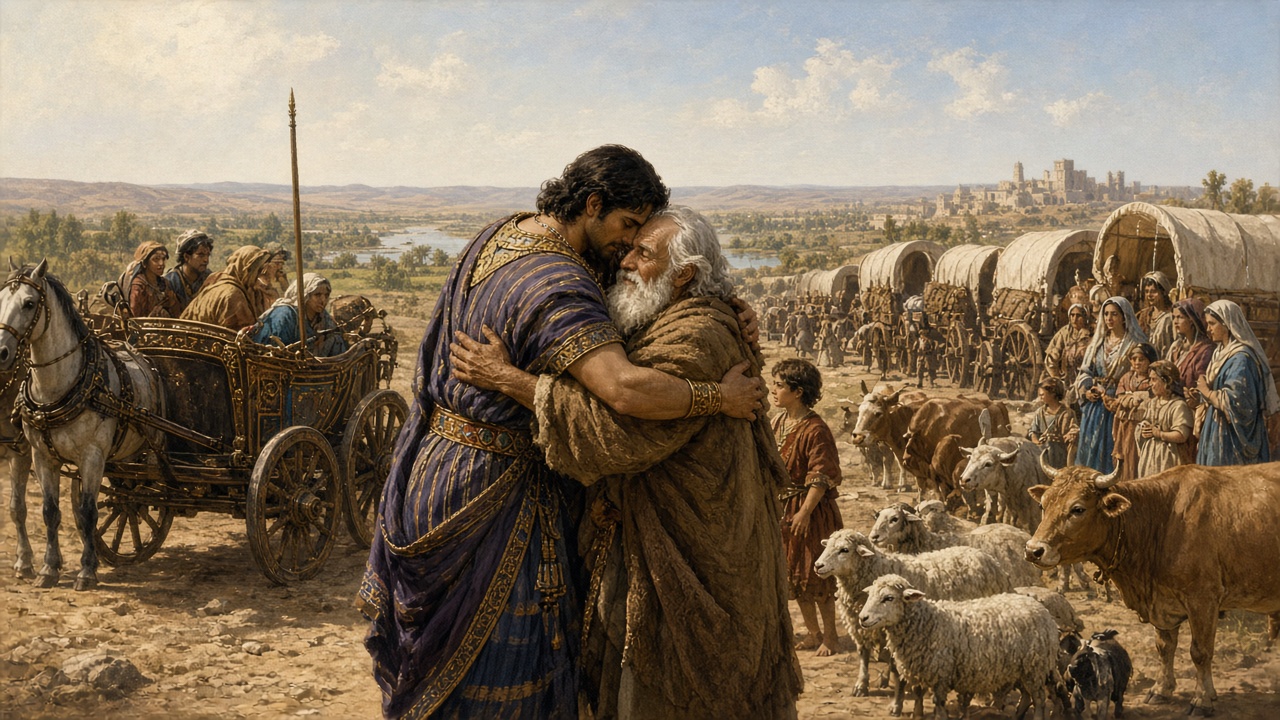
Israel Goes Down to Egypt
- As Israel set out for Egypt with all that he had, he stopped at Beersheba and offered sacrifices to the God of his father Isaac. Beersheba, meaning well of the oath or well of seven, was a well Abraham dug and named after a compact with Abimelech; when Isaac reopened it, he gave it the same name. It was a favorite dwelling of both patriarchs, and there that night God spoke to Jacob in a vision, telling him not to fear going down to Egypt, for he would make him a great nation there.Sources: the Bible text itself · Beersheba
- Jacob sent Judah ahead to Joseph for directions to Goshen, an Egyptian district east of the Nile, apparently near the royal residence, where the family remained until the Exodus. Easton's Bible Dictionary (1897) calls it the best of the land, now a desert, and also the land of Rameses. Joseph told his brothers to say they had raised livestock from youth, so they might settle there, because shepherds were detestable to the Egyptians; that dictionary suggests Pharaoh was probably Apopi, last of the Hyksos, who welcomed these Asiatic shepherds, while native Egyptians abhorred them, though some argue Joseph arrived later, under Thothmes III, after the Hyksos were expelled.Sources: the Bible text itself · Goshen · Pharaoh (of Joseph)
- The chapter counts sixty-six of Jacob's direct descendants who came to Egypt, not counting the wives of his sons, and seventy when Joseph's two sons already born in Egypt are included. Leah's sons and her daughter Dinah are named in that tally, although Easton's Bible Dictionary (1897) says Leah herself had died in Canaan before the journey and was buried in the cave of Machpelah; Rachel had died earlier giving birth to Benjamin and was buried on the way to Ephrath, that is, Bethlehem. Manasseh and Ephraim were born to Joseph in Egypt by Asenath, daughter of Potiphera, priest of On, a center of sun-worship that the Septuagint and Vulgate call Heliopolis.Sources: the Bible text itself · Leah · Rachel · On
Notes written with AI assistance from open sources (Theographic Bible Metadata, CC BY-SA 4.0; Easton’s Bible Dictionary, public domain) and reviewed before publishing.
Places in this chapter
- Egypt · 30.129, 31.308 · verses 1, 3, 4, 5, 6, 7, 8, 20, 26, 27
- Canaan · 32.767, 35.333 · verses 6, 12, 31
- Heliopolis · Today: Ain Shams · 30.129, 31.308 · verse 20
- Goshen · Today: Goshen 1 · 30.799, 31.834 · verses 28, 29, 34
Only places identified with high confidence are shown (90% or more according to the scholarly sources compiled by OpenBible). Period map: DARE (Digital Atlas of the Roman Empire), CC BY 4.0; modern map: © OpenStreetMap contributors; places: OpenBible.info (CC BY 4.0).
Credits and license for this translation
A Nitana Vure
Genesis, Exodus, Leviticus, Numbers, Deuteronomy, Joshua, Ruth, Jonah, and the New Testament in the Bola language of Papua New Guinea
Sampela hap Buk Baibel long tokples Bola long Niugini
copyright © 2011 Wycliffe Bible Translators, Inc.
Language: Bola
Translation by: Wycliffe Bible Translators
This translation is made available to you under the terms of the
Creative Commons Attribution-Noncommercial-No Derivatives license 4.0.
You may share and redistribute this Bible translation or extracts from it in any format, provided that:
You include the above copyright and source information.
You do not sell this work for a profit.
You do not change any of the words or punctuation of the Scriptures.
Pictures included with Scriptures and other documents on this site are licensed just for use with those Scriptures and documents.
For other uses, please contact the respective copyright owners.
2014-12-03
Source: http://png.bible/bnp/ · eBible.org