Genesis 4
A Nitana Vure · Tap a verse to see its cross-references.
E Kain Rua e Abel
1E Adam i mahita turana e girihina, e Eva, i singou, i podea e Kain. Lakea e Eva i ta maea, “I tuhori iau e BAKOVI DAGI, a vakabelea a bakovi.” 2Muri i podea e Abel, e tarine Kain.
E Abel i matakari a sipsip, e Kain i leho na hania. 3Na parava tara e Kain i bole ranga maki ni kani na hania ge a nihabi ne BAKOVI DAGI. 4Pali e Abel i bole a maka tuna sipsip a tabua i vi. Lakea e BAKOVI DAGI i ngarua a nihabi ne Abel, 5pali a nihabi ne Kain, i uka ma i ngarua. Ngane e Kain i madihi a hatena, i robo a matana.
6Muri e BAKOVI DAGI i nanea e Kain, “I navai i madihi a hatemu, i robo a matamu? 7Ioe bara o rata a rabu malamala bara ngarua a nihabi vomu. Ioe, i uka ma o rata a rabu malamala, a rabu hale i pesi kalidoga ge rabalaki ioe. O matakari a nilaho vomu, bara i lobo a naro hale vomu.”
8Ngane e Kain i turea e tarina, i ta maea, “Abel, tu lakea na hania.” Lakea ru vano. Na tahuna ru bele na hania, lakea e Kain i ubi matea e tarina.
9Muri e BAKOVI DAGI i nanea e Kain, “Avia e tarimu e Abel?”
E Kain i koli mule i ta maea, “I uka ma a masia. Ra iau, ge iau a vora ni matakari e tarigu?”
10Lakea e BAKOVI DAGI i ta maea, “A ra o ratea ke? O longo valai! A darane tarimu i tangi valai nau pali na malala, ga kolia a nimate vona. 11Ngane bara ruduraha ioe, ga lili tala ioe na malala, ra i todo a darane tarimu na limamu. 12Ngane na tahuna o leho na malala, i uka ma ge vakabele a maki ni kani vomu. I uka ma go made tata, bara o kanipede viliha.”
13E Kain i kide i ta maea, “I kupo polo a maka maregoa nau. 14Ngane o lili tala iau na malala bara kapiloho na matamu. Bara a uka tanga, a kanipede. Pali e re i matavisi iau bara i rabalaki iau.”
15E BAKOVI DAGI i koli mule, i ta maea, “I uka ma ge mavonga. A viri bara i rabalaki ioe bara i bolea a nikoli dagi balaka polorua.” Muri i rua ne Kain tara kilakila ne vona ni matakilaka vona, i uka ma ni gi rabalaki. 16Muri e Kain i pea e BAKOVI DAGI, i vano i made na robo e Nod, na tabeke na nirikena haro o Iden.
17E Kain i mahita turana e girihina, muri i singou e girihina, i podea e Enok. E Kain i ratea a tanga dagi i vunua e Enok, i muri mai a rane tuna. 18E Enok i vakabelea e Irad, e Irad e tamane Mehusael, e Mehusael e tamane Metusael, e Metusael e tamane Lamek.
19E Lamek i parangi a ngatavine ala rua. A rane rua e Ada e Sila. 20E Ada i podea e Iabal. Iabal e tamane huriki ri matakari a sipsip a bulmakau, ri made na kape. 21E turana a rana e Iubal, e tamane huriki ri lohoka ni sigi a gita, ni vaki a piloli. 22E Sila tara i tahoka e tuna, a rana e Tubal-Kain, ia a mari ni rata a kira na aen a kapa. E kurabana a rana e Nama.
23E Lamek i vakalongo e girihina rua, i ta maea, “Ada o Sila, muru longo valai muru longo a ngavagu. Iau a rabalakia a bakovi i rata tuhare iau, i tolo iau, a koma tamuhane. 24A viri bara i rabalakia e Kain, a nikoli vona bara i bole dagi. Pali a viri bara i rabalaki iau, muholi hateka a nikoli vona bara i bole dagi hateka!”
25E Adam i mahita turana tabu e girihina, lakea e girihina i podea a koma bakovi, i vunua e Set. Lakea e girihina i ta maea, “A Vure i habi tabua nau a koma ge bole a murine Abel, ra i rabalakia e Kain.”
26E Set i tahoka e tuna bakovi, i vunua e Enos. Na tahuna iea, e huriki a bakovi ri vakatubu ni kavurikea a rane BAKOVI DAGI.
Did you know?
Cain, Abel, and Life East of Eden
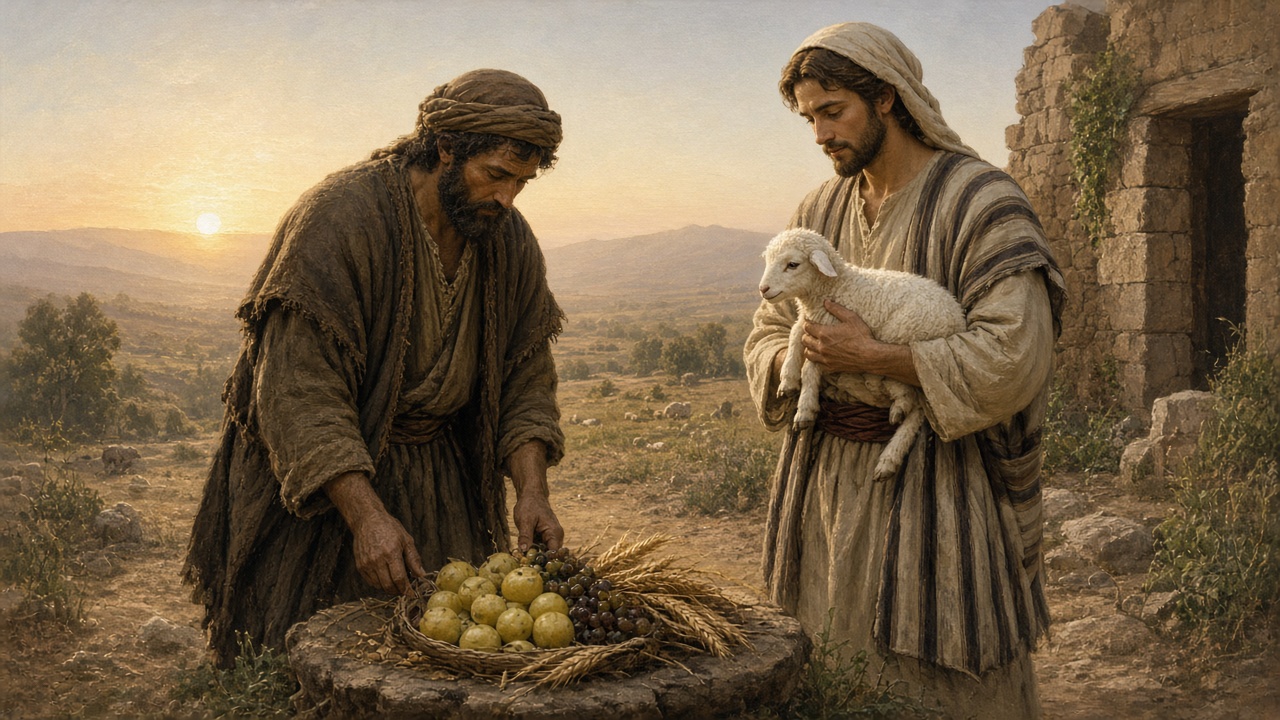
- Abel’s Hebrew name means “breath” or “vanity.” He kept sheep, while his brother Cain tilled the soil: Abel brought the best portions of the firstborn of his flock, and Cain brought fruit of the ground. Easton's Bible Dictionary (1897) reads the phrase “in process of time” (margin, “at the end of days”) as probably referring to the Sabbath.Sources: Abel · Cain · the Bible text itself
- After Abel’s death, Cain settled in the land of Nod, east of Eden, a name meaning exile, wandering, or unrest. There he built a city and named it after his son Enoch. Easton's Bible Dictionary notes that this is the first city mentioned in Scripture.Sources: Nod · Enoch (son of Cain) · the Bible text itself
- Lamech, fifth in descent from Cain, married two women, Adah and Zillah. Easton's Bible Dictionary calls his address to them the only extant example of antediluvian poetry, sometimes known as “Lamech’s sword-song.” Their children are tied to early ways of life: Jabal with tents and livestock, Jubal with the harp and flute, and Tubal-cain with forging bronze and iron.Sources: Lamech (descendant of Cain) · Adah (wife of Lamech) · Zillah · the Bible text itself
Notes written with AI assistance from open sources (Theographic Bible Metadata, CC BY-SA 4.0; Easton’s Bible Dictionary, public domain) and reviewed before publishing.
Credits and license for this translation
A Nitana Vure
Genesis, Exodus, Leviticus, Numbers, Deuteronomy, Joshua, Ruth, Jonah, and the New Testament in the Bola language of Papua New Guinea
Sampela hap Buk Baibel long tokples Bola long Niugini
copyright © 2011 Wycliffe Bible Translators, Inc.
Language: Bola
Translation by: Wycliffe Bible Translators
This translation is made available to you under the terms of the
Creative Commons Attribution-Noncommercial-No Derivatives license 4.0.
You may share and redistribute this Bible translation or extracts from it in any format, provided that:
You include the above copyright and source information.
You do not sell this work for a profit.
You do not change any of the words or punctuation of the Scriptures.
Pictures included with Scriptures and other documents on this site are licensed just for use with those Scriptures and documents.
For other uses, please contact the respective copyright owners.
2014-12-03
Source: http://png.bible/bnp/ · eBible.org