Genesis 4
Sunbin-Got em Kitakamin Weng · Tap a verse to see its cross-references.
Ken e Akalem Akunum Ebel elo Ase em Sang te.
1Beli, Adam e kalel Iw ulo aul duumei, u kunum aul mak dukuko, beem wiin e “Ken.”, dangsu kale. Nimtew angom? U bokolomelu: “Yawe e nelo ken kenemei, ne kunum aul mak dukuli te.”, angsu kasike. 2Angeko, iti aul fakileweko, aul mak dukului, i em wiin e “Ebel”, dangsiliw kale. E Ken em awkunum te. Aso i tenbelsomeliwi, Ebel em aluwbamin e siwsiw yetebin kunum kesomelei, Ken em aluwbamin e wanin kaimin kunum kese kale.
3Keko beli, deiw mak ding mak kelei, Ken e Yawe elo “Weso! Seyo!”, dangeko, emisik em yongiw wanin kuluko, dukalewale kale. 4Beli, Ebel akati Yawe elo “Weso! Seyo!”, dangeko, emisik dukulu siwsiw men ibolow mel ati kuw mak kele be anko, dukalewale kale. Dukalewei, Yawe e Ebel elo kalfong fian kelewale kate, 5e Ken so, akalem dukulewkabe emisik yongiw wanin beso diw atemeko, beelo kakatinba kelewale kale. Kelewbelei, Ken e atemeko, ibolow wa kelei, em kiinguen kaim alala kaisuw nanew kuw famdes kese kale. 6Keko beli, Yawe e Ken elo bokolewomele: “Kutaka! Ku nobelew a? Nimtew angom ete kom kiinguen amu kaim alala kaisuw nanew kuw famdes kebelew, a? 7Ku kilila! Kute ken kukuw kuw kebelew tewe, ken kuw bokolew te. Kate, ku wa kukuw kemew tewe, wa kukuw be kulo kensomelei, teng so kekemoke te. Kate, kukal kitil keko, beelo de mit da kolewolewka!”, dangse kale.
8Dangei, anfel e, Ken e Ebel awkunum beelo bokolewomele: “Kaso nu kut kakamuma!”, dangse kale. Dangei, aso i uneko, kut dim mit tem unsiliw kale. Uneko, Ken e awkunum beelo alei, e kuanse kale. |alt="Kain killing Abel" src="CA08.tif" size="col" ref="Talfut Kese 4:8" 9Keko beli, Yawe e Ken elo dakalalomele: “Kom kawkunum Ebel e, nal kel be?”, dangse kale. Dangei, Ken e yan weng mak bokolewomele: “Ne kal e! Ne elo atebin kunum ba kasike!”, dangse kale. 10Dangei, Yawe e Ken elo bokolewomele: “Kutaka! Nimtew angom ete ku kukuw wa be kelew a? Feinka! Kawkunum beem kaim e buselewi, e kawin tem une te. Ne kaim beem amemin kililika. Kaim be nelo gaaneko, bokonemomele: ‘Kukuw wa beem yan wa dulewa o!’, nange te. 11Kame, ne weng kitil weng mak dukemi te. Nimtew angom? Ku kawkunum alewi, e kuane kasike. Kame, kukati yakok kekemi te. Kawkunum em kaim aleleko, kawin kale du kelew kasike, wanin kailokolew be, nam tebeme te. Ku fukafuka kunum kesomi, kawin abin dak kilele ken nam teinew te.”, dangse kale. 13Dangei, Ken e yan weng bokolewomele: “Ebe! Kame, ilum fian mak dunemew kae! Kal ilum fian mak keli te. 14‘Ku wanin nam kaimew te!’, nangew te. ‘Nem mewso nam bew te!’ nangew te. ‘Kawin banim o!’ nangew te. ‘Fukafuka kunum bew te!’, nangew te. Kame ne ‘I nelo neniw kuanoki sako!’, angomi, finganbi te.”, dangse kale. 15Dangei, Yawe e Ken elo bokolewomele: “Ku finganemokolew te! Ne weng fawtuk ayem weng fian mak kulo dukemi te. Mak kunum mak keniw tewe, ne ilo ilum fian mak duyemsomi, im yan wa kulokoliw yan be kom kulubelew yan wa be ben kel em dim bakilewoke te.”, dangse kale. Dangeko, Yawe e Ken em dim e mak eisneng mak dukulewbelei, kawtiw i beelo atemsomi, elo alinba kemaliw kale.
16Beli, Ken e Yawe em mit elo koleweko, uneko, kawin mak teinse kale. Kawin beem wiin e Not. Kawin be musun Iden em ataan matem talakabe beem dulum mewso kese kale.
17Beli, Ken e akalem kalel so bomi, ulo aul duumse kale. Duumei, u kunum aul mak dukuko, em wiin e “Enok”, dangsu kale. Keko beli, Ken e abiw mutuk fian mak gesomelei, abiw mutuk fian beem wiin e akalem min em wiin so takayak moleweko, “Enok!”, dangse kale.
Ken em Muluwel Dow im Wiin te.
18Beli, Ken em min Enok e waneng mak kuluko, aul mak dukuko, em wiin e “Ilat” dangse kale. Ilat em min e Mekuyael te. Mekuyael em min e Metusael te. Metusael em min e Alamek te. 19Alamek be kayot kunum keko, waneng alew mak yemduse kale. Waneng alew mak um wiin e Ada, mak um wiin e Sila te. 20Ada bu kunum aul mak dukuko, em wiin e “Yabal!”, dangsu kale. Yabal so em muluwel dow so i samal kal benemin am kakabiliw kunum waneng kesomi, bulmakao so siwsiw so yetebin kawtiw im kunum mongom kesiliw kale. 21Akalem awkunum em wiin e Yubal te. Yubal so em muluwel dow so i fotiaw so, tanam atew eisneng so, beem dim sim bakabiliw kawtiw im kunum mongom kesiliw kale. 22Keko beli, Alamek em afam waneng Sila ukal aul mali mak dukusu kale. Emisik min em wiin e Tubal-Ken te. Tubal-Ken so em muluwel dow so i biol so sek so kaimin kawtiw im kunum mongom kesiliw kale. Sila bu waneng aul mak ukal dukusomi, um wiin e “Nama!”, dangsu kale. 23Keko beli, Alamek e akalem kalel alew ilo bokoyemomele:
“Ada! Sila! Nem kalel alew, kuso yu nem weng kale kililina!
Kunum tenbel mak neso genei, ne elo anii, e kuanse te.
Beemdiw aul mak nelo betbet dunemei, ne elo an fomdosi te.
24Beli kasike kame, kawtiw kanete mali mak i Ken elo aliw tewe, im yan wa e atin kuw ilum fian keko, mali im ilum kulokoliw beelo ben kel em dim bakilewoke te.
Kate, mali kawtiw mak nelo ilum mak dunemiw tewe, i kanebiliw beem yan e 77 dim kel kulokoliw te!”, yangse kale.
Adam Yemkal im Mali Auk Dukusiliw em Sang te.
25Beli, Adam e kalel Iw ulo iti aul mak duumei, u iti kunum aul mak dukusu kale. Dukuko, aul beem wiin e “Set.”, dangsu kale. Nimtew angom? U bokolomelu: “Feinka! Ken e akalem ning elo alei, e kuanse kate, Yawe e kuanse kunum Ebel em abin kulomin aul mak dunemse te.”, angsu kasike. 26Keko beli, Set akal min mak dukuko, em wiin e “Enos”, dangse kale.
Beem ding kabalak e, kunum waneng i Yawe em wiin daolim kukuw matem dasiliw kale.
Did you know?
Cain, Abel, and Life East of Eden
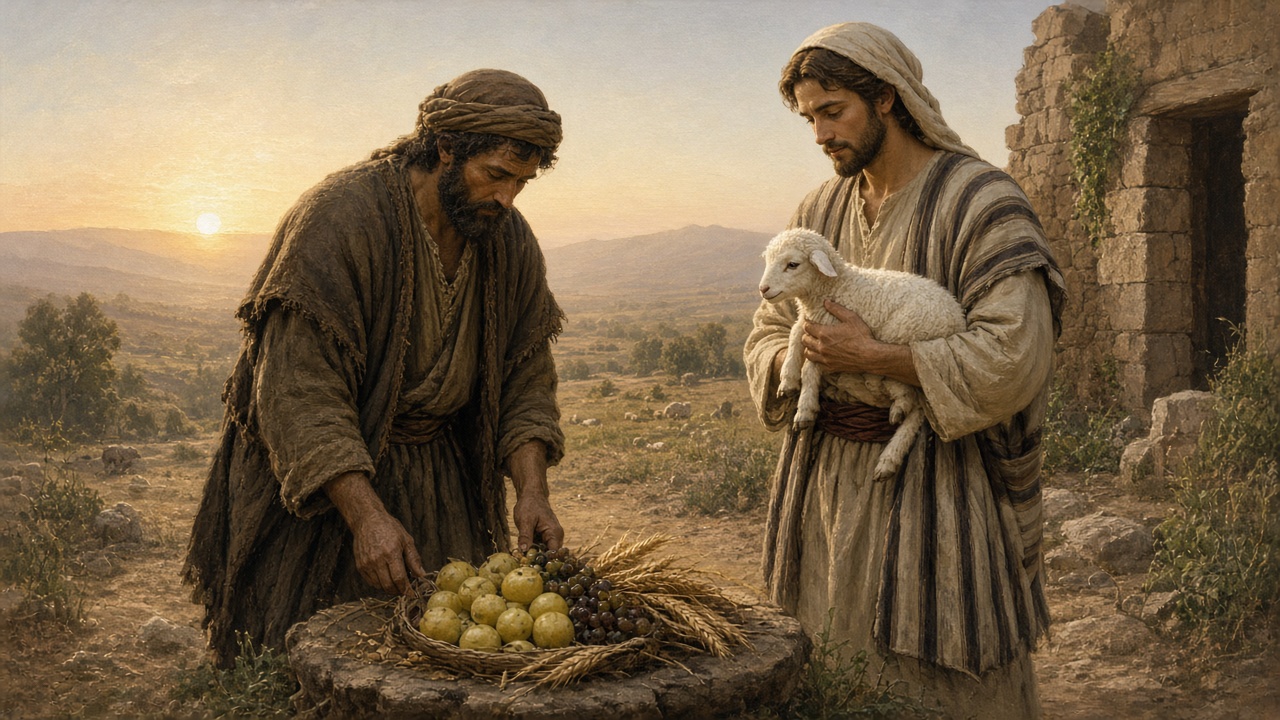
- Abel’s Hebrew name means “breath” or “vanity.” He kept sheep, while his brother Cain tilled the soil: Abel brought the best portions of the firstborn of his flock, and Cain brought fruit of the ground. Easton's Bible Dictionary (1897) reads the phrase “in process of time” (margin, “at the end of days”) as probably referring to the Sabbath.Sources: Abel · Cain · the Bible text itself
- After Abel’s death, Cain settled in the land of Nod, east of Eden, a name meaning exile, wandering, or unrest. There he built a city and named it after his son Enoch. Easton's Bible Dictionary notes that this is the first city mentioned in Scripture.Sources: Nod · Enoch (son of Cain) · the Bible text itself
- Lamech, fifth in descent from Cain, married two women, Adah and Zillah. Easton's Bible Dictionary calls his address to them the only extant example of antediluvian poetry, sometimes known as “Lamech’s sword-song.” Their children are tied to early ways of life: Jabal with tents and livestock, Jubal with the harp and flute, and Tubal-cain with forging bronze and iron.Sources: Lamech (descendant of Cain) · Adah (wife of Lamech) · Zillah · the Bible text itself
Notes written with AI assistance from open sources (Theographic Bible Metadata, CC BY-SA 4.0; Easton’s Bible Dictionary, public domain) and reviewed before publishing.
Credits and license for this translation
Sunbin-Got em Kitakamin Weng
The New Testament and part of the Old Testament in the Bimin Language of Papua New Guinea
Nupela Testamen na sampela hap Oldpela Testamen long tokples Bimin long Niugini
Copyright © 2008 Bible Society of Papua New Guinea
Language: Bimin
Translation by: Wycliffe Bible Translators
This translation is made available to you under the terms of the
Creative Commons Attribution-No Derivatives license 4.0.
You may share and redistribute this Bible translation or extracts from it in any format, provided that:
You include the above copyright and source information.
You do not make any derivative works that change any of the actual words or punctuation of the Scriptures.
Pictures included with Scriptures and other documents on this site are licensed just for use with those Scriptures and documents.
For other uses, please contact the respective copyright owners.
2016-10-03
Source: http://png.bible/bhl/ · eBible.org