Exodus 27
Deo Ele Posanga · Tap a verse to see its cross-references.
Deo ikeo ga tikado popou tenainga aea
1Deo ikeo pade bedane, “Gimi manta abada abei akas ta akado popou tenainga aea ngan. Aea gadae ga iluai bageda aea makor iadag, be aea mamarae ga aea babanga ga iuot lalaede ga iluai leoa ede ga ilia iluai bageda aea makoreai. Popou tenainga aea|alt="Altar of burnt offering" src="HK00256B.TIF" size="span" copy="Horace Knowles © 1954, 1967, 1972, 1995 The British and Foreign Bible Society" ref="27.1-8" 2Be gadae ngan popou igal toa pange ne, asap danga pange imata mambe bulmakao aea pelenga. Be manta asap popou igal toa pange oa toman ngan aea pelenga ngan abei akas ikatinge kelede. Be manta aluga popou tenainga aea isal toa ngada oa toman ngan aea pelenga ngan gid bras ikatinge babanga. 3Ga pade, manta akado gid tabla iman dinga itae aea tadonga, ga dinga itae aea doidoinga, ga gid loba ngan dolnga masilau ising ngan, ga gid duduinga iman masilau imedameda aea galnga, ga gid lalate iman dinga aea badanga. Danga toa ngada ne akakado ngan bras kekelen. 4Ga pade, manta akado popou toa ne aea kakari bras iman dinga aea. Be akado toman ngan aea koea pange toa tidae ngan igal toa pange oa. 5Be ngan popou iae toa pange ne, apatoi bras idanga ede ga idae iae irabuiai, ta iman kakari bras aea kisinga. 6Ga kus ta abada abei akas ta akado sig rua ta amol gid ngan bras ikatinge babanga. 7Sig toa rua ne iman popou aea bisinga. Asabun gid ngan popou aea koea toa pange oa, sig ede iadag, ga sig ede pade iadag. 8Gimi ga adid popou toa ne ngan abei ikatinge kemikemi, be atnan iaoa gadio ga gadae ga idio ibangabanga. Akado ga iuot lalaede mambe ianun toa napasolan pago lusiai.”
Deo ikeo ga titado silasila ga ibalil ngan ele palata
9Deo ikeo pade bedane, “Gimi manta abada malo kemikemi ta asilasila ga ibalil ngan leg palata. Be silasila toa ne ikarkare pan saut, aea mamarae ga iuot sangaul rua leoa lima. 10Be manta akado silasila ikarkare toa ne toman ngan aea kadanga sangaul rua. Be akado gid kadanga ipu bras sangaul rua pade iman gid kadanga ad pagunnga. Be ngan gid kadanga kelede kelede, akado gid lingau silva ga tabalanga silva pade. 11Be silasila toa ne ikarkare pan not, eine ga iuot lalaede mambe iadag aea pade. Aea mamarae ga iuot sangaul rua leoa lima. Be akado aea kadanga sangaul rua toman ngan ad kadanga ipu bras sangaul rua pade iman gid kadanga ad pagunnga. Be ngan silasila aea kadanga kelede kelede, akado gid lingau silva ga tabalanga silva pade.
12“Be silasila toa palata imuriai oa, aea mamarae ga iuot sangaul ede leoa rua aea mana. Be akado silasila toa oa aea kadanga sangaul toman ngan ad kadanga ipu bras sangaul pade iman gid kadanga ad pagunnga. Be akado aea malo lalaede toa bedaoa pade. 13Be silasila iaoa toa ado ele parangai, aea mamarae ga iuot sangaul ede leoa rua aea mana. 14Be ngan silasila iaoa isal iadag ga iadag, apakantutu malo rua, ede iadag, ede pade iadag, ad mamarae iuot leoa tol ga ilia iluai bageda aea makor iadag. Akado silasila iaoa isal toa rua ne toman ngan kadanga lima ga ede, tol iadag, ga tol pade iadag, toman ngan ad kadanga ipu bras.
16“Be akado silasila iaoa aea malo kemi ede, aea mamarae ga iuot leoa lima. Be akeo pan eaba mosi aea ta ipasogo malo toa ne ngan gid oaro salumu aea singsingia ga singsingia tede ga bil. Be akado silasila iaoa aea malo toa ne toman ngan aea kadanga pange ga kadanga ipu bras pange pade. 17Manta akado silasila aea kadanga toa ngada ne toman ngan ad tabalanga silva ga ad lingau silva ga ad kadanga ipu bras. 18Silasila toa ne aea mamarae ga iuot sangaul rua leoa lima. Be aea babanga ga iuot sangaul ede leoa rua aea mana. Akado silasila aea malo toa ngada ne ngan gid malo kemikemi. Be silasila aea gadae ga iuot leoa ede ga ilia iluai bageda aea makoreai. Be akado aea kadanga ipu ngan bras. 19Be manta abada bras kekelen ta akado ngan leg palata aea danga naurata aea toa ngada ne. Ga pade, akado kisinga bras gereirei ngan kisinga gid oaro palata aea, ta muriai agin gid ga tidudunga tanoeai.”
Apu ngan lam aea bude
20Deo ikeo pan Moses pade bedane, “Keo pagid panua Israel ta tibada bude kemi oliv aea ga inam, ta iman gid lam aea ta titaratara somisomi. 21Aron toman ngan ele gergeu arangaranga ga tibada gid lam toa ne ga tidudunga leg palata iloleai ngan tibur toa nalup toman ngan gid. Gid lam toa ne ga ienono leg palata iloleai ngan tibur toa aea ul kapei tede, boloma ngan malo kapei toa ipamumul korol apu aea. Be ado ga ado, Aron ga ele gergeu arangaranga ga tiparere bude ngan gid lam, ta titaratara gau matageai somisomi lailai ga irangrang ngan gaisala. Gimi Israel toman ngan lemi gergeu ga tibutibumi tiuotot muriai, manta anasnasi apu toa ne ga ilalala ga ila.”
Did you know?
The bronze altar, the courtyard, and the lamps
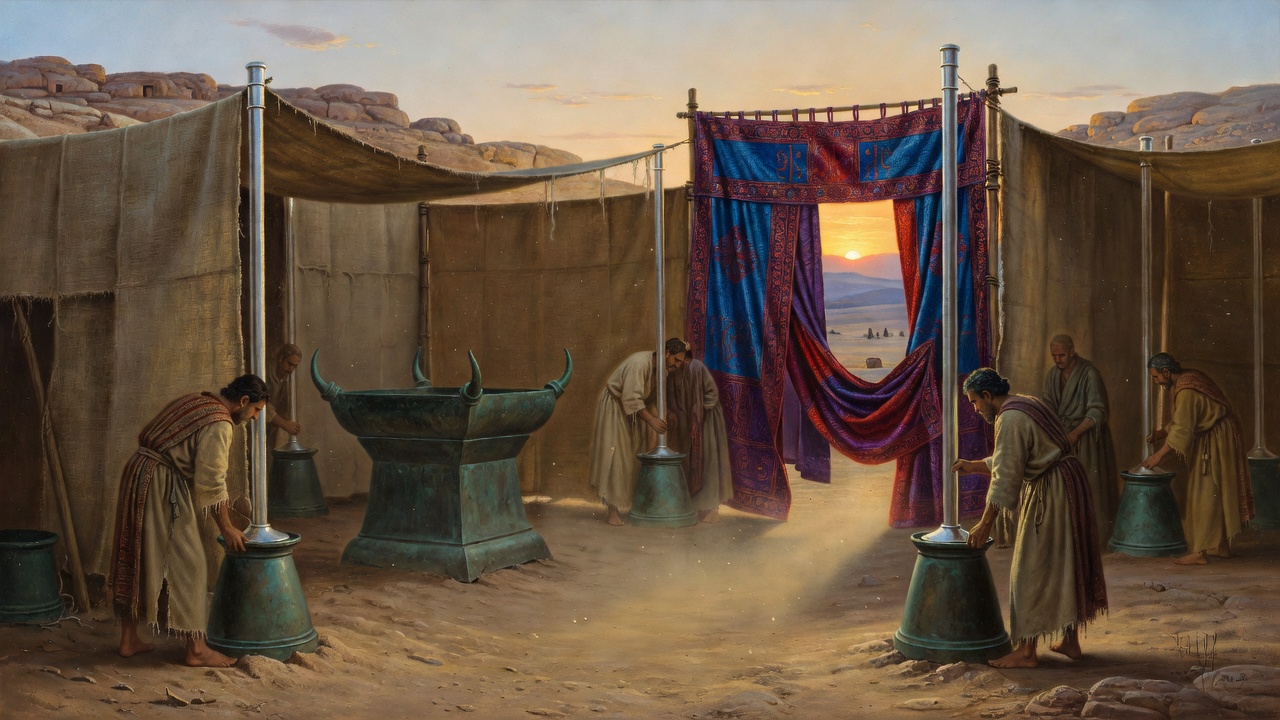
- This chapter calls for a square altar of acacia wood, five cubits long, five cubits wide, and three cubits high, with a horn on each of its four corners, the horns of one piece, and the altar overlaid with bronze. It was to be built hollow, of boards, with a bronze-mesh grate set beneath a ledge so that the mesh came halfway up, and with poles of acacia wood overlaid with bronze, inserted into rings so the altar could be carried. All its utensils—pots for removing ashes, shovels, sprinkling bowls, meat forks, and firepans—were to be bronze, and the altar was to be made just as shown on the mountain.Sources: the Bible text itself
- The courtyard of the tabernacle was to be a hundred cubits long and fifty cubits wide, with curtains of finely spun linen five cubits high. The south and north sides, each a hundred cubits long, were to have twenty posts and twenty bronze bases, with silver hooks and bands; the west side, fifty cubits wide, was to have ten posts and ten bases. The east side, toward the sunrise, was also fifty cubits wide, with a twenty-cubit gate curtain embroidered with blue, purple, and scarlet yarn and finely spun linen, on four posts, and with curtains of fifteen cubits on either side.Sources: the Bible text itself
- The Israelites were to bring pure oil of pressed olives for the light, so that the lamps would keep burning continually. In the Tent of Meeting, outside the veil in front of the Testimony, Aaron and his sons were to tend the lamps before the LORD from evening until morning, a permanent statute for the Israelites for the generations to come. Aaron, eldest son of Amram and Jochebed, was born in Egypt three years before his brother Moses, and by Elisheba, daughter of Amminadab of the house of Judah, whom he married, he had four sons: Nadab, Abihu, Eleazar, and Ithamar.Sources: the Bible text itself · Aaron
Notes written with AI assistance from open sources (Theographic Bible Metadata, CC BY-SA 4.0; Easton’s Bible Dictionary, public domain) and reviewed before publishing.
Credits and license for this translation
Deo Ele Posanga
Genesis, Exodus, and the New Testament in the Bariai language of Papua New Guinea
Sampela hap Buk Baibel long tokples Bariai long Niugini
copyright © 2012 Wycliffe Bible Translators, Inc.
Language: Bariai
Translation by: Wycliffe Bible Translators
This translation is made available to you under the terms of the
Creative Commons Attribution-Noncommercial-No Derivatives license 4.0.
You may share and redistribute this Bible translation or extracts from it in any format, provided that:
You include the above copyright and source information.
You do not sell this work for a profit.
You do not change any of the words or punctuation of the Scriptures.
Pictures included with Scriptures and other documents on this site are licensed just for use with those Scriptures and documents.
For other uses, please contact the respective copyright owners.
2012-10-03
Source: http://png.bible/bch/ · eBible.org