Genesis 37
Tareka Buka · Tap a verse to see its cross-references.
Iosepa totomu
1Iakobo Keineni duriomoro ato wimidirotiti ina nou abera ibose iato ta-gomidiro. Iakobo dubu mere sirio mutu ibo imidirotiti. Iosepa kanikani na-goroho 17 kisimisi ro na-gorobai naramio mutu sipisipi nanigosi nou imowotoititi-mo. Iakobo ro ta-giedea-ma sowake besere teibo, Biriha Siripa mutu, neitiro ato nou ro na-girasomai-ibi dubu mere peteibi neibi Iosepa mutu sipisipi nanigosi atu se wimowotoi-bimo.
Iosepa na-irowametiti-ro moto to naramio nou ro nato wiwautiti abera aboto neio ro beda ubauba tanaro wisioidirotiti-mo.
3Iakobo ata masiro Isiraere, nou ubi mere ie Iosepa mabu Iosepa nou ro oromano ato garasomai. Taie nou ro Iosepa nato gemowaruwoidiro tu tuturu sodo tititi se. 4Nou naramio umoro na-goi-rimo ibo Iosepa Iakobo ubi mere ie, neio aboto auna ubi iamotiti pua noudo ie Iosepa naramio ro neido wohoiotiti-mo. Neio owera Iosepa aboto mea mino to iarotiti pua, masawemasawe to wiaro-mo.
5Taie ata tau Iosepa hiwo nato gorobu, ina nou edi hiwo owera ro nato gorowauti naramio aboto ibo, ‘Mo hiwo owera aboto gare neito ma-diedea-rimo. Mo ro nedi duwo ro nato na-norobu nimo woiti ohona patu nitohiti-dumo pari ato. Mo edi patu ro tuputupu se otoi turi ato, nio edi woiti patu ro neio ro garadabuai-rimo sapuwosapuwo gotoburio-rimo iato giroboreauti-rimo.’
Nou naramio ro edi hiwo owera na-girowai-rimo neio ro ibo, ‘Oro ibo a-imaragoidiro ra oro gabamani to ama-omidiro-ri? Oro ubi ra nimo oro ro iauri ri?’
Nou naramio ro auna ia se wohoiotiti-mo mabu nou edi hiwo owera ro na-irowautititi nou sapuwo to wohoiotiti-mo.
9Taie ata tau ato nou ata hiwo iato gorobu. Iosepa ro ina nou naramio iato gimowauti, ‘Mo ro ata hiwo ta-norobu ina, mo ro ta-niauri saiki sagana 11 kiboni mutu neio ro orowotoi-die toboro ohu ato. Mo aboto neio ro iroboreauti-diomo.’
10Iosepa nou edi hiwo owera ro nou gorowauti nou abera aboto ina Iakobo ro edi hiwo owera ro na-girowai, nou ro Iosepa iato gemaiauti. Iakobo ro ibo, ‘Io beda hiwo owera ra io? Oro ibo a-imaragoidiro ra oro mamu mo ia nimo atu se oro aboto iroboreauti-ri?’
11Iosepa ro naramio masawe ia gimowai, kaupoti Iakobo ro nou hiwo owera beda sosoro to girowidiro nou ro na-gimaragoidiro ina maumo kimaragoidiro beda sosoro ra, nou ro nou gosora.
Iosepa mani to gahodorai-rimo
12Iosepa naramio ta-gou-rimo Sekemi sabowa gomo to abera edi sipisipi ro neio imowotoi rie. 13Taie neibi abera Iakobo iato gutura Iosepa aboto, ‘Oro ba-dou Sekemi to, oro naramio toroho-dumo sipisipi timowotoi-dumo iedi sabowa gomo nato.’
Iosepa ro iato gutura, ‘Io idau mo anama-imai-ri.’
14Taie nou abera ro iato gutura nou ato, ‘Ba-dou oro naramio ba-diraturiomai neio modobo ato hato oroho-dumo ibose sipisipi modobo ato hato oroho-dumo? Ina ba-dorowameai-ro neito mo emowapotai ri neio beda sosoro oroho-dumo.’
Taie Iosepa nou ro ioudo gotiodorai-ro Heboroni gawagogo rido Sekemi sabowa to, 15nou na-gorowateai ata dubu ro iato gowea. Iosepa koroho kawa goroho.
Taie iedi dubu ro nou ro iato gemodowa nou, ‘Oro etou osora?’
16Ina Iosepa ro ibo, ‘Mo naramio niosora sipisipi na-imowotoi-dumo. Sipisipi beda ipi ato imowotoi-dumo mo ma-demowapotai-ro neio bato oroho-dumo?’
17Ina nou ro ibo, ‘Neio ro ta-wemeserai-mo nedi moro ro, ta-wou-mo. Mo ro ta-nimororowai neio na-waro-dumo Dotani sabowa to ou ri.’
Taie Iosepa ro na-girowai nedi owera ro nou imese gaimai naramio iosora ri Dotani sabowa to. Taie nou ro iato aise giwia Dotani sabowa gomo ato.
18Neio ro muso rido gowea-rimo nou, ito ido ama-orowateai-ri nou naramio nato geremowauti-rimo nou kesuai sapuwo to. 19Neio ro ibo, ‘Hiwo dubu tou-die. 20Dou-rimo esuai rie, nou pamo durupi anamadime-eherai-ri goto bobo to. Taie Idau nimo ro nato anamadime-emowapotai-ri ibo, “Ata tumu na ro ouho nou.” Nou hiwo owera morobise to amadimo-ororosioidiro-ri ra?’
21Rubeni ro ta-gimewidiro nou niramio beda sosoro geremowauti-rimo nou ubi tato ie Iosepa neio ro kesuai aboto ina nou ro nou ri gidiobo.
Nou ro ibo, ‘Nimo ro esuai-ri pua nou. 22Nedi goto bobo ro nakara moro ato na-owamo neito se meherai-rimo temeteme omia ate!’
Taie nou ro niramio nou ri gimowapotai mabu nou kimaragoidiro to ta-giwia neio ro kopia rie ina nou ri gidiobo. Ina nou ubi a-gowamo ibo Iosepa nou ro piro se eihai ri goto bobo rudo ina emeiriai ri abera aboto.
23Iosepa na-gorowateai-ro nou naramio aboto neio ro nou iato aise gohiai-rimo tu tututu sodo tititi se edina goroidiro neio ro aise gowopirutai-rimo, 24imese gomudo-rimo goto bobo to nato geherai-rimo. Iedi goto bobo ro obo iato omidiro pua, nou bobo ato imese gotoi.
25Iosepa naramio na-gorowameai-rimo komititi taie neio dokou imese giho-rimo. Neio dokou giho-rimo edi tau ro nato neio na-girarowea-rimo Isimere gu urubia ro gou-rimo muso ato. Neio ioudo gou-rimo Giriadi duriomoro rudo meamea nibo meresini nou giwou-rimo Isipi duriomoro to imade ri, kemoro ohu ato giamo neio ro gitomaidiro-ro.
26Taie Iuda ro ibo, ‘Nimo ro karima boina na beda namadimo-opia-ri piro se, etou mabu ato ra? 27Nimo ro modobo ie kaiwai iedi Isimere gu urubia ro neio aboto, mani to neio ro amadimo-omidai-ri. Nimo ro nou temeteme komia modobo pua mabu nou nimo ia karima boina na ie.’
Iuda beda owera garo naramio ubi aise goi-rimo. 28Iato Isimere urubia na-gou-rimo, nou naramio ro goto bobo rudo na-geihai-rumo, iato gahodorai-rimo auna mani to Isimere urubia aboto, Iosepa neio ro imese gowou-rimo Isipi to.
29Rubeni na-gorowameai-ro nou ro Iosepa potoro se gowea goto bobo ato. Taie nou auna mibo ro gorobai neama sapuwo to, nou obotama nou ri gerewekekeouti. 30Nou imese gorowameai niramio aboto iato gimowapotai-ibi ibo, ‘Iodio mere ro boira? Potoro ie bobo ato! Mo nou abera aboto beda sosoro nama-orowameai-ri nou tato?’
31Iato niramio ro nanigosi na-gopia-rimo nou edi sodo ro tu tuturu tititi se neio ro na-godobia-rimo iato gowoiti-rimo karima to 32imese gowou-rimo Iakobo aboto.
Neio ro iato gutura-rimo nou aboto, ‘Nodi sodo ro tu tuturu tititi se oro mere do hata ie? O nou do pua ra?’
33Iato Iakobo ro na-geibimai nou ro ibo, ‘Io nou do se ie, mo mere do ie. Nou ata tumu na ro ta-wouho. Nou durupi imese wasinawasina ta-emowai.’ 34Nou auna natonato ie mere aboto iato Iakobo edi obotama na-giroidiro aise gerewekekeouti iato garegare obotama imese giroiti. Nou pape imese gomidiro, Iosepa nou ro auna idobi aise gemeretetiti tuturu tau to. 35Nou merebusere ta-wiroho-mo nou aboto nou a-geawadori kaupoti nou ubi tato ie nou kageawado.
Nou ro iato gutura ibo, ‘Nou pape anama-imidirotiti-ri womu tato mo pamo kowea.’ Iosepa nou ro sirio saiki to emeretetiti idobi.
36Wisa na Iosepa Potipa ro mani to gahodorai Isimere urubia aboudo. Potipa Isipi duriomoro ato auna gabamani dubu e. Isipi eputa dubu moto na-emotoititi-mo urubia imese Potipa ro iaurititi. Taie.
Did you know?
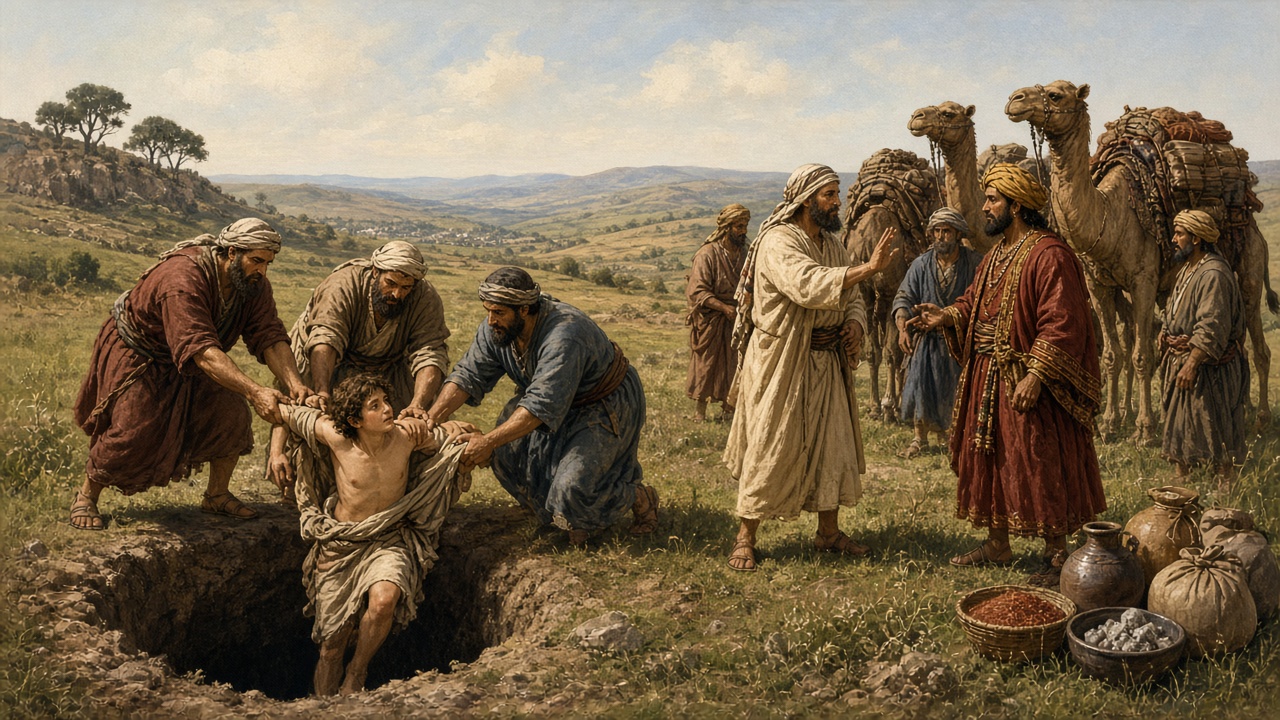
Joseph Sold by His Brothers
- Israel loved Joseph more than his other sons because he was the child of his old age, and he made him a robe of many colors. Easton's Bible Dictionary (1897) reads the Hebrew of Genesis 37:3 as a long, full garment with sleeves, the kind worn by the children of nobles. When the brothers saw that favor, they hated him and could not speak a kind word to him.Sources: Joseph (son of Jacob) · the Bible text itself
- Jacob sent seventeen-year-old Joseph from the Valley of Hebron to see how his brothers and the flocks were faring; they had pastured near Shechem and then gone on to Dothan. Easton's Bible Dictionary (1897) calls Dothan a famous pasture ground with two wells, identified with modern Tell-Dothan about twelve miles north of Samaria among the hills of Gilboa, and says it is mentioned on monuments in 1600 BC. There the brothers saw a caravan of Ishmaelites coming from Gilead, their camels carrying spices, balm, and myrrh on the way down to Egypt.Sources: Dothan · Gilead · the Bible text itself
- Reuben, Jacob's eldest son by Leah, tried to save Joseph from death and planned to return him to their father. Judah then persuaded the brothers to sell Joseph to the Ishmaelites rather than shed his blood. In Egypt the Midianites sold him to Potiphar, an officer of Pharaoh and captain of the guard; Easton's Bible Dictionary (1897) explains that name as 'dedicated to Ra,' the sun-god, and takes the title to mean, probably, chief of the state police, with a margin reading 'chief of the executioners.'Sources: Reuben · Judah (patriarch) · Potiphar · the Bible text itself
Notes written with AI assistance from open sources (Theographic Bible Metadata, CC BY-SA 4.0; Easton’s Bible Dictionary, public domain) and reviewed before publishing.
Places in this chapter
- Canaan · 32.767, 35.333 · verse 1
- Shechem · Today: Tell Balatah · 32.214, 35.282 · verses 12, 13, 14
- Valley of Hebron · 31.525, 35.102 · verse 14
- Egypt · 30.129, 31.308 · verses 25, 28, 36
- Gilead · Today: Gilead 1 · 32.187, 35.692 · verse 25
Only places identified with high confidence are shown (90% or more according to the scholarly sources compiled by OpenBible). Period map: DARE (Digital Atlas of the Roman Empire), CC BY 4.0; modern map: © OpenStreetMap contributors; places: OpenBible.info (CC BY 4.0).
Credits and license for this translation
Tareka Buka
Portions of the Holy Bible in the Bamu language of Western Province, Papua New Guinea
Buk Baibel long tokples Bamu long Niugini
copyright © 2023 SIL Papua New Guinea
Language: Bamu
This translation is made available to you under the terms of the
Creative Commons Attribution-Noncommercial-No Derivatives license 4.0.
You may share and redistribute this Bible translation or extracts from it in any format, provided that:
You include the above copyright and source information.
You do not sell this work for a profit.
You do not change any of the words or punctuation of the Scriptures.
Pictures included with Scriptures and other documents on this site are licensed just for use with those Scriptures and documents.
For other uses, please contact the respective copyright owners.
2026-08-26
Source: http://png.bible/bcf/ · eBible.org