Leviticus 12
Azərbaycan dilində Müqəddəs Kitab · Tap a verse to see its cross-references.
Zahı qadınlar üçün qaydalar
1Rəbb Musaya dedi: 2«İsrail övladlarına belə de: “Hamilə olub oğlan uşağı doğan bir qadın aybaşı, murdarlıq dövründə olduğu kimi yeddi gün murdar sayılsın. 3Səkkizinci gün uşaq sünnət olunsun. 4Qadın qanaxmadan paklanmaq üçün daha otuz üç gün gözləsin. Bu paklanma dövrü bitənə qədər qadın heç bir müqəddəs şeyə toxunmamalı və Müqəddəs məkana yaxınlaşmamalıdır.
5Əgər bir qadın qız uşağı doğarsa, aybaşı vaxtı kimi iki həftə murdar sayılsın və paklanmaq üçün əlavə olaraq altmış altı gün gözləsin.
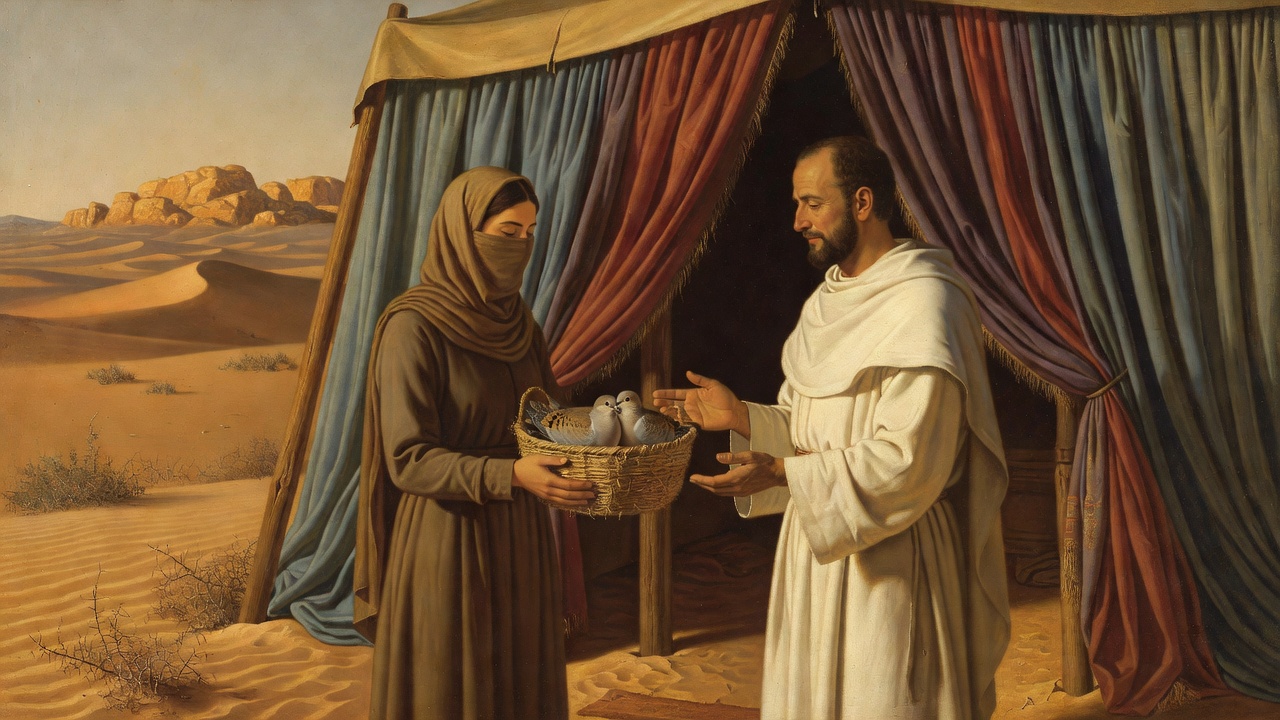
6Oğlan yaxud qız uşağı doğub paklanma müddəti bitəndə qadın Hüzur çadırının girişinə birillik toğlunu yandırma qurbanı kimi və göyərçin yaxud qumru quşunu kahinin yanına günah qurbanı kimi gətirsin. 7Kahin bunları Rəbbin hüzurunda qurban gətirib, zahı qadın üçün kəffarə etsin ki, o qan axmasından pak olsun. Qız ya oğlan doğan zahı qadın üçün təlimat budur.
8Əgər qadının toğlu gətirməyə gücü çatmırsa, onda birini yandırma qurbanı, o birini isə günah qurbanı olaraq iki qumru quşu yaxud iki göyərçin gətirsin. Bununla kahin həmin zahı üçün kəffarə etsin ki, o pak olsun”».
Did you know?
Purification after Childbirth
- Leviticus specifies distinct periods of ceremonial purification following childbirth: forty days total for a male child (seven days plus thirty-three days) and eighty days total for a female child (fourteen days plus sixty-six days). During this time, the mother was prohibited from touching sacred objects or entering the sanctuary.Sources: the Bible text itself
- At the conclusion of the purification period, the mother was instructed to bring a burnt offering and a sin offering to the priest at the Tent of Meeting. If she could not afford a lamb, the law explicitly allowed an alternative offering of two turtledoves or two young pigeons.Sources: the Bible text itself
Notes written with AI assistance from open sources (Theographic Bible Metadata, CC BY-SA 4.0; Easton’s Bible Dictionary, public domain) and reviewed before publishing.
Credits and license for this translation
Azərbaycan dilində Müqəddəs Kitab
The Holy Bible in the Azerbaijani language, also known as the Azeri language, of Azerbaijan, Iran, Iraq, Syria, and Turkey
Copyright © 2008 Müqəddəs Kitab Sirkəti
Language: Azeri (Azerbaijani, South)
Translation by: Institute for Bible Translation
Contributor: Bible Society of Azerbaijan
This translation text is made available to you under the
terms of the Creative Commons License: Attribution-Noncommercial-No Derivative Works.
( http://creativecommons.org/licenses/by-nc-nd/3.0/ )
In addition, you have permission to port the text to different file formats, as long as you
do not change any of the text or punctuation of the Bible.
You may share, copy, distribute, transmit, and extract portions
or quotations from this work, provided that you include the above copyright
information:
You must give Attribution to the work.
You do not sell this work for a profit.
You do not make any derivative works that change any of the actual words or punctuation of the Scriptures.
Permissions beyond the scope of this license may be
available if you contact
us with your request.
This translation is made available to you under the terms of the
Creative Commons Attribution-Noncommercial-No Derivatives license 4.0.
You may share and redistribute this Bible translation or extracts from it in any format, provided that:
You include the above copyright and source information.
You do not sell this work for a profit.
You do not change any of the words or punctuation of the Scriptures.
Pictures included with Scriptures and other documents on this site are licensed just for use with those Scriptures and documents.
For other uses, please contact the respective copyright owners.
2018-11-09
Source: http://ebible.org/azb/ · eBible.org