Nehemiah 8
Buk Baibel long Anuki · Tap a verse to see its cross-references.

About this book
About Nehemiah
- Easton's Bible Dictionary (1897) presents Nehemiah as the author of the book, pointing to first-person writing in chapters 1–7, 12:27–47, and 13, and to third-person sections in chapters 8–10 that some suppose Ezra wrote, though it says there is no distinct evidence of that. The same entry dates the book to about 431–430 B.C., after Nehemiah returned a second time to Jerusalem from Persia, and excepts 12:11, 22, and 23 from his hand.Sources: Easton: Nehemiah, Book of
- Nehemiah, son of Hachaliah and probably of the tribe of Judah, belonged to a family of Jerusalem and was one of the Jews of the dispersion. In his youth he served as royal cup-bearer at the palace of Shushan under Artaxerxes Longimanus, and through his brother Hanani he learned that the holy city lay mournful and desolate.Sources: Nehemiah
- The scribe Ezra had led a second company of exiles from Babylon to Jerusalem in 459 B.C., and Easton's dictionary treats Nehemiah as a historical continuation of Ezra. When Nehemiah went up to rebuild the ruined walls, Sanballat, who held some place of authority in Samaria, tried to hinder the work, and Tobiah the Ammonite joined the opposition and sent letters to put him in fear.Sources: Ezra · Easton: Nehemiah, Book of · Sanballat · Tobiah
- Easton's Bible Dictionary (1897) divides the book into four parts: the rebuilding of Jerusalem's wall and the register of those who had returned from Babylon (chapters 1–7); the state of religion among the Jews (8–10); the growth of Jerusalem's population, a census of adult men, and lists of chiefs, priests, and Levites (11 through 12:1–26); and the dedication of the wall, the ordering of temple officers, and Nehemiah's reforms (12:27–13).Sources: Easton: Nehemiah, Book of
- While Nehemiah was away, the priest Eliashib prepared a chamber in the courts of the house of God for Tobiah; on his return Nehemiah cast out all of Tobiah's household goods. Easton's dictionary also notes that the book closes the history of the Old Testament and that the prophet Malachi was contemporary with Nehemiah.Sources: Tobiah · Easton: Nehemiah, Book of
Notes written with AI assistance from open sources (Theographic Bible Metadata, CC BY-SA 4.0; Easton’s Bible Dictionary, public domain) and reviewed before publishing.
Esra, Yawe God yana gwara wawaya biiyadi ikabiyavidi
1Wawaya tupadi sipiika debadebae matamketa tana sakwatuveni rarima naghone sivitaghomidi bi gwara wiiyeveveyana tomoyina kana waghawagha Esra siwoneni da Mosis yana gwara bukana meko Yawe God sisiya bagibagidi Isrel damdi iveredi na iyakawari iyapiika.
2Wasina bi nawaravi kana wii 7 bi gabudara dagudagune na prist kana waghawagha Esra gwara bukana ikawari ipiika wawaya biiyadi, tomotomogha, wasiwasike da ededa iiyawogha kadi bodu rubana da siyakowa na sivitaghomidi. 3Na debadebae bi Esra gwara bukana ikabiyawa gwaruveni wawaya biiyadi. Touna kabiyawa gabudara iyageegeena idaguni patana da gabudara yubasuve, bi wawaya tupadi gwara bukana siwaiyanena wiimasiyeni.
5Esra na pesapesa debane iyamiimiiri na wawaya tupadi rubana siyakitakita. Bi raghanine gwara bukana irutatari bi wawaya sikita na yadi kabikarawagha Yawe God yana gwara biidi sitore na tupadi simakegeghomiiri.
6Wasina bi Esra iwona bo, “Kabepepa Yawe biidi, God maragata kirakiina!” Na wawaya tupadi imadi sirukabekabepa kiidamove bi siwona bo, “Waghasina! Waghasina, noko wiisuwona!” Wasina bi sivituwapore oghogheyana da mayiyidi siyowogha dobodobove bi Yawe God sikabepepi.
8Livait gwara bukana sikabiyavi bi yana basuna wawaya biiyadi sivisisiyena yapoyaporidi, na wawaya akovina siyakabi wiimasiyeni da awaki sikabiyavi.
9Noko raghanine wawaya gwara sisiyidi siwaiyana, na kiiravine siyaduudu na gavena Niyamaiya, bi Esra touna prist bi gwara wiiyeveveyana tomoyina, da kate dam Livai tomotomogha, toudi na gwara kana wonawonavereyana wawayidi sigeghomiiri da wawaya tupadi siwonedi bo, “Mmko gabudarina na kabikabikuwayina Yawe yami God kiiravine na gekoninuwabero bo konaduuna!”
10Wasina bi Niyamaiya sisiya ivikiitayini iwona bo, “Konagho bareye bi kepo kobera, kam miimiisedi kokam, wain metevidi koniuna, bi wawaya iiyawogha moyamoyakidi na toudi teya kovikamvereyana. Mmko gabudarina na kabikabikuwayina yada Bada biidi, na gekoninuwaberona, kiiravine Yawe God yana nuwamiise tami biiyadi na yami maragata!”
Did you know?
The Reading of the Law and the Feast of Booths
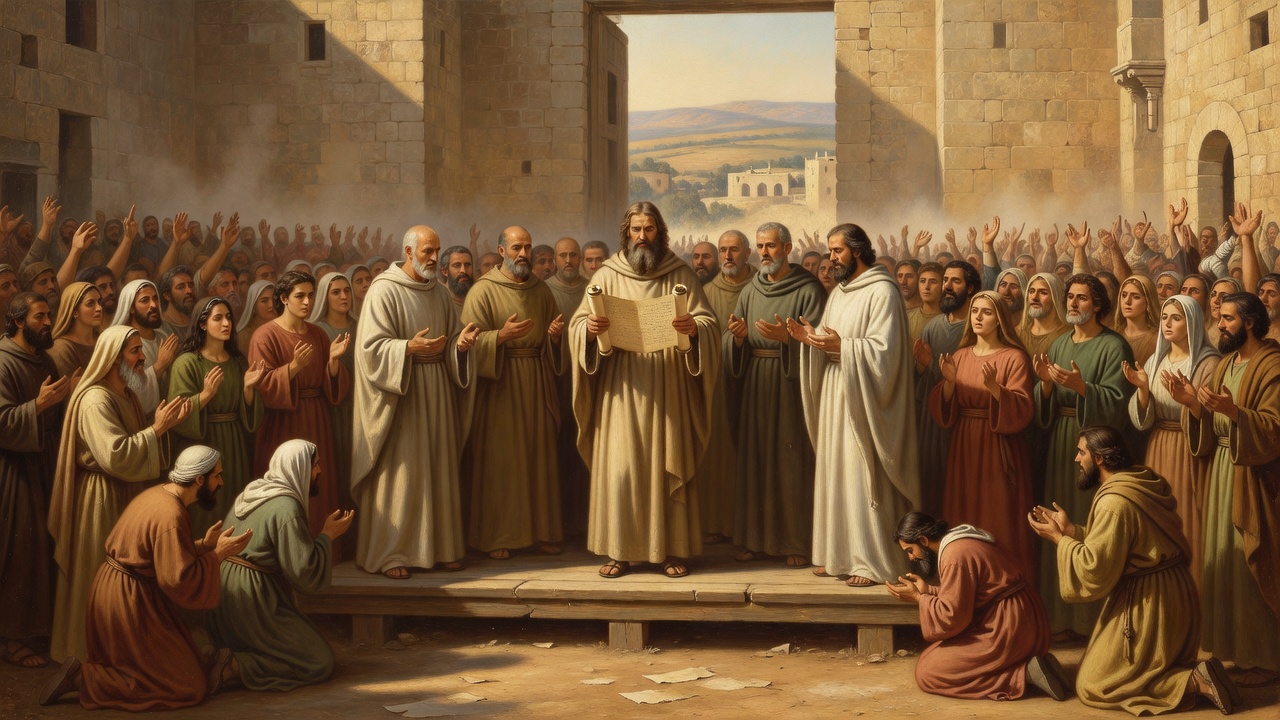
- Ezra the scribe, a priest descended from Aaron who had led exiles back from Babylon, read the Book of the Law of Moses from daybreak until noon to the assembly in Jerusalem. Standing on a high wooden platform in the square before the Water Gate, he read while Levites explained the text so the entire crowd could understand.Sources: the Bible text itself · Ezra · Water Gate · Jerusalem
- When the people wept upon hearing the Law read, Nehemiah the governor, Ezra, and the Levites instructed them not to grieve on a holy day. The people were told to celebrate with rich food and sweet drinks, share portions with those who had nothing prepared, and take comfort in the joy of the Lord.Sources: the Bible text itself
- After discovering the command in the Law to live in booths during the seventh month, the returned exiles gathered palm, olive, and myrtle branches to build shelters across Jerusalem's rooftops, courts, and squares by the Water Gate and the Gate of Ephraim. The text notes that the Israelites had not celebrated this feast in such a manner since the time of Joshua son of Nun.Sources: the Bible text itself · Water Gate · Gate of Ephraim
Notes written with AI assistance from open sources (Theographic Bible Metadata, CC BY-SA 4.0; Easton’s Bible Dictionary, public domain) and reviewed before publishing.
Places in this chapter
- Water Gate · Today: in Jerusalem · 31.777, 35.234 · verses 1, 3, 16
- Jerusalem · 31.777, 35.234 · verse 15
- Ephraim Gate · Today: in Jerusalem · 31.777, 35.234 · verse 16
Only places identified with high confidence are shown (90% or more according to the scholarly sources compiled by OpenBible). Period map: DARE (Digital Atlas of the Roman Empire), CC BY 4.0; modern map: © OpenStreetMap contributors; places: OpenBible.info (CC BY 4.0).
Credits and license for this translation
Buk Baibel long Anuki
Portions of the Holy Bible in the Anuki language of Papua New Guinea
Buk Baibel long tokples Anuki long Niugini
copyright © 2010-2016 Wycliffe Bible Translators, Inc.
Language: Anuki
Translation by: Wycliffe Bible Translators
This translation is made available to you under the terms of the
Creative Commons Attribution-Noncommercial-No Derivatives license 4.0.
You may share and redistribute this Bible translation or extracts from it in any format, provided that:
You include the above copyright and source information.
You do not sell this work for a profit.
You do not change any of the words or punctuation of the Scriptures.
Pictures included with Scriptures and other documents on this site are licensed just for use with those Scriptures and documents.
For other uses, please contact the respective copyright owners.
2014-06-02
Source: http://png.bible/aui/ · eBible.org