Genesis 32
Cishingini Agwara Kambari [asg] · Tap a verse to see its cross-references.
Yakubu u foɓusoi kugasa n Isuwa
1Ayin a na Yakubu wi a nwalu ɗa alingata a̱ Ka̱shile o yoku a gasai n a̱yi. 2Ana Yakubu we enei le ɗa u danai, <<Na ka̱tsura̱ ka̱ Ka̱shile kaꞋa>>, ɗaɗa u neꞋi ubuta̱ wa kula Mahanayim.
3Yakubu u suki alingata a kubana u vuza ni Isuwa a iɗika i Edom, 4u danai le: <<Na ɗa ili i na i kudana vuzakpa vu va̱ Isuwa, kagbashi ka̱ nu Yakubu ka danai, ta ɗe mi o kuyongo n Laban ali m megeshe ma ɗe sai gogo na ta na. 5Mi ta̱ n anaka, ni njaki, ni nkyon, ni nraɗika, n agbashi. N suku ta̱ akaka a nampa ciya̱ a dana vuzakpa vu va̱ a na mi a̱ kuta̱wa̱, adama a na n ciya̱ wu ushuki u ni.>>
6Ana Alingata a o bonoi u Yakubu ɗa a danai, <<Tsu bana ta̱ u vuza nu Isuwa, wi ta̱ lo a̱ kuta̱wa̱ kucina wu, wi ta̱ a kuwala n uma amangatawa̱na̱shi (400).>>
7Ɗa Yakubu u dagazai n wovon. Ɗa u peciki uma a na i koɓolo n a̱yi ali ugboku u re, u yaꞋin nannai ni nkyon n ni, nraɗika, anaka n arakuma dem. 8Kusheshe ku ni ku ɗaɗa, <<Isuwa u ta̱wa̱ baci ɗa u niꞋwa̱nta̱ngi ugboku u iyain, ka̱ta̱ ugboku u ire tamkpamu u laꞋaka.>>
9Ɗa Yakubu u danai, <<O Ka̱shile ka Dada vu va̱ Ibirahi n Ka̱shile ka Dada vu va̱ Ishaku, panaka mu. Avu Vuzavaguɗu vu danai mu, <Bono a iɗika i nu a̱ ubuta̱ wu umaci u nu, mi ta̱ a kuzuwa ili i yaꞋan derere a kubana wa̱ nu dem.> 10Mpa n yawa vi yotsongu mu kenu gbani a ucigi u nu u na u kukpa̱ɗa̱ kusabaꞋa ba, koɓolo kpamu n wu ushuki u nu u na vi yotsongi mu mpa kagbashi ka̱ nu. N kalangu ka nwalu kaꞋa koci m pasai Kuyene ku Urudu, ama mpa ɗa na mo okpoi ka̱tsura̱ ke re. 11N folono wu ta̱ isa mu a̱ ubuta̱ u vuza va̱ Isuwa. Mi ta̱ a kupana wovon u ni u na u kuta̱wa̱ wa kuna tsu ra̱ka̱, ali m muku n ina̱ku i le dem. 12N nannai dem, ɗa vu danai mu sai vi yaꞋanka mu kasingai, ka̱ta̱ kpamu vi neke mu ntsukaya n a̱bunda̱i n na n lazai kukece an kayala ka mala.>>
13Yakubu wa asai ɗe, ɗaɗa a̱ ka̱tsuma̱ ki ili i na wi n i ɗa, ɗa u zagbai punu kuneꞋe ɗa u nekei vuza ni Isuwa, 14a̱na̱ku a nraɗika amangatawenre (200) nu nga̱ji kamanga, koɓolo kpamu n a̱na̱ku a nkyon amangatawenre (200) n a̱giri kamanga, 15a̱na̱ku a arakuma kamangankupa m muku n le, koɓolo n a̱na̱ku a anaka amangere n obomburom kupa, n a̱na̱ku a njaki kamanga n kogono kupa e le. 16U peciki le ushiga-ushiga ɗa u zuwai agbashi a̱ ni vuza te te a ushiga dem. Ɗa u danai le, <<Walai kelime ka̱ va̱, ka̱ta̱ i ka̱sukpa̱ ka̱ba̱nga̱ e mere mu ushiga u kelime n u ka̱ca̱pa̱.>>
17U danai kagbashi ka iyain, <<Ayin a na baci vuza vu Isuwa u gasai n a̱ɗa̱ ɗa we ecei, <Yayi vuzagbayin vu ɗa̱? Te ɗai yi a kubana? Yayi n kuzuwa ku na ki kelime ka̱ ɗa̱ na?> 18Ka̱ta̱ vu ushuku yi, <A Yakubu a ɗa kagbashi ka̱ nu. KuneꞋe ku ɗa u suki a kubana u vuzagbayin vi ni Isuwa. A̱yi Yakubu a̱ ka̱ci ka̱ ni wi ta̱ lo ka̱ca̱pa̱ ka̱ tsu.> >>
19U danai kagbashi ke ire ka yaꞋan feu nannai, n ka tatsu, koɓolo n aza a na a buwai i n ushiga u na a kinda feu: <<I dana Isuwa feu nannai ayin a na baci i gasai n a̱yi. 20Mayun ɗa i dana, <Kagbashi ka̱ nu Yakubu ki ta̱ lo ka̱ca̱pa̱ ka̱ tsu.> >> Yakubu wi ta̱ e kusheshe, <<Mi ta̱ a kulyaꞋa utsura u ni n kuneꞋe kakau ka, n cina yi baci u gaꞋan ba wi ta̱ a ki isa mu.>> 21U suki kuneꞋe ka kelime ka̱ ni ɗa a̱yi tamkpamu wa asai punu a̱ ka̱tsura̱ ka.
Yakubu u yaꞋin mpolo a Peniyelu
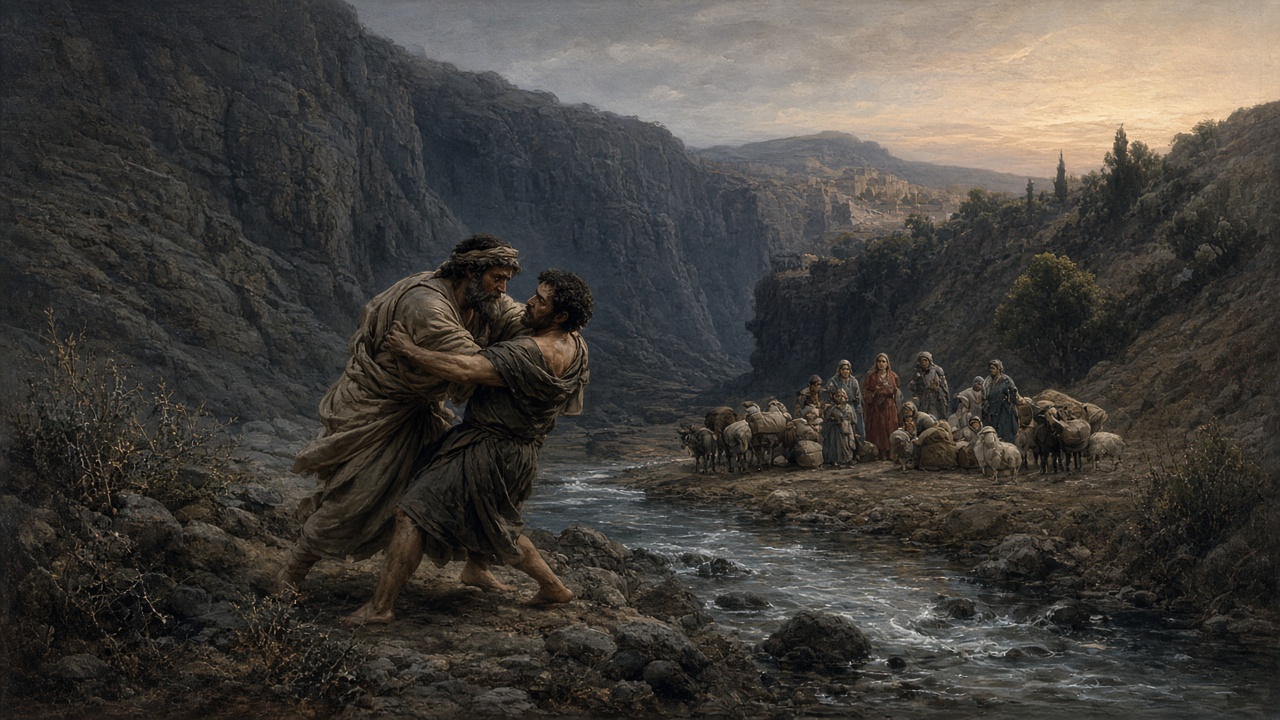
22N kayin ka nanlo Yakubu u ɗikai a̱ma̱ci e re a̱ ni, koɓolo n agbashi a̱ a̱ma̱ci e re a nanlo a m muku n ni kupa n vuza te, ɗa u pasai kuyene ku Jaboku. 23Ana u zuwai le a pasa kuyene ka koɓolo n ili i na wi n i ɗa dem. 24Yakubu wo okpoi endeꞋen; ɗa vuza u yongoi a kuyaꞋan mpolo n a̱yi ali sai kayin washi. 25Ana vuza va we enei wi a kufuɗa kulaꞋa utsura u ni ba, ɗa u gbashai Yakubu va a̱ ma̱kuta̱, ɗa ta na ugasatangi u ketele wa u sulamgbanai. 26Ɗaɗa u danai, <<YaꞋan m bana, kayin ki ta̱ a kasa.>>
Ama ɗa Yakubu u danai, <<Mi a̱ kuka̱sukpa̱ wu vu laza ba, sai vu zuwaka mu una̱singai.>>
27Ɗa vuza va we ecei, <<Yayi kula ku nu.>>
Ɗa wu ushuki, <<Mpa ɗa Yakubu.>>
28Ɗa vuza va u danai ni, <<Ili i na i ɗikai anana, kula ku nu ku buwa Yakubu ba. E kuɗeke wu ta̱ Isaraila, n tsa aza a Ibirahi kula ka ki ta̱ a kudana, vi yaꞋan ta̱ mpolo n Ka̱shile koɓolo kpamu n uma.>>
29Yakubu u danai vuza va, <<Mi ta̱ ufolu u nu dana mu kula ku nu.>>
Ama wu ushuki, <<Yiɗa̱i ɗa vi ecei kula ku va̱?>> Ɗa ta na u zuwakai ni ɗe una̱singai.
30Adama a nannai Yakubu u neꞋi ubuta̱ wa kula Peniyelu. U danai, <<Me ene ta̱ Ka̱shile a̱shi n a̱shi ama m buwa ta̱ ta na n wuma.>>
31Yakubu a̱ kuka̱sukpa̱ Peniyelu kanna ta na a kuɓatsa, a kuwala nu nsa̱ga̱ɗu adama a na ketele ka̱ ma̱kuta̱ ka̱ ni ka sulamgbanai ta̱. 32Ali a̱ kuta̱wa̱ anana, ntsukaya mi Isaraila a tsu takuma akawa e etele a na i punu a̱ ma̱kuta̱ ba, adama a na ta punu a gbashai Yakubu a akawa a nanlo a.
Did you know?
At the Jabbok, on the Way to Esau
- Mahanaim means “two camps.” Jacob gave that name to the place near the Jabbok, beyond the Jordan, when the angels of God met him and he said, “This is the camp of God.” There he also divided his people, flocks, herds, and camels into two camps, hoping one might escape if Esau attacked the other.Sources: Mahanaim · the Bible text itself
- The Jabbok, whose name is explained as “a pouring out, or a wrestling,” is a stream east of the Jordan. It joins the Jordan about midway between the Sea of Galilee and the Dead Sea, after a course of about 65 miles through a wild, deep ravine. At its ford Jacob sent his two wives, two maidservants, eleven sons, and all he owned across, then remained alone and wrestled with a man until daybreak.Sources: Jabbok · the Bible text itself
- Jacob sent messengers to Esau in the land of Seir, the country of Edom, calling him lord and himself a servant. Seir is a mountainous region along the east side of the Arabah, from the southeastern end of the Dead Sea toward Akabah, the eastern branch of the Red Sea; the Edomites occupied it, and it was allotted to Esau’s descendants. Esau, the firstborn twin and a hunter, had sold his birthright for red lentil stew and was also called Edom, “red,” while Jacob—whose name means “one who follows on another’s heels,” or “supplanter”—had conspired with his mother to deceive Isaac.Sources: the Bible text itself · Seir · Esau (Edom) · Jacob (Israel)
Notes written with AI assistance from open sources (Theographic Bible Metadata, CC BY-SA 4.0; Easton’s Bible Dictionary, public domain) and reviewed before publishing.
Places in this chapter
- Edom · 30.746, 35.604 · verse 3
- Jordan · Today: Jordan River · 31.761, 35.558 · verse 10
- Jabbok · Today: Zarqa River · 32.115, 35.543 · verse 22
Only places identified with high confidence are shown (90% or more according to the scholarly sources compiled by OpenBible). Period map: DARE (Digital Atlas of the Roman Empire), CC BY 4.0; modern map: © OpenStreetMap contributors; places: OpenBible.info (CC BY 4.0).
Credits and license for this translation
Cishingini Agwara Kambari [asg]
Cishingini: Cishingini Agwara Kambari [asg] (Bible)
copyright © 2025 Language Development and Translation Initiative (LDTI)
Language: (Cishingini)
Contributor: The Seed Company
This translation is made available to you under the terms of the
Creative Commons Attribution Share-Alike license 4.0.
You have permission to share and redistribute this Bible translation in any format and to make reasonable revisions and adaptations of this translation, provided that:
You include the above copyright and source information.
If you make any changes to the text, you must indicate that you did so in a way that makes it clear that the original licensor is not necessarily endorsing your changes.
If you redistribute this text, you must distribute your contributions under the same license as the original.
Pictures included with Scriptures and other documents on this site are licensed just for use with those Scriptures and documents.
For other uses, please contact the respective copyright owners.
Note that in addition to the rules above, revising and adapting God's Word involves a great responsibility to be true to God's Word. See Revelation 22:18-19.
2025-07-09
Source: http://ebible.org/asg/ · eBible.org