Genesis 16
Cishingini Agwara Kambari [asg] · Tap a verse to see its cross-references.
Hajara n IsumaꞋilu
1Vuka vu Iburam, Saraya, u matsaka yi muku ba. Ama vuka va wi ta̱ n kabara ka maku ma vuka, vuza va aza a Masar, kula ku ni ku ɗa Hajara. 2Ɗa Saraya u danai vali vi ni, <<Vuzavaguɗu u neꞋe mu limata ba. Yiɗa̱i i zuwai ɗa va kuvaku m maku mu usuki ma̱ va̱ ba? U gaꞋan ba, wi ta̱ a̱ kuciya̱ka̱ mu maku.>>
Iburam wu ushuki n ili i na Saraya u danai. 3Ana Iburam u yongoi a KanaꞋana ali a̱ya̱ kupa. Ɗa Saraya vuka vu Iburam u nekei ni kabara ka̱ ni Hajara u yaꞋan vuka vi ni vu gbani. 4Wa asai n Hajara, ɗa ta na u yaꞋin ka̱tsuma̱. Ana u yevei u ka̱na̱ ta̱ ka̱tsuma̱, ɗa u gita̱i kugoyo Saraya a̱na̱ku a kanna a̱ ni. 5Ɗaɗa Saraya u danai Iburam, <<Avu ɗa vu zuwai mu atakaci a na mi o kusoꞋo na. N zuwakai nu kagbashi ka̱ va̱ a̱ nkuta̱ n nu, gogo na a na u yevei u ka̱na̱ ta̱ ka̱tsuma̱, ɗa u goyoi mu. YaꞋan Vuzavaguɗu u yaꞋanka tsu afada a̱ tsu n avu.>>
6Iburam u danai, <<Maku mu usuki ma̱ nu mi ta̱ e ekiye a̱ nu. YaꞋanka yi ili i na ve enei i gaꞋin nu.>> Ɗaɗa Saraya u takacikai Hajara, ɗa ta na u sumai u ka̱sukpa̱i ni.
7Ɗa kalingata ka Vuzavaguɗu ka cinai Hajara ɗevu n kuyene a kakamba, kuyene ku na ki ɗevu n uye u na u banai Shuru. 8Ɗa kalingata ka danai, <<Hajara, kagbashi ka Saraya, te ɗai vu uta̱i, te ɗai kpamu vi a kubana?>> Wu ushuki, <<Mi ta̱ a kusuma a̱ ubuta̱ u vuza gbayin vu kunu vu va̱ Saraya.>>
9Ɗaɗa kalingata ka Vuzavaguɗu ka danai ni, <<Bono a̱ ubuta̱ u vuza gbayin vu kunu vu nu ka̱ta̱ kpamu vu tono yi.>> 10Ɗa kalingata ka ko doku ka danai kpamu, <<Mi ta̱ a kuzuwa ntsukaya n nu n yimkpa ali n laza kukece.>>
11Kalingata ka Vuzavaguɗu ka danai ni kpamu,
<<Gogo na vi ta̱ n ka̱tsuma̱ ka maku,
vi ta̱ a kumatsa maku mo kolobo.
Ka̱ta̱ vi neꞋi kula IsumaꞋilu,
adama a na Vuzavaguɗu u pana ta̱ una̱mgbi u ka̱tsuma̱ u nu.
12Wi ta̱ o kokpo majaki ma kakamba ma uma,
wi ta̱ a kuyaꞋan tsurala n yaba dem
ka̱ta̱ feu yaba dem u yaꞋan tsurala n a̱yi,
wi ta̱ o kuyongo endeꞋen
kau n aza a̱ ni ra̱ka̱.>>
13U neꞋi Vuzavaguɗu vu na u yaꞋin kadanshi n a̱yi kula ku nampa, <<Avu ɗa Ka̱shile ka na ke ci ene mu,>> adama a na u dana ta̱, <<Gogo na me ene ta̱ Ka̱shile ka na ke ci ene mu.>> 14I ɗaɗa i zuwai ɗa uma e ci ɗeke kayinva ka na ki e mere me Kadeshi m Biya-lahi-royi, <<Kayinva ka Vuza Wuma vu na u ce ene Mu.>>
15Hajara u matsakai Iburam maku, ɗa u neꞋi ni kula IsumaꞋilu. 16Iburam wi ta̱ n a̱ya̱ amanga̱na̱shi n a̱ ta̱li ana Hajara u matsakai ni IsumaꞋilu.
Did you know?
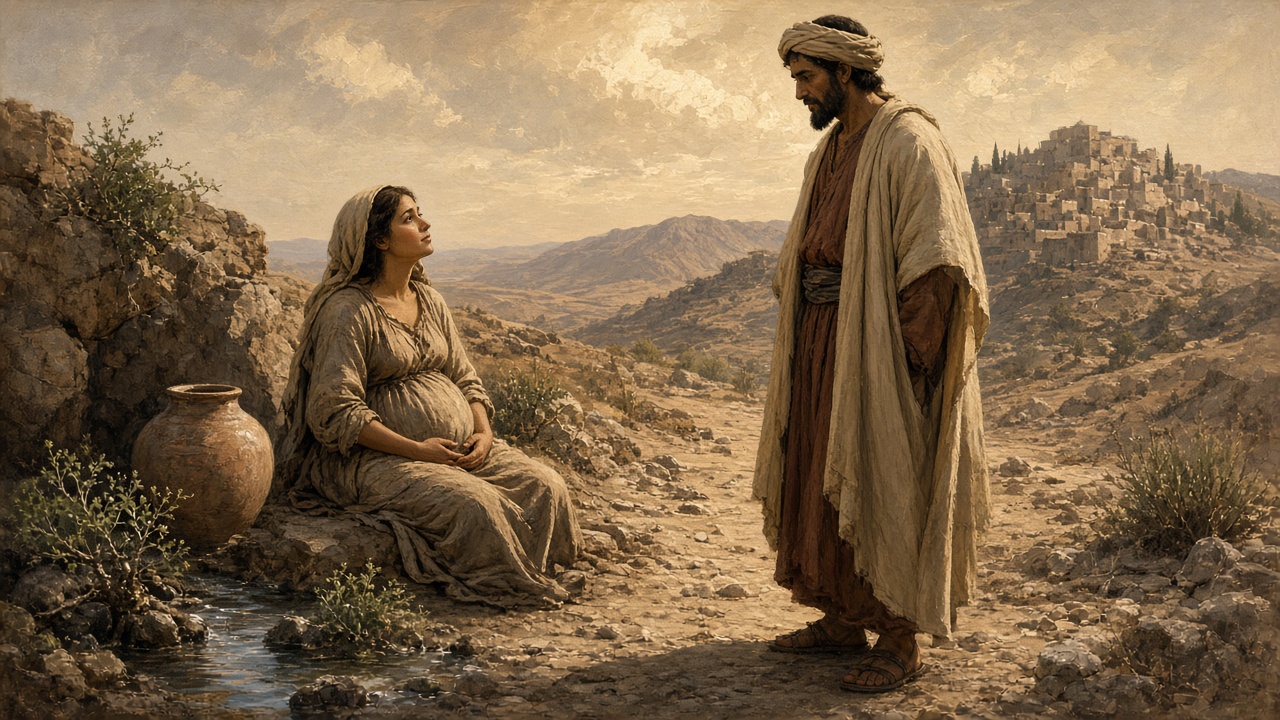
Hagar’s Flight and the Birth of Ishmael
- Hagar, an Egyptian maidservant of Sarai, bears a name understood to mean “flight,” or, according to others, “stranger.” After Abram had lived in Canaan for ten years, Sarai gave her to him as a secondary wife, hoping to build a family through her.Sources: Hagar · the Bible text itself
- When Sarai treated her harshly, Hagar fled along the road to Shur, through the desert that lay between her and Egypt, apparently intending to return to her relatives. The angel of the LORD found her by a spring of water there. Shur, meaning “wall,” was a wilderness on Egypt’s north-eastern border, probably named for frontier fortifications running from Pelusium to Heliopolis.Sources: the Bible text itself · Hagar · Shur
- Hagar called the LORD who spoke to her “the God who sees me,” and the well was named Beer-lahai-roi, “the well of the visible God,” between Kadesh and Bered, a town in the south of Palestine in the desert of Shur. She returned to Abram’s tent, and his eldest son, Ishmael, was born at Mamre when Abram was eighty-six; Abram gave him the name the angel had announced, because the LORD had heard her affliction.Sources: the Bible text itself · Hagar · Bered · Ishmael (Son of Hagar)
Notes written with AI assistance from open sources (Theographic Bible Metadata, CC BY-SA 4.0; Easton’s Bible Dictionary, public domain) and reviewed before publishing.
Places in this chapter
- Canaan · 32.767, 35.333 · verse 3
Only places identified with high confidence are shown (90% or more according to the scholarly sources compiled by OpenBible). Period map: DARE (Digital Atlas of the Roman Empire), CC BY 4.0; modern map: © OpenStreetMap contributors; places: OpenBible.info (CC BY 4.0).
Credits and license for this translation
Cishingini Agwara Kambari [asg]
Cishingini: Cishingini Agwara Kambari [asg] (Bible)
copyright © 2025 Language Development and Translation Initiative (LDTI)
Language: (Cishingini)
Contributor: The Seed Company
This translation is made available to you under the terms of the
Creative Commons Attribution Share-Alike license 4.0.
You have permission to share and redistribute this Bible translation in any format and to make reasonable revisions and adaptations of this translation, provided that:
You include the above copyright and source information.
If you make any changes to the text, you must indicate that you did so in a way that makes it clear that the original licensor is not necessarily endorsing your changes.
If you redistribute this text, you must distribute your contributions under the same license as the original.
Pictures included with Scriptures and other documents on this site are licensed just for use with those Scriptures and documents.
For other uses, please contact the respective copyright owners.
Note that in addition to the rules above, revising and adapting God's Word involves a great responsibility to be true to God's Word. See Revelation 22:18-19.
2025-07-09
Source: http://ebible.org/asg/ · eBible.org