Genesis 14
Cishingini Agwara Kambari [asg] · Tap a verse to see its cross-references.
Iburam wi isai Lotu
1Ayin a na ngono n na̱shi n nampa m banai kuvon: Amurafe mogono ma Shina, n Ariyo mogono me Elesa, n Kedaloma mogono me Elim, koɓolo n Tida mogono mo Goyim, 2A banai kuvon adama a na a lyaꞋa ngono n yoku: Bera mogono mo Sodom, m Bisha mogono mo Gomora, n Shinabu mogono ma Aduma, n Shemeba mogono ma Zeboyim, m mogono me Bela (ɗaɗa Zora). 3Ngono n nampa n foɓusoi ɗa o ɓolongi una̱ n aza o kuvon e le a̱ ka̱ra̱Ꞌa̱ ka Sidim, ubuta̱ u na gogo na wo okpoi Mala ma mkpaɗi. 4Ali a̱ya̱ kupa n e re ele o kutono kadanshi ka Kedaloma, ama a̱ ka̱ya̱ ka kupa n a tatsu ɗa a̱ kpa̱ɗa̱i kudoku kutono yi.
5A̱ ka̱ya̱ ka kupa n a̱ na̱shi, Kedaloma nu ngono ma o ɓolongi una̱ n a̱yi ɗa a banai a lyaꞋi aza a Refimu punu a̱ likuci i Ashatara Karanayim, aza a Zuzim a Ham, aza a Emimu a Shava Keritiya 6n aza o Horitu a nsasan n Siyaru, na lo va kpamu likuci i le i ɗa, ali sai ɗe El-param ɗevu n kakamba. 7A kpatalai ɗa o bonoi a En-mishafata (ɗaɗa Kadeshi), ɗa a lyaꞋi uɓon wa aza a Emeleki ra̱ka̱ n kuvon, koɓolo n aza a Amoriya ele na i o kuyongo a Hazazon-tamaru.
8Ɗaɗa mogono mo Sodom, m mogono mo Gomora, m mogono ma Aduma, m mogono ma Zeboyim m mogono ma Bela (ɗaɗa Zora) a̱ uta̱i ɗa a shamkpai ubuta̱ u kuvon u le a̱ ka̱ra̱Ꞌa̱ ka̱ Sidim 9adama a Kedaloma mogono ma Elim, Tidala mogono mo Goyim, Amurafe mogono ma Shina n Ariyo mogono ma Elesa. Ngono n na̱shi a̱ kushilika̱ nu ngono n tawun. 10Ka̱ra̱Ꞌa̱ ka̱ Sidim ki ta̱ n enle n a̱bunda̱i tukpa n kayala ka mapaɗaka ulima̱ an kopoti. Ana mogono mo Sodom n Gomora i a ilaɗi a̱ kuka̱sukpa̱ ubuta̱ u kuvon, uma o yoku a̱ yikpa̱i punu aza o yoku a sumai a banai a nsasan.
11Ngono n na̱shi n nanlo a isai ucanuku u Sodom n Gomora dem n ilikulyaꞋa i le dem, ɗaɗa a lazai. 12Ɗaɗa feu a ɗikai Lotu (maku ma vangu vi ni) Iburam, n ili i na wi n i ɗa dem, adama a na wi ta̱ ida̱shi o Sodom.
13Ama vuza na u fa̱ta̱tsa̱i u banai u danai Iburam vuza va aza a Ibirahi a̱yi na wi o kuyongo ɗevu nu nɗanga m gbagbaꞋin m Mamure va aza Amoriya. Mamure n aza a̱ ni Eshikolu n Aneru, o ɓolongi una̱ n Iburam ciya̱ a̱ ɓa̱nka̱na̱i. 14Ana Iburam u panai a ɗika ta̱ vuza ni Lotu a kubana ugbashi, ɗa u ɗikai uma o kuvon a̱ ni amangatawantatsu n kupa n kunla̱i (318), aza a na kpamu ta punu a matsai le a kpaꞋa. Ɗa a banai ɗa o tonoi le ali a kubana Dan. 15N kayin Iburam u pecuki uma a̱ ni ɗa u lyaꞋi le utsura ɗa wu unai le, a kiyangi le ali sai Hoba, gaɗi vu Dimaska. 16Ɗa wi isai ucanuku wa ra̱ka̱, u na a ɗikai va. Ɗa u bonoi n vuza ni Lotu, n vuka vi ni, n ili i na i buwai.
Malikisada u zuwakai Iburam una̱singai
17Ana Iburam u bonoi a̱ ubuta̱ u kuvon, a̱ ubuta̱ u na a lyaꞋi anan Kedaloma nu ngono n na mi ɗe dem, ɗa mogono mo Sodom wu uta̱i adama a na u cina yi a̱ Ka̱ra̱Ꞌa̱ ka Shava (ɗaɗa Ka̱ra̱Ꞌa̱ ko Mogono.)
18Ɗa Malikisada mogono ma Salem wu uta̱ka̱i m boroji koɓolo m ma̱kya̱n. A̱yi ta na vuma vu nanlo ganu vu Ka̱shile MalaꞋimili dem. 19Ɗa u zuwakai Iburam una̱singai, u danai,
<<Ka̱shile MalaꞋimili, u zuwaka ta̱ Iburam una̱singai,
Vuza na u yaꞋin gaɗi n iɗika, u zuwaka wu ta̱ Iburam una̱singai.
20Cikpa Ka̱shile MalaꞋimili,
vuza na kpamu u ka̱sukpa̱i irala i nu i uwai ekiye a̱ nu.>>
Ɗa Iburam u neꞋi ni ili i te a̱ ka̱tsuma̱ ki ili kupa.
21Mogono mo Sodom ma danai Iburam, <<Bonoko mu n uma a̱ va̱, avu ɗika ucanuku wa wo okpo u nu.>>
22Ama Iburam u danai mogono mo Sodom, <<N ɗengusa̱ ta̱ kukiye a kubana a̱ ubuta̱ u Vuzavaguɗu, Ka̱shile MalaꞋimili, vuza na u yaꞋin gaɗi n iɗika, n yaꞋan ta̱ kpamu akucina 23mi a kisa ili i nu ba, ko tsugbere ko kashiyatsu ka ataka, adama a na vu kpa̱ɗa̱ kufuɗa kudana, <Mpa ɗa n zuwai Iburam wo okpoi vuza vu uciyi.> 24Ma kuɗika ili adama a̱ ka̱ci ka̱ va̱ ba, ama sai ili i na uma a̱ va̱ a lyaꞋi ɗe koci. Ama ka̱sukpa̱ aza a̱ tsu a na o ɓolongi una̱, Ana, Eshikolu, m Mamure, a ɗika ugboku u le.>>
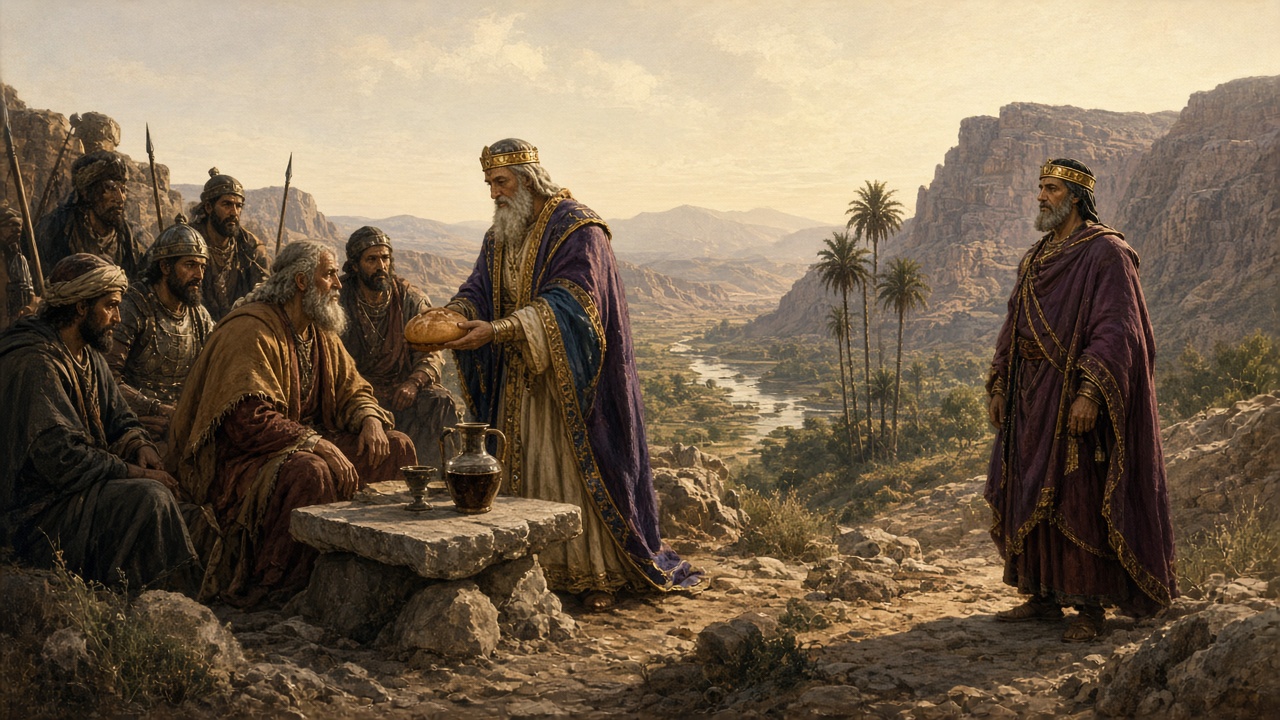
Did you know?
The Campaign of the Four Kings
- Easton's Bible Dictionary (1897) identifies the four invading kings with names on ancient inscriptions: Chedorlaomer with Khudur-Lagamar of Elam, Amraphel with Khammu-rabi of Shinar (southern Chaldea), Arioch, king of Ellasar, with Eri-Aku of Larsa, and Tidal with Tudkhula. It explains Eri-Aku as an Elamite name meaning “servant of the moon-god,” later changed to Rimsin, and takes Goiim—“nations”—as Gutium, east of the Tigris and north of Elam.Sources: Chedorlaomer · Amraphel · Arioch (king of Ellasar) · Tidal
- The five local kings drew up for battle in the Valley of Siddim, which this chapter equates with the Salt Sea, and the valley was full of tar pits into which some of the fleeing men fell. Easton's Bible Dictionary places that valley at the south end of the Dead Sea, between Engedi and the cities of the plain, and calls the pits bitumen pits.Sources: the Bible text itself · Vale of Siddim
- Abram lived near the oaks of Mamre the Amorite, a brother of Eshcol and Aner, and the three were bound by treaty to him. Easton's Bible Dictionary calls Mamre and Eshcol Amorite chiefs and Aner a Canaanite chief, and notes that they joined Abram in pursuing Chedorlaomer and recovering Lot.Sources: the Bible text itself · Mamre · Eshcol · Aner
Notes written with AI assistance from open sources (Theographic Bible Metadata, CC BY-SA 4.0; Easton’s Bible Dictionary, public domain) and reviewed before publishing.
Places in this chapter
- Elam · 32.189, 48.258 · verses 1, 9
- Shinar · Today: Babylonia · 32.543, 44.422 · verses 1, 9
- Salt Sea · Today: Dead Sea · 31.500, 35.500 · verse 3
- Shaveh-kiriathaim · Today: within 1 km of Al Qurayyat · 31.541, 35.686 · verse 5
- Dan · Today: Tel Dan · 33.249, 35.652 · verse 14
- Damascus · 33.511, 36.306 · verse 15
- Valley of Shaveh · Today: intersection of Kidron Valley and Valley of Hinnom · 31.767, 35.236 · verse 17
- Salem · Today: Jerusalem · 31.777, 35.234 · verse 18
Only places identified with high confidence are shown (90% or more according to the scholarly sources compiled by OpenBible). Period map: DARE (Digital Atlas of the Roman Empire), CC BY 4.0; modern map: © OpenStreetMap contributors; places: OpenBible.info (CC BY 4.0).
Credits and license for this translation
Cishingini Agwara Kambari [asg]
Cishingini: Cishingini Agwara Kambari [asg] (Bible)
copyright © 2025 Language Development and Translation Initiative (LDTI)
Language: (Cishingini)
Contributor: The Seed Company
This translation is made available to you under the terms of the
Creative Commons Attribution Share-Alike license 4.0.
You have permission to share and redistribute this Bible translation in any format and to make reasonable revisions and adaptations of this translation, provided that:
You include the above copyright and source information.
If you make any changes to the text, you must indicate that you did so in a way that makes it clear that the original licensor is not necessarily endorsing your changes.
If you redistribute this text, you must distribute your contributions under the same license as the original.
Pictures included with Scriptures and other documents on this site are licensed just for use with those Scriptures and documents.
For other uses, please contact the respective copyright owners.
Note that in addition to the rules above, revising and adapting God's Word involves a great responsibility to be true to God's Word. See Revelation 22:18-19.
2025-07-09
Source: http://ebible.org/asg/ · eBible.org