Ezra 6
Cishingini Agwara Kambari [asg] · Tap a verse to see its cross-references.
Mogono Dariyu u nekei kadanshi a̱ gita̱ kumaꞋa ka
1Ɗa mogono Dariyu u nekei kadanshi, a bana a̱ la̱na̱ a̱ kunu ka atagarda a tsumani a na i a Babila a̱ ubuta̱ u na a zuwai atagarda a tsumani o tsugono. 2Ama a Ekabatana likuci i gbayin i na yi uɓon u Midiya ta ɗe a ciya̱i katagarda ka̱ uka̱ta̱li ko yoku n iɗani i nampa ya, <<Ili i kuciɓasa. 3A̱ ka̱ya̱ ka̱ ugiti ko tsugono tsu Sayiru, u nekei kadanshi adama a KpaꞋa ku Ka̱shile ku na ki a Urushelima. U nekei kadanshi o doku a maꞋasaka KpaꞋa ka, ubuta̱ u na a kuyaꞋansa alyuka. YaꞋan a vara kumiꞋi ku kumaꞋa ka, uɗa̱ngi u kumaꞋa wa u yawa udashi amanga̱na̱shinkupa washi u ni kpamu u yawa amanga̱na̱shinkupa. 4Na ɗa tsu na a kumaꞋa kasaka ka. I ta̱ e kukiyangu atali gbagbain a na a sheꞋwei uwalaki ku tatsu, ka̱ta̱ a kiyangu nɗanga uwalaki ku te. A̱ ubuta̱ u kazuwi ka kpaꞋa ku mogono maꞋa a kutakpa ikebe i kutsupa ulinga wa. 5Kpamu ucanuku wa azanariya n azurufa u na Nebukadnezaru u pura̱i A̱Ꞌisa̱ a gbayin a na i a Urushelima ɗa u tuka̱i a Babila. I ta̱ o kubonoko n uɗa a̱ ubuta̱ u na wi ishi A̱Ꞌisa̱ a gbayin a Urushelima. I ta̱ a ku zuwa uɗa a KpaꞋa ku Ka̱shile.>>
6<<Ɗa mogono Dariyu ushuki u danai, akaka a kubana u Tatenayi gomuna vu uɓon wu upashi u kuyene ku Yufiretu n Shetaru-bozenayi n a̱ɗa̱ na yi a̱ja̱Ꞌa̱ e le, nkoshi n gba̱ra̱-gba̱ra̱ mu uɓon kapashi ka kuyene ku Yufiretu, a̱ ɗa̱nga̱ lo. 7Takpai ekiye a̱ɗa̱ a̱ ubuta̱ wu ulinga u KpaꞋa ku Ka̱shile ka adama a na ulinga wa u lyaꞋa kelime. Ka̱sukpa̱i gomuna vu Yahuda nu nkoshi m gba̱ra̱-gba̱ra̱ n le a maꞋasaka KpaꞋa ku Ka̱shile ka a̱ ubuta̱ u na ku ɗa ki ishi. 8Nannai ɗa koci ba, n neke ta̱ kadanshi i yaꞋan tsu na i kuyaꞋan dem i ɓa̱nka̱ nkoshi m gba̱ra̱-gba̱ra̱ ma aza a Yahuda adama a na a maꞋasaka KpaꞋa ku Ka̱shile ka. A tsupa uma a nanlo ikebe yi ulinga i le uta̱ka̱ punu ikebe ya a̱ ubuta̱ u kuzuwa ku kpaꞋa ku mogono, ikebe yi utafu i na isai uɓon kapashi ke kuyene ku Yufiretu. A tsupa le mayin ka̱ta̱ a ɗika makyan ba. 9I neke anan ganu a na i a Urushelima ili i na a cigai a kanna dem ka̱ta̱ i taɗa ba. I neke le mbomburon ko a̱giri ko nkyon adama a alyuka o kusongu a̱ Ka̱shile ka gaɗi. I neke le alkama ko mkpaɗi ko ma̱kya̱n ko maniꞋin ma zaitu. 10Adama a na a yaꞋan alyuka asingai u Ka̱shile ka gaɗi, ka̱ta̱ kpamu a yaꞋan avasa adama o mogono n muku n ni. 11Kpamu n dana ta̱ vuza na baci u kpa̱ɗa̱i kutono wila̱ u nampa, i ta̱ a kutakpa maɗanga a kpaꞋa ku ni, ka̱ta̱ e sheꞋwe maꞋa, ka̱ta̱ o sovo yi n maꞋa ali ma uta̱i n tsu nan ɗe a i kyamba i ni. Kpamu i ta̱ a ku na kpaꞋa ku ni ra̱ka̱-ra̱ka̱. 12YaꞋan Ka̱shile ka na ka zuwai kula ku ni a Urushelima, u takpa mogono dem ko uma a na i a kuciga ku sabaꞋa wila̱ u nampa ko a̱ la̱nga̱sa̱ KpaꞋa ku Ka̱shile a Urushelima. Mpa mogono Dariyu n zuwa ta̱ wila̱ u nampa, yaꞋan yaba dem u tono u ɗa mayin.>>
Erengi A̱Ꞌisa̱ a gbayin
13Ɗa Tatenayi gomuna vu uɓon kapashi ke kuyene ku Yufiretu, n Shetaru-bozenayi n a̱ja̱Ꞌa̱ e le o tonoi wila̱ u na mogono Dariyu u zuwakai le mayin. 14Ta nkoshi m gba̱ra̱-gba̱ra̱ n Yahuda a lyaꞋi kelime n kumaꞋa n ciya̱i utsura u ka̱ɗu adama e kene ku na Hagai n Zakariya maku Ido a yaꞋin. O kotsoi kumaꞋa ka tsu na Ka̱shile ki Isaraila ka danai Sayiru n Dariyu n Atazesu kpamu, ngono m Pashiya. 15O kotsoi kumaꞋa ka̱ A̱Ꞌisa̱ a gbayin ka a kanna ka tatsu ko wotoi u tatsu, a̱ ka̱ya̱ ka̱ ta̱li ko tsugono tsu Dariyu mogono.
16Ɗa aza a Isaraila, n anan ganu n aza e Levi n kagimi ka uma a na o bonoi n ugbashi a yaꞋin ka̱ɗiva̱ ke kerengu ku KpaꞋa ku Ka̱shile n ma̱za̱nga̱. 17A̱ ka̱ɗiva̱ ke kerengu ku KpaꞋa ku Ka̱shile ka, uma a yaꞋin alyuka n obomburon amangatawun (100), n a̱giri amangatawenre (200), n muku mu nkyon amangatawuna̱na̱shi (400). Ɗa kpamu e nekei nga̱ji kupa n re adama e kuneꞋe ku kutakpa unushi a̱ ka̱ɗu ka yaba dem a Isaraila. 18Ɗa e peciki anan ganu n aza e Levi ka̱tsura̱-ka̱tsura̱ adama a ulinga u Ka̱shile a Urushelima, tsu na wi a uɗani a katagarda ka Musa.
Ka̱ɗiva̱ ka Kupasamgbanai
19A kanna ka kupa n ka̱ na̱shi ko wotoi u iyain, ɗa uma o bonoi n ugbashi a yaꞋin Ka̱ɗiva̱ ka Kupasamgbanai. 20Adama a na anan ganu n aza e Levi ra̱ka̱ a takpaka ta̱ ɗe ka̱ci ke le nshinda̱, ra̱ka̱ vi le okpoi ciɗa. Ɗa aza e Levi a kiɗai ma̱giri ma̱ Ka̱ɗiva̱ ka Kupasamgbanai adama a aza a na o bonoi n ugbashi, n adama aza e le anan ganu n adama a̱ ka̱ci ke le kpamu. 21Uma a Isaraila a na o bonoi n ugbashi, koɓolo n aza a na e pecei ka̱ci ke le n ukuna wu unata wu uduniyan u na wi ida̱shi a iɗika ya, adama a na o tono Vuzavaguɗu Ka̱shile ki Isaraila a takumai ma̱giri ma̱ Ka̱ɗiva̱ ka Kupasamgbanai ka. 22Ɗa kpamu a yaꞋin ka̱ɗiva̱ ko Boroji vu na vi n yisiti ba ali ayin e cindere ele a̱ ma̱za̱nga̱, adama a na Vuzavaguɗu u zuwa le ta̱ a yaꞋan ma̱za̱nga̱ a na u vadalukpai ka̱ɗu ko mogono ma Asiriya we e le, adama a na u ɓa̱nka̱ le ta̱ ulinga u kumaꞋa KpaꞋa ku Ka̱shile, Ka̱shile ki Isaraila.
Did you know?
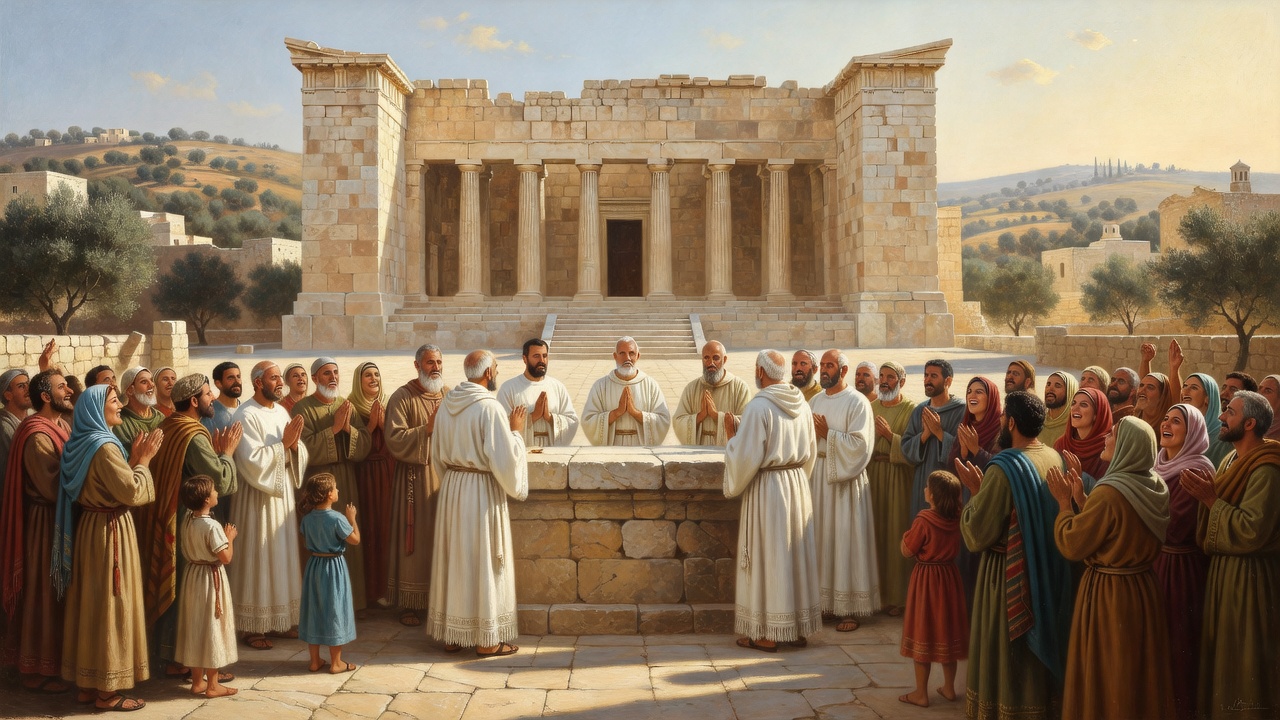
Completion and Dedication of the Temple
- Although King Darius ordered a search of the treasury archives in Babylon, the original decree of Cyrus authorizing the rebuilding of the temple was discovered in the fortress of Ecbatana in the province of Media, where Cyrus maintained a royal residence.Sources: the Bible text itself · Ecbatana
- Tattenai, the Persian governor of the region west of the Euphrates who had investigated the building project, was commanded by Darius to fully fund the construction and provide sacrificial animals daily from the imperial taxes collected in his province.Sources: the Bible text itself · Tatnai
- The temple was completed in the sixth year of Darius through the prophetic ministry of Haggai and Zechariah, and its dedication was celebrated with joyful sacrifices, including twelve male goats representing all the tribes of Israel.Sources: the Bible text itself · Haggai · Zechariah
Notes written with AI assistance from open sources (Theographic Bible Metadata, CC BY-SA 4.0; Easton’s Bible Dictionary, public domain) and reviewed before publishing.
Places in this chapter
- Babylonia · 32.543, 44.422 · verse 1
- Ecbatana · Today: Tell Hagmatana · 34.806, 48.516 · verse 2
- Media · 34.806, 48.516 · verse 2
- Jerusalem · 31.777, 35.234 · verses 3, 5, 9, 12, 18
- Babylon · 32.543, 44.422 · verse 5
- Beyond the River · 31.777, 35.234 · verses 6, 8, 13
- Euphrates · Today: Euphrates River · 31.004, 47.442 · verse 6
- Persia · 34.806, 48.516 · verse 14
- Assyria · 36.359, 43.153 · verse 22
Only places identified with high confidence are shown (90% or more according to the scholarly sources compiled by OpenBible). Period map: DARE (Digital Atlas of the Roman Empire), CC BY 4.0; modern map: © OpenStreetMap contributors; places: OpenBible.info (CC BY 4.0).
Credits and license for this translation
Cishingini Agwara Kambari [asg]
Cishingini: Cishingini Agwara Kambari [asg] (Bible)
copyright © 2025 Language Development and Translation Initiative (LDTI)
Language: (Cishingini)
Contributor: The Seed Company
This translation is made available to you under the terms of the
Creative Commons Attribution Share-Alike license 4.0.
You have permission to share and redistribute this Bible translation in any format and to make reasonable revisions and adaptations of this translation, provided that:
You include the above copyright and source information.
If you make any changes to the text, you must indicate that you did so in a way that makes it clear that the original licensor is not necessarily endorsing your changes.
If you redistribute this text, you must distribute your contributions under the same license as the original.
Pictures included with Scriptures and other documents on this site are licensed just for use with those Scriptures and documents.
For other uses, please contact the respective copyright owners.
Note that in addition to the rules above, revising and adapting God's Word involves a great responsibility to be true to God's Word. See Revelation 22:18-19.
2025-07-09
Source: http://ebible.org/asg/ · eBible.org