Exodus 27
Cishingini Agwara Kambari [asg] · Tap a verse to see its cross-references.
Katalikalyuka ko Kusonku ili i KuneꞋe
1<<Vi yaꞋan katalikalyuka ka m maɗanga ma megele, ugaɗi u ni u yawa udashi u cindere n kagimi, wanshi kpamu nannai udashi u cindere n kagimi. Uɗa̱ngi u ni u yaꞋan udashi u na̱shi n kagimi, wanshi n ugaɗi u katalikalyuka ka u yaꞋan feu derere. 2Vi yaꞋan avana a ngon n na̱shi n ni dem, adama a na avana a o okpo umatyangbani ubuta̱ u te punu n katalikalyuka ka, ka̱ta̱ vu kuma kaꞋa n vuyum vi shili. 3Vu maꞋa mgbodo n na a̱ ku tsuwa̱nsa̱ka̱ kokomo ka katalikalyuka ka, n ikenekpetsu ya akina, n apara, n ikaɓatsu, n a̱mbu a̱ kupura̱ka̱ cikina, ili i nampa ya a yaꞋan i ɗa n iyum i shili. 4Ka̱ta̱ vi yaꞋan katalikalyuka n kazatsu n viyum vi shili, ɗe atusu a ka̱ta̱ vu uka nkawani mi iyum i shili n na̱shi adama a ngon n na̱shi n katalikalyuka ka. 5Vu zuwa kazatsu ɗaka, adama a na u pala katalikalyuka ka kagimi. 6Vi yaꞋan alangu a̱ kuɓa̱na̱ka̱ katalikalyuka ka m maɗanga ma megele vu kuma maꞋa n viyum vi shili. 7Vu uka alangu a punu a nkawani ma, akambu e re dem adama a na a̱ ciya̱ a yaꞋanka ulinga a ayin a na baci i a kuɗika katalikalyuka ka. 8Vi yaꞋan katalikalyuka ka n kungu nu nɗanga n na e sheꞋwei n na mi wanshi, ka̱ta̱ vu yaꞋan tsa akpati vu na vi n ka̱ɓa̱ya̱mkpa̱tsu ba, tsu na n yotsonki nu a kusan ka.
Ulanga u Ma̱va̱li ma kuciɓa n Ka̱shile
9<<Ka̱ta̱ vi yaꞋan Ulanga u Ma̱va̱li ma kuciɓa n Ka̱shile ma, a saku ɗe kakashi ka na a yaꞋin n arikinlai n tsugbere tsu singai tsa. A uɓon u ɗaka kpamu ugaɗi u kakashi wa u yawa udashi amangatawun (100), 10ka̱ta̱ a saku ɗe akashi a a̱ nshikpu mi iyum i shili kamanga, aza a na a zuwai a anci e le a na a yaꞋin n iyum i shili a na i kamanga feu. Vu saku akashi a̱ utsutsu a nu nroki n na a yaꞋin n azurufa koɓolo nu nkawani. 11Ta kpamu i kuyaꞋan nannai n tsu gaɗi a kakashi ka na a kusaku va, ka yaꞋan udashi amangatawun n amangerenkupa (150), nu nshikpu kamanga, ida̱sa̱mkpa̱tsu i le a yaꞋan i ɗa n iyum i shili kamanga feu. Nkawani n awin, a yaꞋan a ɗa n azurufa.
12<<N tsu ukocishi u ka̱livi u kakashi wa wanshi u ni u yaꞋan udashi amangatatsunkupa n u tawun n nshikpu kupa n ida̱sa̱mkpa̱tsu kupa feu a yaꞋan a ɗa n azanariya. 13N uɓon u kasana a̱ ubuta̱ u na utsutsu wi, udashi u yawa amangatatsunkupa n u tawun. 14Akashi a kakambu ke te ku utsutsu ka ugaɗi u ni u yawa udashi kamanga n u re n kagimi, ka̱ta̱ i saku ɗe kaꞋa a ashamkpatsu a tatsu ka̱ta̱ i kiyangu le a̱ ida̱sa̱mkpa̱tsu i tatsu ya. 15Ta kpamu nannai n kakambu ka nan ɗe. Ukambu u re wu utsutsu wa, a saku ɗe akashi a na i n ugaɗi u na u yawai udashi kamanga n u re n kagimi koɓolo n ashamkpatsu a tatsu n ida̱sa̱mkpa̱tsu a tatsu feu. 16A utsutsu u kuꞋuwa a ulanga u Ma̱va̱li ma kuciɓa n Ka̱shile ma, ugaɗi u ni u yawa udashi kamangankupa. Ka̱ta̱ a yaꞋan kakashi n arikinla n tsugbere tsu na ci tsu mini mu usuni, n tsu na ci yotsoi mini ma garula, n tsu mini ma̱ ma̱ɗiya̱, n tsugbere tsa akaɗa. Ka̱ta̱ a caꞋa n igani, ka̱ta̱ a saku ɗe kaꞋa a yaꞋanka le ashamkpatsu a̱ na̱shi n ida̱sa̱mkpa̱tsu i na̱shi. 17Ashamkpatsu ra̱ka̱ a na a̱ ka̱ra̱Ꞌi a ulanga u Ma̱va̱li ma kuciɓa n Ka̱shile ma, ka̱ta̱ a shiya le n awin a azurufa. Okoɓotsu e le o okpo a na a yaꞋan n azurufa feu, ida̱sa̱mkpa̱tsu yo okpo i na a yaꞋin n iyum i shili. 18Ugaɗi wu ulanga wu uteku u Ma̱va̱li wa ra̱ka̱ u yawa udashi amangatawun n amangerenkupa (150), wanshi u ni u yaꞋan udashi amangatatsunkupa n u tawun, kashani ka̱ ni ka yawa ubapi u cindere n kagimi. Ka̱ta̱ a̱ ka̱ra̱ka̱ uteku wu uba̱nga̱ wa n kakashi ka na a yaꞋin n arikinla a singai, n anci a̱ iyum e le. 19Ucanuku u na a kuyaꞋanka ulinga u Ma̱va̱li wa dem, n aguta a na a̱ kushukpa̱ka̱ Ma̱va̱li ma, a uteku wu ulanga u Ma̱va̱li wa feu a yaꞋan i ɗa n iyum i shili.
ManiꞋin adama a̱ Ma̱kuni
20<<Vu dana muku mi Isaraila a̱ tuka̱ m maniꞋin ma zaitu ma na a pishai mayin adama a kutasukusu ma̱kuni ma ayin tutu. 21Ka̱ta̱ i zuwa kashamkpatsu ka̱ ma̱kuni a̱ ubuta̱ u Ma̱va̱li mo Oɓolo wa n tsu pulai tsu kakashi ka na a palakai Akpati vu Uzuwakpani vu na vi a̱ ubuta̱ u ciɗa wa. Haruna m muku mo olobo n ni, ele ɗa a̱ kula̱na̱ ma̱kuni ma akina ma kanna n kayin dem, adama a na mo yongo a kakana e kelime ka Vuzavaguɗu. Na va ɗaɗa wila̱ u uma Isaraila, i tono u ɗa ali nu ntsukaya n na i kumatsa.
Did you know?
The bronze altar, the courtyard, and the lamps
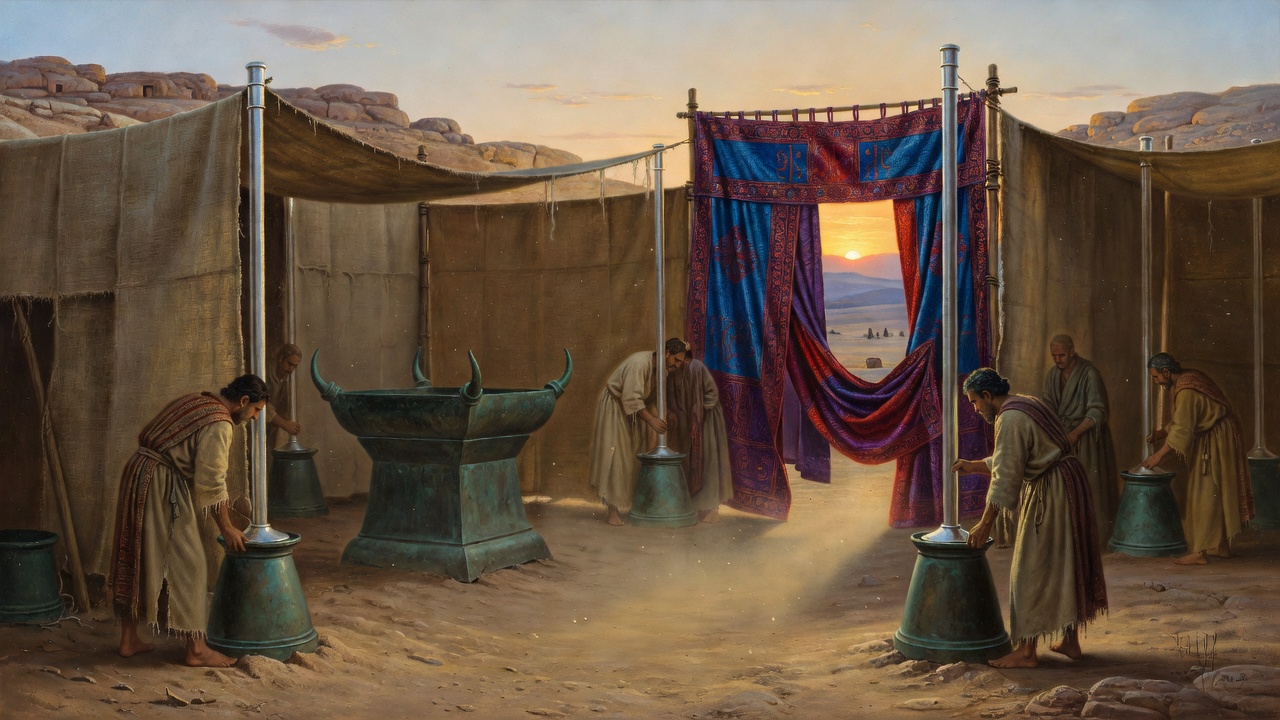
- This chapter calls for a square altar of acacia wood, five cubits long, five cubits wide, and three cubits high, with a horn on each of its four corners, the horns of one piece, and the altar overlaid with bronze. It was to be built hollow, of boards, with a bronze-mesh grate set beneath a ledge so that the mesh came halfway up, and with poles of acacia wood overlaid with bronze, inserted into rings so the altar could be carried. All its utensils—pots for removing ashes, shovels, sprinkling bowls, meat forks, and firepans—were to be bronze, and the altar was to be made just as shown on the mountain.Sources: the Bible text itself
- The courtyard of the tabernacle was to be a hundred cubits long and fifty cubits wide, with curtains of finely spun linen five cubits high. The south and north sides, each a hundred cubits long, were to have twenty posts and twenty bronze bases, with silver hooks and bands; the west side, fifty cubits wide, was to have ten posts and ten bases. The east side, toward the sunrise, was also fifty cubits wide, with a twenty-cubit gate curtain embroidered with blue, purple, and scarlet yarn and finely spun linen, on four posts, and with curtains of fifteen cubits on either side.Sources: the Bible text itself
- The Israelites were to bring pure oil of pressed olives for the light, so that the lamps would keep burning continually. In the Tent of Meeting, outside the veil in front of the Testimony, Aaron and his sons were to tend the lamps before the LORD from evening until morning, a permanent statute for the Israelites for the generations to come. Aaron, eldest son of Amram and Jochebed, was born in Egypt three years before his brother Moses, and by Elisheba, daughter of Amminadab of the house of Judah, whom he married, he had four sons: Nadab, Abihu, Eleazar, and Ithamar.Sources: the Bible text itself · Aaron
Notes written with AI assistance from open sources (Theographic Bible Metadata, CC BY-SA 4.0; Easton’s Bible Dictionary, public domain) and reviewed before publishing.
Credits and license for this translation
Cishingini Agwara Kambari [asg]
Cishingini: Cishingini Agwara Kambari [asg] (Bible)
copyright © 2025 Language Development and Translation Initiative (LDTI)
Language: (Cishingini)
Contributor: The Seed Company
This translation is made available to you under the terms of the
Creative Commons Attribution Share-Alike license 4.0.
You have permission to share and redistribute this Bible translation in any format and to make reasonable revisions and adaptations of this translation, provided that:
You include the above copyright and source information.
If you make any changes to the text, you must indicate that you did so in a way that makes it clear that the original licensor is not necessarily endorsing your changes.
If you redistribute this text, you must distribute your contributions under the same license as the original.
Pictures included with Scriptures and other documents on this site are licensed just for use with those Scriptures and documents.
For other uses, please contact the respective copyright owners.
Note that in addition to the rules above, revising and adapting God's Word involves a great responsibility to be true to God's Word. See Revelation 22:18-19.
2025-07-09
Source: http://ebible.org/asg/ · eBible.org