1 Samuel 6
Cishingini Agwara Kambari [asg] · Tap a verse to see its cross-references.
Aza a Filisitiya o bonokoi n akpati vu uzuwakpani
1Ana akpati vu uzuwakpani vu Vuzavaguɗu vi yaꞋin wotoi u cindere, a̱ likuci ya aza a Filisitiya. 2Ɗa aza a Filisitiya e ɗekei oɓolo a anan ganu va̱ a̱ma̱li vi le n oboci, ɗa e ecei le a danai, <<Yiɗa̱i tsa kuyaꞋan n akpati vu uzuwakpani vu Vuzavaguɗu va? Danai tsu tsu na tso kubonoko n vu ɗa a̱ ubuta̱ u na vi ishi?>> 3Ɗa uma a a̱ ushuki, <<Yi baci o kubonoko n akpati vu Ka̱shile ki Isaraila va, i bonoko vu ɗa ekiye agaɗa ba. I yaꞋan tsu na i kuyaꞋan i suku vu ɗa n kuneꞋe ka alyuka a̱ unushi, nannai ɗa i kupotso ka̱ta̱ i yeve i na i zuwai ɗa wi a kutakacika ɗa̱.>> 4Ɗa aza a Filisitiya a ecei, <<IcuꞋu i kuneꞋe ku unushi ye ne i ɗai tsa̱ kusuku a kubana wa̱ ni?>>
Ɗa oboci a n anan ganu a̱ ushuki a danai, <<YaꞋin iyoci yi mɓa̱la̱ ma amici ya azanariya i tawun, tsu ka̱bunda̱i ka ngono ma aza a Filisitiya, adama a na ma̱dukpa̱ me te maꞋa ma lapai ɗa̱ n ele dem. 5I yaꞋan kpamu ili i tawun n iyoci yi mɓa̱la̱ ma amici koɓolo n iyoci ya abana, ele vu na a̱ la̱nga̱sa̱i iɗika i ɗa̱, ta i kuneke Ka̱shile ka aza a Isaraila tsugbayin nannai. U gaꞋan ba, wi ta̱ a̱ kuka̱sukpa̱ kuneke ɗa̱ atakaci n a̱ma̱li a̱ ɗa̱ n iɗika i ɗa̱ feu. 6Yiɗa̱i i zuwai ɗa yi ugbamukaci tsu na aza a Masar n FiriꞋauna a yaꞋin? Sai na Ka̱shile ka takacikai le wuya-wuya, ɗa yeve a̱ ka̱sukpa̱i aza a Isaraila a yaꞋin nwalu n le. 7Gogo na yaꞋin keke va anaka vu savu, i ciya̱ anaka e re a na i e kuneke ndendem mani, aza ana ka̱ta̱ a saꞋwai kushiya ka kogboro ba, i shiyaka anaka a keke va, ama ka̱ta̱ i shiya ndendem ma a kpaꞋa. 8Ɗikai akpati vu uzuwakpani vu Vuzavaguɗu va, i zuwa vu ɗa a gaɗi vu keke va, i zuwa feu iyoci ya amici n iyoci ya abana punu akpati o yoku. Ka̱ta̱ i suku ili i nanlo ya koɓolo n vu ɗa, adama a kuyaꞋan kuneꞋe ku unushi. Yi uta̱ka̱ vu ɗa a uye i ka̱sukpa̱ keke va vu wala endeꞋen ni a kubana ɗe, 9ka̱ta̱ i la̱na̱. Vu laza baci a kubana a iɗika i Betu-shemeshi na lo wi ta̱ a kudana tsu Vuzavaguɗu Ka̱shile ka aza a Isaraila kaꞋa ki a kutakacika tsu. Ama ili i yaꞋan baci nannai ba, ɗaɗa tsa kuyeve an a̱yi ɗa u nekei tsu atakaci ba, ayin a ɗa de a̱ ta̱wa̱i nannai.>>
10Ɗa uma a a yaꞋin tsu na a danai le, ɗa a̱ ciya̱i anaka e re ɗa a shiyakai le keke va, ɗa a̱ ka̱na̱i ndendem ma a shiyai a kpaꞋa. 11Ɗa a zuwai akpati vu uzuwakpani punu e keke va, n akpati vu iyoci ya abana a zinariya n mɓa̱la̱ ma amici ma. 12Ɗa anaka a a̱ ka̱na̱i uye a kubana a Betu-shemeshi o tonoi uye wa mejege, a ɓatsa ugula̱ ko usingai ba. Ɗa a walai n a̱ shika̱i. Ɗa ngono ma aza a Filisitiya ma n tonoi le ali a yawai kureꞋe ki iɗika i le n Betu-shemeshi. 13A ayin a nanlo aza Betu-shemeshi a vikyaꞋa vu alkama vi le a̱ ka̱ra̱Ꞌa̱. Ana a̱ ɗa̱ngusa̱i aci e le ɗa e enei akpati vu uzuwakpani vu Vuzavaguɗu, ɗa a̱ ka̱na̱i ma̱za̱nga̱ ana e enei vu ɗa. 14Ana keke va anaka va vi yawai a kashina ka Jesuwa vuza va aza a Betu-shemeshi, ɗa a shamgbai lo ɗevu n kakpanlai. Ɗa aza a na i lo a̱ ubuta̱ wa ɗa a ɓatsai kogboro ka keke ka, ɗa a kiɗai anaka a o songi le tsa alyuka o kusongu u Vuzavaguɗu. 15Ɗa anan Levi a ɗikai akpati vu uzuwakpani vu Vuzavaguɗu va koɓolo n akpati vu na a zuwai punu iyoci yi ili i na a yaꞋin n azanariya, ɗa a zuwai a gaɗi vu kakpanlai. Ɗa uma a Betu-shemeshi e nekei kuneꞋen ku kusongu ku le n alyuka o yoku u Vuzavaguɗu a kanna ka nanlo. 16Ana ngono n tawun ma aza a Filisitiya n kotsoi kinda le a kuyaꞋan ili i nampa, ɗa a lazai o kubono a̱ likuci i le e Ekoron a kanna ka nanlo.
17Aza a Filisitiya a̱ suki ili yi iyoci yi mɓa̱la̱ ma amici i tawun ya azanariya a na a yaꞋin va, adama a na e neke Vuzavaguɗu kuneꞋe ciya̱ a cinukpa n unushi u le. KuneꞋe ku te dem adama a̱ likuci i te, ku te adama a Ashidodu, ku te adama Gaza, ku te adama Ashikelon, ku te adama Gatu, ku te kpamu adama Ekoron. 18Ɗa a̱ suki kpamu abana a na a yaꞋin n azanariya, ke te dem a una̱ u likuci u na ngono n tawun ma aza a Filisitiya i o tsugono, likuci i na yi ukanji n i wawaꞋa i na yi babu ukanji feu. Kakpanlai ka gbayin ka na ki a kashina ka Jesuwa vuza vu Betu-shemeshi, a̱ ubuta̱ u na a zuwai akpati vu uzuwakpani vu Vuzavaguɗu, ubuta̱ wa wi ta̱ ɗe tsu magan mi ili i na i ɗa̱nga̱i ɗe a̱ ubuta̱ wa. 19Ɗa Vuzavaguɗu wu unai uma amangatatsunkupa a Betu-shemeshi adama a na aza a yoku e le e lele ta̱ adama a na e ene i na yi punu a akpati vu uzuwakpani vu Vuzavaguɗu va, ɗa uma a̱ na̱mgba̱i ka̱tsuma̱ ka̱u adama a na Vuzavaguɗu u yaꞋan ta̱ munuka ma̱ a̱bunda̱i. 20Ɗa uma a Betu-shemeshi a danai, <<Yayi u kushamgba e kelime ka Vuzavaguɗu, Ka̱shile ka ciɗa ka nampa? Te ɗai tsa kusuku akpati vu uzuwakpani va ciya̱ vu ka̱sukpa̱ tsu?>> 21Ɗa a̱ suki alingata a kubana wa aza a Kiriyatu-jerimu, a danai,<<Aza a Filisitiya o bonoko ta̱ n akpati vu uzuwakpani vu Vuzavaguɗu. Ta̱wa̱i adama a na i ɗika vu ɗa i bonoko wa̱ ɗa̱.>>
Did you know?
The Return of the Ark
- The Philistine leaders represented a confederation of five major cities: Ashdod, Gaza, Ashkelon, Gath, and Ekron. To seek relief from the plagues that struck their people, their priests and diviners advised sending a guilt offering of five gold tumors and gold rats corresponding to the five rulers and their territories.Sources: the Bible text itself · Ashdod · Gaza · Ashkelon
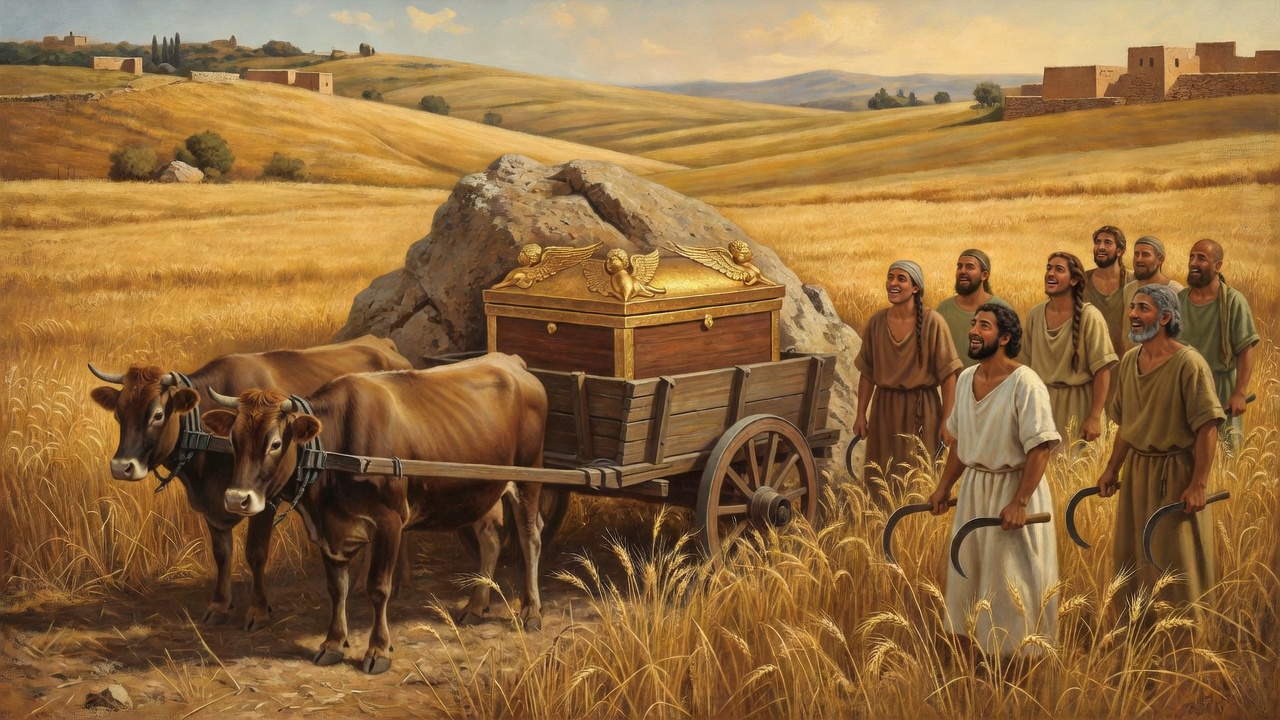
- Beth-shemesh was a sacerdotal (priestly) town on the northern border of Judah. This priestly status explains the presence of Levites who could properly take down the Ark and set it on the large stone in the field during the wheat harvest.Sources: the Bible text itself · Beth-shemesh
- To test whether their troubles were genuinely from Israel's God or simply happened by chance, the Philistines hitched two nursing cows that had never been yoked to the cart and penned up their calves. Contrary to natural maternal instinct, the cows went straight along the road to Beth-shemesh without turning aside.Sources: the Bible text itself
Notes written with AI assistance from open sources (Theographic Bible Metadata, CC BY-SA 4.0; Easton’s Bible Dictionary, public domain) and reviewed before publishing.
Places in this chapter
- Ekron · Today: Tel Miqne · 31.777, 34.852 · verses 16, 17
- Ashdod · Today: Tel Ashdod · 31.757, 34.658 · verse 17
- Ashkelon · Today: Tel Ashkelon · 31.664, 34.546 · verse 17
- Gaza · Today: Tell Harube · 31.504, 34.464 · verse 17
- Kiriath-jearim · Today: Deir el Azar · 31.809, 35.104 · verse 21
Only places identified with high confidence are shown (90% or more according to the scholarly sources compiled by OpenBible). Period map: DARE (Digital Atlas of the Roman Empire), CC BY 4.0; modern map: © OpenStreetMap contributors; places: OpenBible.info (CC BY 4.0).
Credits and license for this translation
Cishingini Agwara Kambari [asg]
Cishingini: Cishingini Agwara Kambari [asg] (Bible)
copyright © 2025 Language Development and Translation Initiative (LDTI)
Language: (Cishingini)
Contributor: The Seed Company
This translation is made available to you under the terms of the
Creative Commons Attribution Share-Alike license 4.0.
You have permission to share and redistribute this Bible translation in any format and to make reasonable revisions and adaptations of this translation, provided that:
You include the above copyright and source information.
If you make any changes to the text, you must indicate that you did so in a way that makes it clear that the original licensor is not necessarily endorsing your changes.
If you redistribute this text, you must distribute your contributions under the same license as the original.
Pictures included with Scriptures and other documents on this site are licensed just for use with those Scriptures and documents.
For other uses, please contact the respective copyright owners.
Note that in addition to the rules above, revising and adapting God's Word involves a great responsibility to be true to God's Word. See Revelation 22:18-19.
2025-07-09
Source: http://ebible.org/asg/ · eBible.org