Exodus 7
Yi Antiw Bible / Yi Ac'aj Testament · Tap a verse to see its cross-references.
1Bene'n tzun tlol Ryos tetz Moisés:
—Yaj, aẍ ink'ajbil sbne' swutz faraón nin yi awutzicy Aarón sjilonk tetz axel. 2Tajwe'n tan ibene'n tan talche'n tetz faraón tan tk'ol i' ama'l tan cyele'n tzaj yi e' xonl Israel Egipto. Swale' tzatz yi mbi tajwe'n tan awalol tetz Aarón. I' tzun tz'a'lon tetz faraón. 3Poro tzinquiwse' yi talma' faraón tan qui tk'ol ama'l tan cyele'n tzaj. Na tzinchaje' yi imporer nin tzimbne' wi'nin e'chk milawr le luwar Egipto tan xtx'ixpe'n tajtza'kl tan tk'ol i' ama'l tan cyele'n tzaj. 4Poro quil tocsaj faraón yi iyol. Ma na jalen yil tzinchaj yi imporer tibaj Egipto. Ej nin yil til e'chk milawra'tz kalena's tzun ltak' yi rey ama'l tan cyele'n tzaj intanum. 5Tz'elepon tzun chitxum yi e' aj Egipto yi at imporer nin yi in yi wi'tz ajcaw bene'n tzi'n wi munt, stzun Ryos bantz scyetz Moisés tu Aarón.
6Ya'tz nin tzun cyulej Moisés tu Aarón quib yi tal Ryos scyetz. 7At tzun Moisés tul jun mutx' yob, ma tetz Aarón at i' tul jun mutx' tu ox yob te yi chijilone'n tetz faraón.
Yi toque'n yi xtx'amij Aarón tetz lu'baj
8Ej itzun tal Ryos scyetz Moisés tu Aarón:
9—Yil xben wok tan yol tetz faraón, nin kol jak tan ichajol jun milawr, ba'n tzichajwok. Yi aẍatz Moisés ba'n tzawal nin tetz Aarón yi ba'n sc'ox cu'n yi xtx'amij wuxtx'otx'. Ej nin yil sc'ox cu'n, tz'ocopon tetz lu'baj. Ba'n tzibanwok yi xtxolbile'j swutz faraón, stzun Ryos.
10Chibene'n tzun Moisés tu Aarón tan yol tetz faraón. Yi cyopone'n nintzun e' ban quib yi tal Ryos scyetz. Cwe'n tzun c'oxol Aarón yi xtx'amij ẍchiwutz faraón scyuch' yi e' mas ajcaw yi ate'-tz xlaj. Oque'n nin tzun ban yi xtx'amij tetz lu'baj. 11Yi tilol faraón yi xtxolbile'j, nintzun cawunin tan chichakle'n yi e' nachol scyuch' e' wi'tz aj cun. Nin tan yi cyetz quipisyo' e' xcye' tan banle'n chi e' ban Moisés tu Aarón. 12Cwe'n tzun chic'oxol len yi cyetz chitx'amij wuxtx'otx', nintzun e' oc lentz tetz lu'baj. Poro nin ben yi xtx'amij tetz Aarón tan chibajse'n yi chitx'amij yi e' nachol scyuch' yi e' wi'tz ajcaw yi nsken cho'c tetz lu'baj. 13Chin xo'wbil nin ban yi xtxolbile'j, poro yi tetz faraón mas tcunin stze'tzaxe'n talma' nin qui nin tak' i' ama'l scyetz yi e' xonl Israel tan cyele'n tzaj Egipto. Tan yi xtxolbile'j el cu'n te'j quib yi tal Kataj Ryos tetz Moisés.
Yi tk'ol Ryos yi bajx chicaws yi e' aj Egipto
14Itzun tal Ryos tetz Moisés:
—Yi faraón ja tocsaj tib nim, nin ja tze'tzax yi talma' tan qui tk'ol ama'l tzitetz, yi axwok xonl Israel, tan itele'n liwr. 15Ma jalu' tajwe'n tan abene'n tan yol tetz ek jalchan. Ba'n cẍben tzi yi tzanla' nin cho'n tzach'iwtz jalen yil copon, na copon i' tzi' a' tan jichi'n. Cy'ajnin yi atx'amij yi oc tetz lu'baj. Nin ba'n tzawal yi xtxolbile'j tetz: 16“Yi Kataj yi kaRyosil yi o' hebrey, i' nchinchakon tzaj swutzu' tan talche'n yi xtxolbile'j. Nin je yi yol i'e'j: ‘Ak'aj ama'l scyetz intanum tan chibene'n tan inc'u'laje'n le ama'l tz'inunin tu'.’ Poro qui nin na awak'o'k ama'l scyetz, stzun i'. 17Cha'stzun te ja tal i' yi xtxolbile'j: ‘Ma jalu' tzinchaje' tetz faraón chij, yi in yi wi'tz ajcaw,’ nin je jun techle'j yi nẍchaj i' swetz: Yil tzinjab cu'n yi a' tan yi intx'amij yi cy'a'n wa'n, tz'ocopon yi a' tetz chich'. 18Ej nin ẍchiquimok cyakil cay. Ej nin chin xewe'n nin sbne' yi jun tzanla'a'tz. Ej nin cyakil yi axwok aj Egipto smulmuchk ic'u'l yil chic'aje'n,” cẍchij sban tetz.
19Ncha'tz tal Ryos tetz Moisés.
—Alaj tetz Aarón yi ba'n ẍchajnin yi xtx'amij, te cyakil yi e'chk ne'ẍ tzanla' tu e'chk lawun nin alchok ama'l kale atit a' cwent Egipto. Na na waj yil tz'oc cyakil yi a' tetz chich'. Chich' cu'n sbne' cyakil yi a' yi at tulak e'chk cu'lbil. Qui'c na ban yi ko c'ub nka tze' yi cu'lbil a'a'tz, stzun Ryos bantz tetz Moisés.
20I nintzun cyulej Moisés tu Aarón quib yi tal Ryos scyetz. Chibene'n tzun tan yol tetz faraón. Yi cyopone'n tzi a', bene'n tzun Aarón tan jabe'n cu'n yi a' tan yi xtx'amij ẍchiwutz cu'n faraón scyuch' yi e' mas ajcaw yi xomche' te'j. Tircu'n tzun yi a' octz tetz chich'. 21Chiquime'n tzun cyakil yi e' cay yi ate' xe a'. Chin tzu'j nin tzun ban yi a'a'tz nin qui't jal quic'a' yi e' aj Egipto na chich' cu'n tane'n tircu'n yi a' cwent Egipto.
22Yi quilol yi e' nachol scyuch' yi e' ajcun yi xtxolbile'j nintzun e' octz tan banle'n cyetz, chi yi e' ban Moisés tu Aarón, nin e' xcye' te'j tan yi cyetz quipisyo'. Cha'stzun te qui nin bisun faraón ta'n. Nin qui nin tocsaj i' yi chiyol Moisés. Ma na mas tcunin tocsal tib nim tu tajtza'kl. Nin qui nin tbit yi yol Kataj Ryos. 23Aje'n nin ban faraón xe tetz ca'l. Qui nin oc il i' tan xtxumle'n yi xtxolbila'se'j nin qui nin bisun i' ta'n, na chin tze'tzuj nin ban yi talma', chi alijt tan Ryos. 24Ma yi e' aj Egipto cyoque'n tzun tan kople'n jul tzi'ak yi tzanla' tan joyle'n balaj a' tetz quic'a', na yi tzanla' qui'c rmeril tan baje'n cya'n tetz quic'a'.
Yi chijale'n wi'nin wo' tetz chicaws yi e' aj Egipto
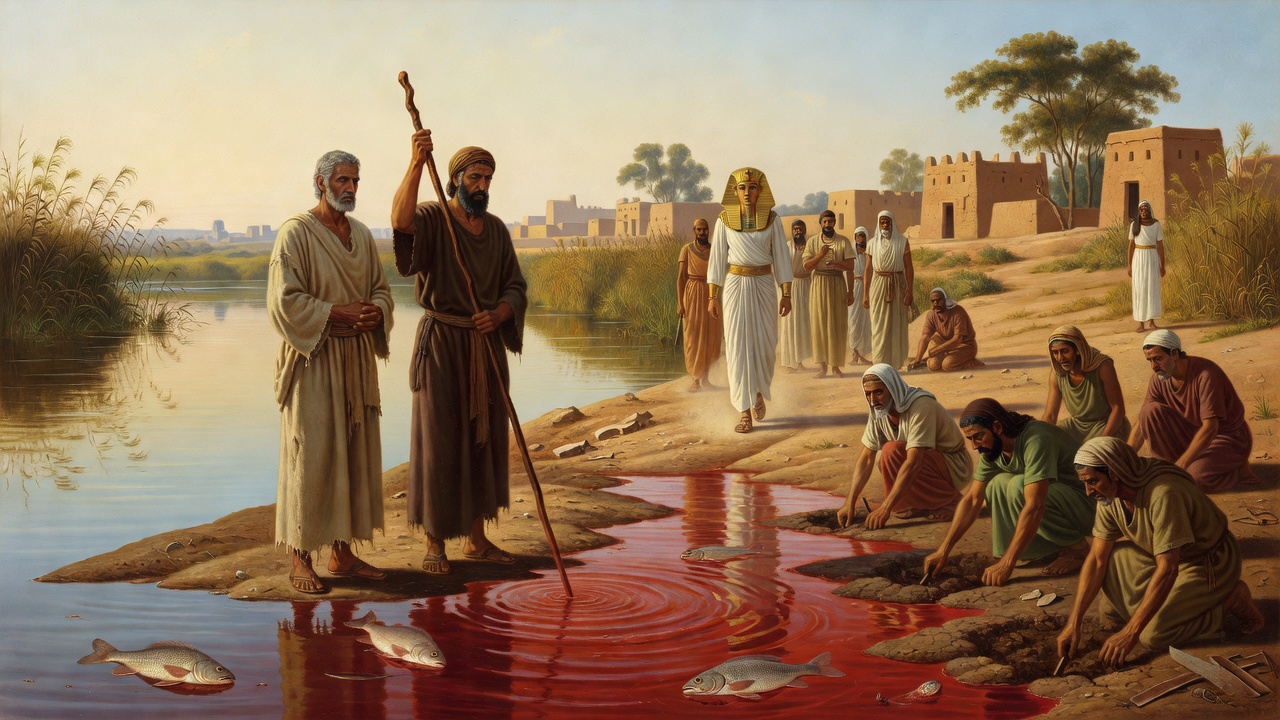
25Itzun bantz yi tele'n juk k'ej yi tocle'nix Kataj Ryos tan po'tze'n yi a'.
Did you know?
Moses and Aaron before Pharaoh
- Moses was eighty years old and Aaron eighty-three when they spoke to Pharaoh. Easton's Bible Dictionary (1897) notes that Aaron, the eldest son of Amram and Jochebed, was born in Egypt three years before his brother Moses. In this chapter the LORD says he has made Moses "like God to Pharaoh," with Aaron as his prophet: Moses is to speak all that he is commanded, and Aaron is to tell Pharaoh to let the Israelites leave his land.Sources: the Bible text itself · Aaron
- Easton's Bible Dictionary (1897) notes that the name Nile is not found in Scripture; the Old Testament calls that river Sihor, "the black stream," or simply "the river," and also "the flood of Egypt." The Nile is formed by the White Nile and the Blue Nile, which meet at Khartoum, and it is the water Aaron strikes in this chapter. The fish died, the river stank, the Egyptians could not drink it and dug around the Nile for water, and seven full days passed.Sources: Nile · the Bible text itself
- Easton's Bible Dictionary (1897) says the Pharaoh of the Exodus was probably Menephtah I, the fourteenth and eldest surviving son of Rameses II, and that he resided at Zoan, where he had the interviews with Moses and Aaron recorded in Exodus. The same entry leaves the identification open: it is still a question whether Seti II or his father Menephtah was that Pharaoh, and some think the evidence favors Seti II.Sources: Pharaoh (of the Exodus) · the Bible text itself
Notes written with AI assistance from open sources (Theographic Bible Metadata, CC BY-SA 4.0; Easton’s Bible Dictionary, public domain) and reviewed before publishing.
Places in this chapter
- Egypt · 30.129, 31.308 · verses 3, 4, 5, 11, 19, 21, 22
- Nile · Today: Nile River · 31.465, 30.367 · verses 15, 17, 18, 20, 21, 24, 25
Only places identified with high confidence are shown (90% or more according to the scholarly sources compiled by OpenBible). Period map: DARE (Digital Atlas of the Roman Empire), CC BY 4.0; modern map: © OpenStreetMap contributors; places: OpenBible.info (CC BY 4.0).
Credits and license for this translation
Yi Antiw Bible / Yi Ac'aj Testament
Bible in Aguacateco (GT:agu:Aguacateco)
copyright © 2011 Wycliffe Bible Translators, Inc.
Language: Aguacateco
Translation by: Wycliffe Bible Translators, Inc.
Copyright Information
© 2011-02-18, Wycliffe Bible Translators, Inc. All rights reserved.
This translation text is made available to you under the
terms of the Creative Commons License: Attribution-Noncommercial-No Derivative Works.
( http://creativecommons.org/licenses/by-nc-nd/3.0/ )
In addition, you have permission to port the text to different file formats, as long as you
do not change any of the text or punctuation of the Bible.
You may share, copy, distribute, transmit, and extract portions
or quotations from this work, provided that you include the above copyright
information:
You must give Attribution to the work.
You do not sell this work for a profit.
You do not make any derivative works that change any of the actual words or punctuation of the Scriptures.
Permissions beyond the scope of this license may be
available if you contact
us with your request.
The Bible
in Aguacateco
© 2011-02-18, Wycliffe Bible Translators, Inc. All rights reserved.
This translation is made available to you under the terms of the
Creative Commons Attribution-Noncommercial-No Derivatives license 4.0.
You may share and redistribute this Bible translation or extracts from it in any format, provided that:
You include the above copyright and source information.
You do not sell this work for a profit.
You do not change any of the words or punctuation of the Scriptures.
Pictures included with Scriptures and other documents on this site are licensed just for use with those Scriptures and documents.
For other uses, please contact the respective copyright owners.
2014-04-21
Source: http://ebible.org/aguBl/ · eBible.org