John 4
I 'utz laj tzij re i dios · Tap a verse to see its cross-references.
I Jesucrísto xu tijoj jun ixok aj Samária
1I aj Fariséo winak, xqui ta rason chi je qʼui i winak que terej chirij i Jesus, je qʼui quiqui tzʼonoj u kajsaxic ya piquiwi, mas xe qʼuiar i winak ruʼ i Jesus chuwach quiqui ʼan ruʼ i ma Wan, aj kajsanel ya. Katzij n-are ti Jesus ca kajsaw ya piquiwi i winak, xa are i u tijoxelab. I Jesus, are xretamaj chi xpe coywal i aj Fariséo winak, ire xel pa Judéa, xtzalij chic pa Galiléa.
4Pu tzalijbal, xicʼaw na pa jyub Samária. 5Chila pa Samária, xupon che jun tinimit, Sicar u bi. I tinimit-le, ʼo chu nakaj i rulew i mam Jacob ujer; i ulew-le xu ya can che i u cʼojol, chi ma Jose. 6Chila ʼo wi i cʼotom re can i mam Jacob; (i Jesus, cuʼ u tijoxelab, xe upon chila). I Jesus, cosnak chic che i be, rumal-i, xcubi chu chiʼ i cʼotom. Are oʼonom ʼor-le, colo tiqʼuil ʼij. 7Cul i Jesus chila, xupon jun ixok aj Samária chu cʼamic u yaʼ pa cʼotom. I Jesus xu bij che:
—Cha ya jubiʼ in yaʼ —coʼon che.
8I u tijoxelab i Jesus je ʼenak tan pa tinimit, chu loʼic wach quiqui tijo. 9I ixok aj Samária xu laʼ u wach che i Jesus:
—Yet at aj Israel winak, ¿wuchac ca tzʼonoj a yaʼ chwe yin chi in aj Samária winak?
Queje ile xu bij che man i aj Israel winak n-cacaj ta quib cuʼ aj Samária. 10I Jesus xu bij che:
—N-awetaʼam taj wach cu sujuj i Dios chawe, xak n-awetaʼam taj in pachin yin chi quin tzʼonoj jubiʼ in yaʼ chawe. We tene awetaʼam ile, yet tene-ri ca tzʼonoj a yaʼ chwe yin, y yin quin ya ne ʼuri i cʼaslic ya chawe —xu bij che i ixok.
11I ixok xu bij che:
—Nim laj winak, i cʼotom naj u pam, y cʼa naj ʼo kaj i ya; yet n-ta ne cawesbej li re. ¿Pa ca cʼam wi i cʼaslic ya chi ca ya chwe? 12I nim laj ka mam, mam Jacob, u yom can i cʼotom-i chake. Che i cʼotom-i xresaj wi u yaʼ ire, tak que i racʼal, tak que u chicop. ¿Xataba mas nim a ʼij yet chuwach i ka mam, mam Jacob? —xu bij i ixok che.
13I Jesus xu bij che:
—Pachin i quiqui tij i ya chi quel pa cʼotom-i, xa ca pe chic i cʼatic chique. 14We jun cu tuʼ i ya chi quin ya yin che, n-ca pe ta chic i cʼatic che. Man i ya chi quin ya yin che, coʼon pu cʼux pacha jun ralaxbal ya chi lic ca silabic, cu yabej re i cʼaslemal chi n-ca qʼuis ta chic —xu bij i Jesus che.
15Teʼuri i ixok xu bij che:
—Nim laj winak, cha ya i ya-le chwe chi ca sujuj, man n-ca pe ta chic i cʼatic chwe, xak quin mayij cʼunic ʼij ʼij waral chu cʼamic in yaʼ —coʼono.
16I Jesus xu bij che:
—Jat, ja siqʼuij awachijil, teʼuri chix petok —xu bij che.
17I ixok xu bij che:
—Yin n-ta wachijil.
Are ʼuri i Jesus xu bij che:
—Katzij i ca bij “N-ta wachijil,” cat cha. 18Man joʼob awachijil je icʼawnak, y are i ʼo awuʼ woʼor, n-awachijil taj. Rumal-i a bim i sak laj tzij —coʼon i Jesus che.
19I ixok, are xu ta ile, xu bij:
—Nim laj winak, woʼor quin ta u be chi yet at ajbil u tzij i Dios. 20I katit ka mam yoj chi oj aj Samária, chi xqui coj wi u ʼij i Dios puwi i jyub-le; péro yix chi ix aj Israel qui bij chi xui pa Jerusalen coc wi u ʼij i Dios —xu bij i ixok che. 21I Jesus xu bij che:
—Chatape, ixok, cha cojo i quin bij chawe-ri: cu rik ni ʼij n-tu chac quix ʼe chic puwi i jyub-i, xak n-tu chac quix ʼe cʼa pa Jerusalen chu cojic u ʼij i Ta chicaj. 22Yix chi ix aj Samária, qui coj u ʼij jun Dios chi n-iwetaʼam tu wach. Péro yoj chi oj aj Israel ketaʼam u wach i Dios chi caka coj u ʼij, man i tobal que i winak chi Dios u yijbam, cuʼ i aj Israel winak ca pe wi. 23Péro cu rik i ʼij, y are chic i ʼij iri, chi conojel niʼpa i lic katzij quiqui coj u ʼij i Ta chicaj, ruʼ qui cʼux quiqui ʼano, lic sakil quiqui ʼano. I Ta chicaj, queje ile craj chique niʼpa i quiqui coj u ʼij ire. 24I Dios, lic tewal, n-cakil tu wach. Xak queje u cojic u ʼij: niʼpa i quiqui coj u ʼij, ʼo u chac quiqui ʼano lic pa qui cʼux; lic sakil quiqui ʼan na —xu bij i Jesus che ixok.
25Teʼuri xu bij i ixok che:
—Wetaʼam chi ca cʼun i Tolke chatal rumal i Dios, “Crísto” ca bix che. Are ca cʼunic, ire ʼis ronojel cu sakij chake —xu bij ixok che.
26—Yin ile chi ca bij, chi quin lapan awuʼ —xu bij i Jesus che.
27Teʼuri xe upon u tijoxelab. Are xquilo chi Jesus ca lapan ruʼ jun ixok, lic xqui bisoj. Mi jun chique xu tzʼonoj che wach craj i ixok; xak n-xqui tzʼonoj ta che wach tak quiqui lap ruʼ. 28Teʼuri i ixok xu canaj can u cucub, y xa ʼe pa tinimit. Xu bij chique i winak:
29—Chix petok, chol iwila jun achi chi xu bij chwe ronojel wach in ʼanom. ¿Mok are i Crísto ile? —coʼon chique.
30Teʼuri i winak xe ʼel pa tinimit, y xe ʼe pa ʼo wi i Jesus. 31Are cʼa maja que upon i winak, i u tijoxelab i Jesus lic xqui sujuj u wa. Xqui bij che:
—Tijonel, cha tija jun a wa —xe cha che.
32Ire xu bij chique:
—Yin, ʼo i quin tijo chi yix n-qui maj ti usucʼ —xu bij.
33I u tijoxelab xe oc chu bixquil chiquiwach:
—¿ʼO nawi jun xcʼamaw li u wa? —xe cha.
34I Jesus xu bij chique:
—Are in wa yin, are iri; chi quin ʼan na pacha i craj i Ta chi in takawnak lok, xak quin qʼuis ni u chac chi u yom pin ʼab. 35Yix qui bij: “Cʼa pa cajib icʼ, teʼuri ca ʼan i chac re i jachʼanic” quix cha. Xui-ri yin quin bij chiwe: are chic ʼij iri chi ca ʼan i jachʼ. Chiwilapeʼ, i abix ya ʼutz chic ca jachʼic. 36Pachin jun ca chacun che i jachʼanic-le, ca yaʼ ni rajil. Niʼpa i xe moltajic, que yaʼ pa cʼaslemal chi n-ca qʼuis ta chic. Teʼuri i chacun-nak che i jachʼ-le, que quicot na junam ruʼ i ticawnak. 37Man pacha i cu bij jun tzij: “Jun ca ticanic, y jun chic ca jachʼanic.” Sak laj tzij ile. 38Yix ix in takom chu molic u wach i ticon chi ni ticom taj. Junwi je ticawnak i ticon-le, y yix xui qui mol u wach i qui chac —xu bij i Jesus chique u tijoxelab.
39Je qʼui i aj Samária winak xqui cuba qui cʼux che i Jesus rumal i tzij chi xu bij ixok chique: “Ire xu bij chwe ronojel niʼpa in ʼanom,” xu bij chique. 40Bay, are xe upon i aj Samária ruʼ i Jesus, xqui bij che chi ca canaj na cuʼ pa tinimit. Rumal-i, i Jesus xcanaj cuʼ queb ʼij. 41Je qʼui chic xqui cuba qui cʼux che, are xqui ta u tzij i Jesus. 42I winak-i xqui bij che i ixok:
—Woʼor lic caka cojo; n-xui ta rumal wach i xa lap yet chake caka cojo, xak yoj mísmo xka ta u tzij ire. Rumal-i, ketaʼam chi lic katzij, ire are i Crísto, are i Tolque i winak chuwach i jyub taʼaj —xqui bij i aj Samária winak.
I Jesus xrutzirsaj i racʼal jun achi, nim u patan
43Churox ʼij xel i Jesus pa Samária; xu maj chubi u be, xa ʼe pa jyub Galiléa. 44Man ire mísmo u bim chi jun ajbil u tzij i Dios, n-cocsax tu ʼij pa tinimit pa xqʼuiy wi. 45Are xupon pa Galiléa, i winak chila lic xqui cʼulaj cuʼ, man ique quilom i milágro u ʼanom pa Jerusalen. Ique je upon-nak chila pa Jerusalen chi rilic i nimaʼij páscua; chupam i ʼij-le, xquilo ronojel wach u ʼanom i Jesus chila.
46Entónces i Jesus xupon chic che i tinimit Cana, u cwenta i jyub Galiléa; are i tinimit-le pa xu yijba wi i víno che i toʼ ya. ʼO jun achi aj Capernaum, nim u patan chirij i ʼatol tzij; y ʼo jun racʼal iwab. 47Ire xu ta chi ya xtzalij li Jesus pa Judéa, ya ʼo chic pa Galiléa; rumal-i, xa ʼe ruʼ i Jesus. Xu tzʼonoj pawor che, chi ca ʼe ruʼ chi rachoch, crutzirsaj i racʼal chi ya ca camic. 48I Jesus xu bij che:
—Yix n-quiwaj ta qui cuba i cʼux chwe we n-quiwil ta jun milágro, we n-quiwil ta nimak tak ʼanic chi quin ʼano —xu bij i Jesus.
49I achi xu bij:
—Cuyu in mac, Nim laj Winak, cha bisoj chwe chi cat ʼe wuʼ, man ya ca cam i wacʼal.
50I Jesus xu bij che:
—Jat che awachoch; i awacʼal ca cʼasi na —coʼono.
I achi xu cojo wach xu bij i Jesus che, y xa ʼec. 51Are ca tijin chi be, xa ʼe cʼulax cumal i rajchaquib je aj pa rachoch, y xqui bij che:
—I awacʼal ca cʼasi na —xe cha.
52I achi xu tzʼonoj chique:
—¿Wach u ʼonom ʼor xu ticba utziric?
Ique xqui bij che:
—Iwir a la úna re u kajbal ʼij xchup i ʼaʼ chirij —xe cha che.
53I u kajaw i iwab, are xu ta i ʼor-le, xu nabej chi are ʼor ʼuri are xu bij i Jesus che: “Awacʼal ca cʼasi na.” Teʼuri i achi xu cuba u cʼux che i Jesus junam cuʼ conojel u miʼal ralcʼwal. 54Are ucab milágro iri, xu ʼan i Jesus, are xel pa Judéa y xa ʼe cʼa pa Galiléa.
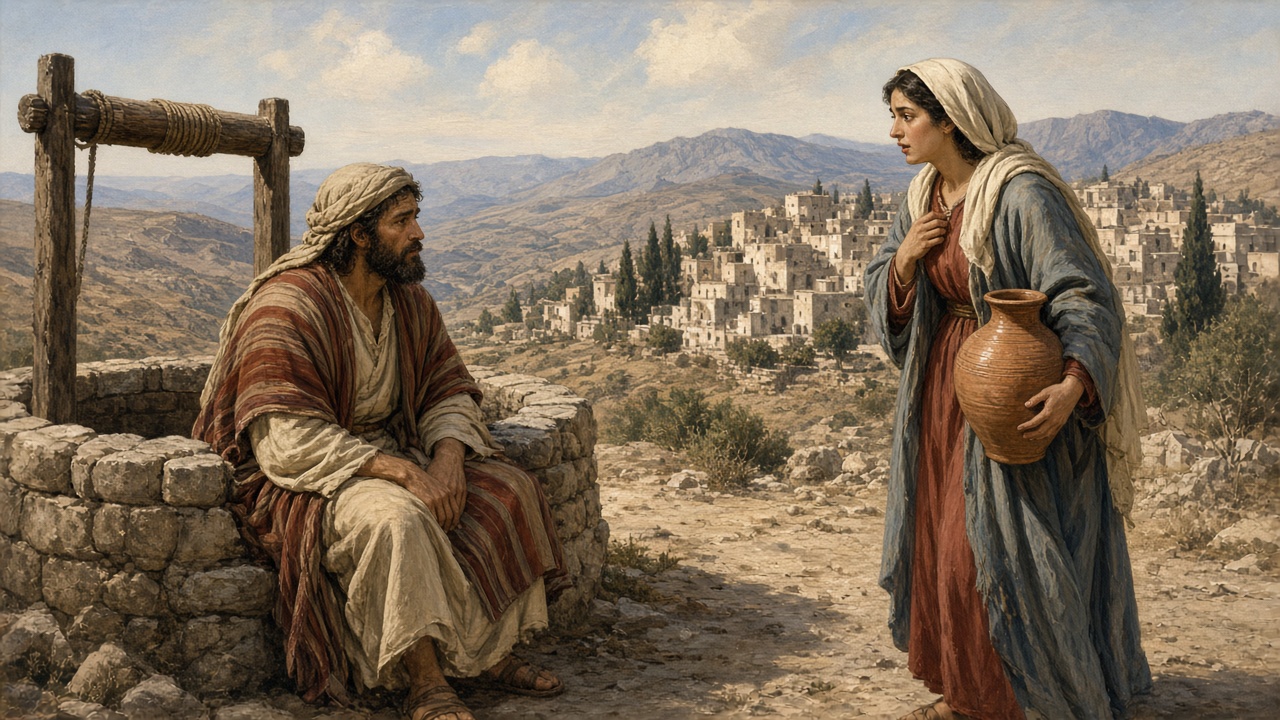
Did you know?
Living Water in Samaria
- Jesus left Judea to return to Galilee, and the Gospel says he had to pass through Samaria. Under the Romans in Jesus' time, Judea was the southernmost of Palestine's three divisions, distinguished from Samaria and Galilee, and the narrative notes that Jews did not associate with Samaritans.Sources: the Bible text itself · Judea
- He came to Sychar, near the plot of ground that Jacob had given his son Joseph, and, weary from the journey, sat down by Jacob's well. Easton's Bible Dictionary (1897) records that from the time of the Crusaders Sychar was usually identified with Shechem, but that explorations had identified it with 'Askar, a small Samaritan town on the southern base of Ebal, about a mile north of the well.Sources: the Bible text itself · Sychar
- The woman contrasted worship on this mountain with the Jewish claim that one must worship in Jerusalem, and she spoke of a coming Messiah, called Christ. When the disciples returned from buying food in the town, they were surprised that Jesus was speaking with a woman.Sources: the Bible text itself
Notes written with AI assistance from open sources (Theographic Bible Metadata, CC BY-SA 4.0; Easton’s Bible Dictionary, public domain) and reviewed before publishing.
Places in this chapter
- Galilee · 32.760, 35.527 · verses 3, 43, 45, 46, 47, 54
- Judea · Today: Judea 1 · 31.777, 35.234 · verses 3, 47, 54
- Samaria · Today: Samaria 2 · 32.276, 35.195 · verses 4, 5, 7, 9
- Jerusalem · 31.777, 35.234 · verses 20, 21, 45
- Mount Gerizim · 32.199, 35.273 · verse 20
Only places identified with high confidence are shown (90% or more according to the scholarly sources compiled by OpenBible). Period map: DARE (Digital Atlas of the Roman Empire), CC BY 4.0; modern map: © OpenStreetMap contributors; places: OpenBible.info (CC BY 4.0).
Credits and license for this translation
I 'utz laj tzij re i dios
New Testament in Achi (I 'utz laj tzij re i dios)
copyright © 2009 Wycliffe Bible Translators, Inc.
Language: Achi
Dialect: Cubulco
Translation by: Wycliffe Bible Translators, Inc.
Achi, Cubulco
Achi' is a Mayan language very
closely related to K'iche' (Quiché in the older orthography). It is spoken by the
Achi people, primarily in the area of Baja Verapaz in Guatemala. There are two Achi'
dialects. Cubulco Achi' is spoken by approximately 48,000 people in the Cubulco area
west of Rabinal area. Rabinal Achi' is spoken by approximately 37,000 people in the
Rabinal area.
El Nuevo Testamento
en el idioma Achí de Cubulco de
Guatemala
Ediciones anteriores
Segunda edición
©2009, Wycliffe Bible
Translators
Primera edición
Publicado por
©1984, Sociedad Bíblica
Internacional
Copyright Information
© 2009, Wycliffe Inc. All rights reserved.
This translation text is made available to you under the terms of the Creative
Commons License: Attribution-Noncommercial-No Derivative Works. ( http://creativecommons.org/licenses/by-nc-nd/3.0/ ) In addition, you have
permission to port the text to different file formats, as long as you do not change
any of the text or punctuation of the Bible.
You may share, copy, distribute, transmit, and extract portions or quotations from
this work, provided that you include the above copyright information:
You must give Attribution to the work.
You do not sell this work for a profit.
You do not make any derivative works that change any of the actual words or
punctuation of the Scriptures.
Permissions beyond the scope of this license may be available if you contact us
with your request. If you want to revise a translation, use a translation in an
adaptation, or use a translation commercially, we will consider your request.
NT:segunda edición
The New Testament
in Achi
© 2009, Wycliffe Inc. All rights reserved.
This translation is made available to you under the terms of the
Creative Commons Attribution-Noncommercial-No Derivatives license 4.0.
You may share and redistribute this Bible translation or extracts from it in any format, provided that:
You include the above copyright and source information.
You do not sell this work for a profit.
You do not change any of the words or punctuation of the Scriptures.
Pictures included with Scriptures and other documents on this site are licensed just for use with those Scriptures and documents.
For other uses, please contact the respective copyright owners.
2013-01-05
Source: http://ebible.org/acr-acc/ · eBible.org