Nehemiah 1
Berean Standard Bible · Tap a verse to see its cross-references.
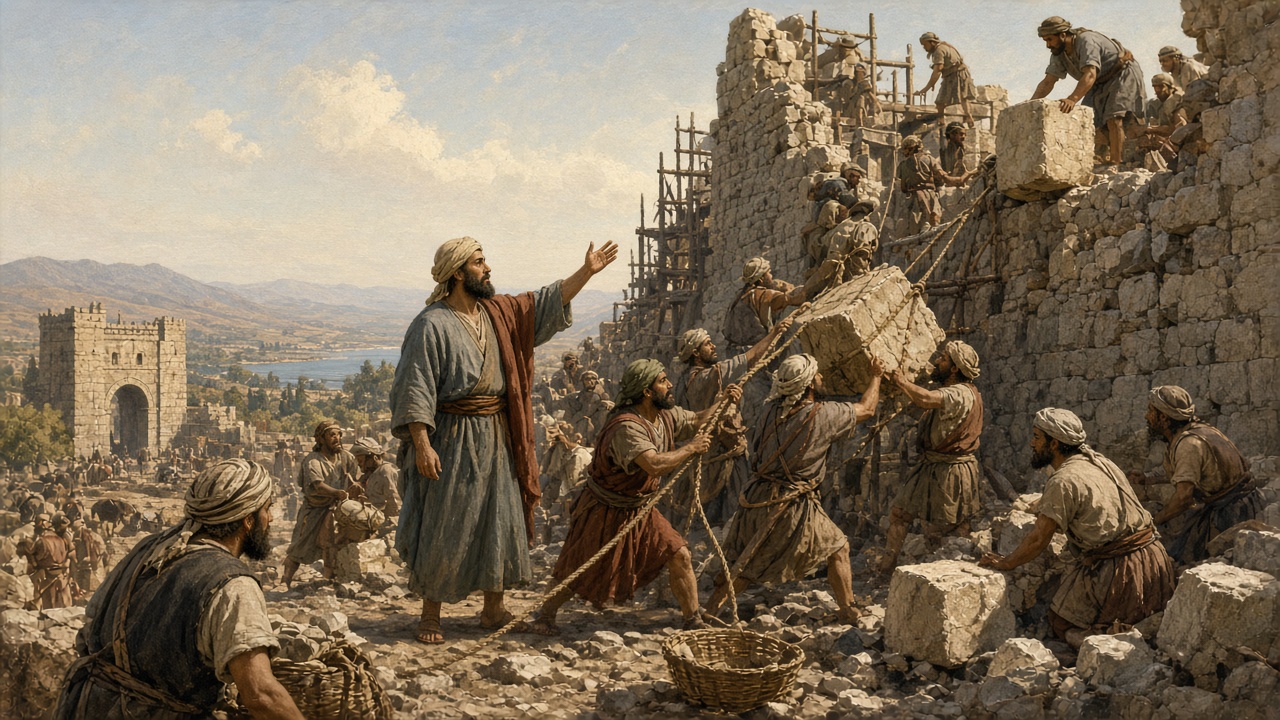
About this book
About Nehemiah
- Easton's Bible Dictionary (1897) presents Nehemiah as the author of the book, pointing to first-person writing in chapters 1–7, 12:27–47, and 13, and to third-person sections in chapters 8–10 that some suppose Ezra wrote, though it says there is no distinct evidence of that. The same entry dates the book to about 431–430 B.C., after Nehemiah returned a second time to Jerusalem from Persia, and excepts 12:11, 22, and 23 from his hand.Sources: Easton: Nehemiah, Book of
- Nehemiah, son of Hachaliah and probably of the tribe of Judah, belonged to a family of Jerusalem and was one of the Jews of the dispersion. In his youth he served as royal cup-bearer at the palace of Shushan under Artaxerxes Longimanus, and through his brother Hanani he learned that the holy city lay mournful and desolate.Sources: Nehemiah
- The scribe Ezra had led a second company of exiles from Babylon to Jerusalem in 459 B.C., and Easton's dictionary treats Nehemiah as a historical continuation of Ezra. When Nehemiah went up to rebuild the ruined walls, Sanballat, who held some place of authority in Samaria, tried to hinder the work, and Tobiah the Ammonite joined the opposition and sent letters to put him in fear.Sources: Ezra · Easton: Nehemiah, Book of · Sanballat · Tobiah
- Easton's Bible Dictionary (1897) divides the book into four parts: the rebuilding of Jerusalem's wall and the register of those who had returned from Babylon (chapters 1–7); the state of religion among the Jews (8–10); the growth of Jerusalem's population, a census of adult men, and lists of chiefs, priests, and Levites (11 through 12:1–26); and the dedication of the wall, the ordering of temple officers, and Nehemiah's reforms (12:27–13).Sources: Easton: Nehemiah, Book of
- While Nehemiah was away, the priest Eliashib prepared a chamber in the courts of the house of God for Tobiah; on his return Nehemiah cast out all of Tobiah's household goods. Easton's dictionary also notes that the book closes the history of the Old Testament and that the prophet Malachi was contemporary with Nehemiah.Sources: Tobiah · Easton: Nehemiah, Book of
Notes written with AI assistance from open sources (Theographic Bible Metadata, CC BY-SA 4.0; Easton’s Bible Dictionary, public domain) and reviewed before publishing.
Nehemiah’s Prayer
1These are the words of Nehemiah son of Hacaliah:
In the month of Chislev, in the twentieth year, while I was in the citadel of Susa, 2Hanani, one of my brothers, arrived with men from Judah. So I questioned them about the remnant of the Jews who had survived the exile, and also about Jerusalem.
3And they told me, “The remnant who survived the exile are there in the province, in great trouble and disgrace. The wall of Jerusalem is broken down, and its gates are burned with fire.”
4When I heard these words, I sat down and wept. I mourned for days, fasting and praying before the God of heaven.
5Then I said:
“O LORD, God of heaven, the great and awesome God who keeps His covenant of loving devotion with those who love Him and keep His commandments, 6let Your eyes be open and Your ears attentive to hear the prayer that I, Your servant, now pray before You day and night for Your servants, the Israelites.
I confess the sins that we Israelites have committed against You. Both I and my father’s house have sinned. 7We have behaved corruptly against You and have not kept the commandments, statutes, and ordinances that You gave Your servant Moses.
8Remember, I pray, the word that You commanded Your servant Moses when You said, ‘If you are unfaithful, I will scatter you among the nations, 9but if you return to Me and keep and practice My commandments, then even if your exiles have been banished to the farthest horizon, I will gather them from there and bring them to the place I have chosen as a dwelling for My Name.’
10They are Your servants and Your people. You redeemed them by Your great power and mighty hand. 11O Lord, may Your ear be attentive to my prayer and to the prayers of Your servants who delight to revere Your name. Give Your servant success this day, I pray, and grant him mercy in the sight of this man.”
(At that time I was the cupbearer to the king.)
Did you know?
Nehemiah's Grief and Prayer
- Nehemiah served as the cupbearer to the Persian king at the citadel of Susa, a prominent administrative center located east of the Tigris River. This royal office gave him direct, trusted access to the monarch.Sources: Nehemiah · Susa · the Bible text itself
- Hanani, a brother of Nehemiah, arrived from Judah with news that the survivors of the exile were in great distress because the walls of Jerusalem were broken down and its gates destroyed by fire.Sources: Hanani · Nehemiah · the Bible text itself
- Upon hearing the news, Nehemiah mourned, fasted, and prayed, recalling God's words to Moses that while unfaithfulness would scatter the people among the nations, turning back to God would bring them back together.Sources: Moses · the Bible text itself
Notes written with AI assistance from open sources (Theographic Bible Metadata, CC BY-SA 4.0; Easton’s Bible Dictionary, public domain) and reviewed before publishing.
Places in this chapter
Only places identified with high confidence are shown (90% or more according to the scholarly sources compiled by OpenBible). Period map: DARE (Digital Atlas of the Roman Empire), CC BY 4.0; modern map: © OpenStreetMap contributors; places: OpenBible.info (CC BY 4.0).
Credits and license for this translation
Berean Standard Bible
The Holy Bible in English: Berean Standard Bible
Public Domain
Language: English
Contributor: BSB Publishing, LLC
2026-10-02
Source: http://ebible.org/engbsb/ · eBible.org