Deuteronomy 1
Berean Standard Bible · Tap a verse to see its cross-references.
About this book
About Deuteronomy
- Easton's Bible Dictionary (1897) explains that the Greek name Deuteronomion, the second law, gave us Deuteronomy: a second statement of laws already promulgated. It says the division of the Pentateuch into five books was probably first made by the Greek translators, whom the Vulgate follows. Jews name the book from its opening Hebrew words, 'Elle haddabharim, These are the words.Sources: Easton: Deuteronomy
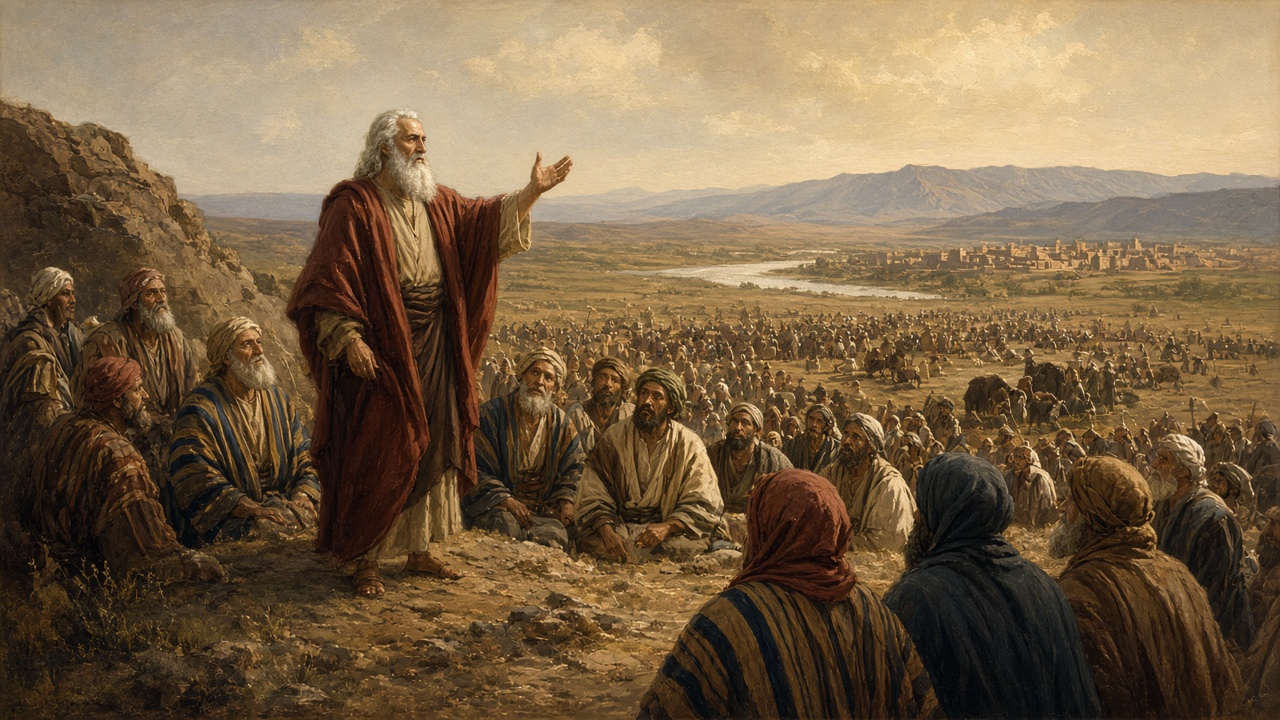
- Easton's Bible Dictionary (1897) presents Deuteronomy as chiefly three discourses delivered by Moses a short time before his death, spoken to all Israel in the eleventh month of the last year of their wanderings in the wilderness. It says the story of his death and burial was written by some other hand, probably that of Joshua, who succeeded him as leader of Israel.Sources: Easton: Deuteronomy · Joshua
- The discourses of Deuteronomy are set in the plains of Moab, east of the Jordan and opposite Jericho, Israel's last encampment before entering Canaan, a region then held by the Amorites. East of the Jordan the Israelites had defeated Sihon, king of the Amorites, whose country ran from the Arnon to the Jabbok, and Og, king of Bashan, whose kingdom was given to Reuben, Gad, and half the tribe of Manasseh.Sources: Easton: Deuteronomy · Moab · Sihon · Og
- Easton's Bible Dictionary (1897) describes three discourses: the first (1-4:40) recapitulates forty years in the wilderness, exhorts obedience to the divine ordinances, and warns against forsaking the God of their fathers; the second (5-26:19), the body of the book, restates the law given at Mount Sinai and instructs Israel for life in Canaan; the third (chapters 27-30) sets out blessings for the obedient and the curse on the rebellious, urging faithfulness to the covenant.Sources: Easton: Deuteronomy
- Easton's Bible Dictionary (1897) adds three appendices after the addresses: a song which God had commanded Moses to write (32:1-47), blessings pronounced on the separate tribes (chapter 33), and the story of his death (32:48-52) and burial (chapter 34). In Hebrew manuscripts the Pentateuch forms one scroll; Jews divided this book into eleven parshioth, and the English Bible contains thirty-four chapters.Sources: Easton: Deuteronomy
Notes written with AI assistance from open sources (Theographic Bible Metadata, CC BY-SA 4.0; Easton’s Bible Dictionary, public domain) and reviewed before publishing.
The Command to Leave Horeb
1These are the words that Moses spoke to all Israel in the wilderness east of the Jordan—in the Arabah opposite Suph—between Paran and Tophel, Laban, Hazeroth, and Dizahab.
2It is an eleven-day journey from Horeb to Kadesh-barnea by way of Mount Seir. 3In the fortieth year, on the first day of the eleventh month, Moses proclaimed to the Israelites all that the LORD had commanded him concerning them. 4This was after he had defeated Sihon king of the Amorites, who lived in Heshbon, and then at Edrei had defeated Og king of Bashan, who lived in Ashtaroth.
5On the east side of the Jordan in the land of Moab, Moses began to explain this law, saying:
6The LORD our God said to us at Horeb: “You have stayed at this mountain long enough. 7Resume your journey and go to the hill country of the Amorites; go to all the neighboring peoples in the Arabah, in the hill country, in the foothills, in the Negev, and along the seacoast to the land of the Canaanites and to Lebanon, as far as the great River Euphrates.
8See, I have placed the land before you. Enter and possess the land that the LORD swore He would give to your fathers Abraham, Isaac, and Jacob, and to their descendants after them.”
Moses Appoints Leaders
9At that time I said to you, “I cannot carry the burden for you alone. 10The LORD your God has multiplied you, so that today you are as numerous as the stars in the sky. 11May the LORD, the God of your fathers, increase you a thousand times over and bless you as He has promised. 12But how can I bear your troubles, burdens, and disputes all by myself? 13Choose for yourselves wise, understanding, and respected men from each of your tribes, and I will appoint them as your leaders.”
14And you answered me and said, “What you propose to do is good.”
15So I took the leaders of your tribes, wise and respected men, and appointed them as leaders over you—as commanders of thousands, of hundreds, of fifties, and of tens, and as officers for your tribes.
16At that time I charged your judges: “Hear the disputes between your brothers, and judge fairly between a man and his brother or a foreign resident. 17Show no partiality in judging; hear both small and great alike. Do not be intimidated by anyone, for judgment belongs to God. And bring to me any case too difficult for you, and I will hear it.”
18And at that time I commanded you all the things you were to do.
Twelve Spies Sent Out
19And just as the LORD our God had commanded us, we set out from Horeb and went toward the hill country of the Amorites, through all the vast and terrifying wilderness you have seen. When we reached Kadesh-barnea, 20I said: “You have reached the hill country of the Amorites, which the LORD our God is giving us. 21See, the LORD your God has placed the land before you. Go up and take possession of it as the LORD, the God of your fathers, has told you. Do not be afraid or discouraged.”
22Then all of you approached me and said, “Let us send men ahead of us to search out the land and bring us word of what route to follow and which cities to enter.”
23The plan seemed good to me, so I selected twelve men from among you, one from each tribe. 24They left and went up into the hill country, and came to the Valley of Eshcol and spied out the land. 25They took some of the fruit of the land in their hands, carried it down to us, and brought us word: “It is a good land that the LORD our God is giving us.”
Israel’s Rebellion
26But you were unwilling to go up; you rebelled against the command of the LORD your God. 27You grumbled in your tents and said, “Because the LORD hates us, He has brought us out of the land of Egypt to deliver us into the hand of the Amorites to be annihilated. 28Where can we go? Our brothers have made our hearts melt, saying: ‘The people are larger and taller than we are; the cities are large, with walls up to the heavens. We even saw the descendants of the Anakim there.’”
29So I said to you: “Do not be terrified or afraid of them! 30The LORD your God, who goes before you, will fight for you, just as you saw Him do for you in Egypt 31and in the wilderness, where the LORD your God carried you, as a man carries his son, all the way by which you traveled until you reached this place.”
32But in spite of all this, you did not trust the LORD your God, 33who went before you on the journey, in the fire by night and in the cloud by day, to seek out a place for you to camp and to show you the road to travel.
Israel’s Penalty
34When the LORD heard your words, He grew angry and swore an oath, saying, 35“Not one of the men of this evil generation shall see the good land I swore to give your fathers, 36except Caleb son of Jephunneh. He will see it, and I will give him and his descendants the land on which he has set foot, because he followed the LORD wholeheartedly.”
37The LORD was also angry with me on your account, and He said, “Not even you shall enter the land. 38Joshua son of Nun, who stands before you, will enter it. Encourage him, for he will enable Israel to inherit the land. 39And the little ones you said would become captives—your children who on that day did not know good from evil—will enter the land that I will give them, and they will possess it. 40But you are to turn back and head for the wilderness along the route to the Red Sea.”
The Defeat at Hormah
41“We have sinned against the LORD,” you replied. “We will go up and fight, as the LORD our God has commanded us.” Then each of you put on his weapons of war, thinking it easy to go up into the hill country.
42But the LORD said to me, “Tell them not to go up and fight, for I am not with you to keep you from defeat by your enemies.”
43So I spoke to you, but you would not listen. You rebelled against the command of the LORD and presumptuously went up into the hill country.
44Then the Amorites who lived in the hills came out against you and chased you like a swarm of bees. They routed you from Seir all the way to Hormah. 45And you returned and wept before the LORD, but He would not listen to your voice or give ear to you.
46For this reason you stayed in Kadesh for a long time—a very long time.
Did you know?
Moses Recounts Israel's Journey
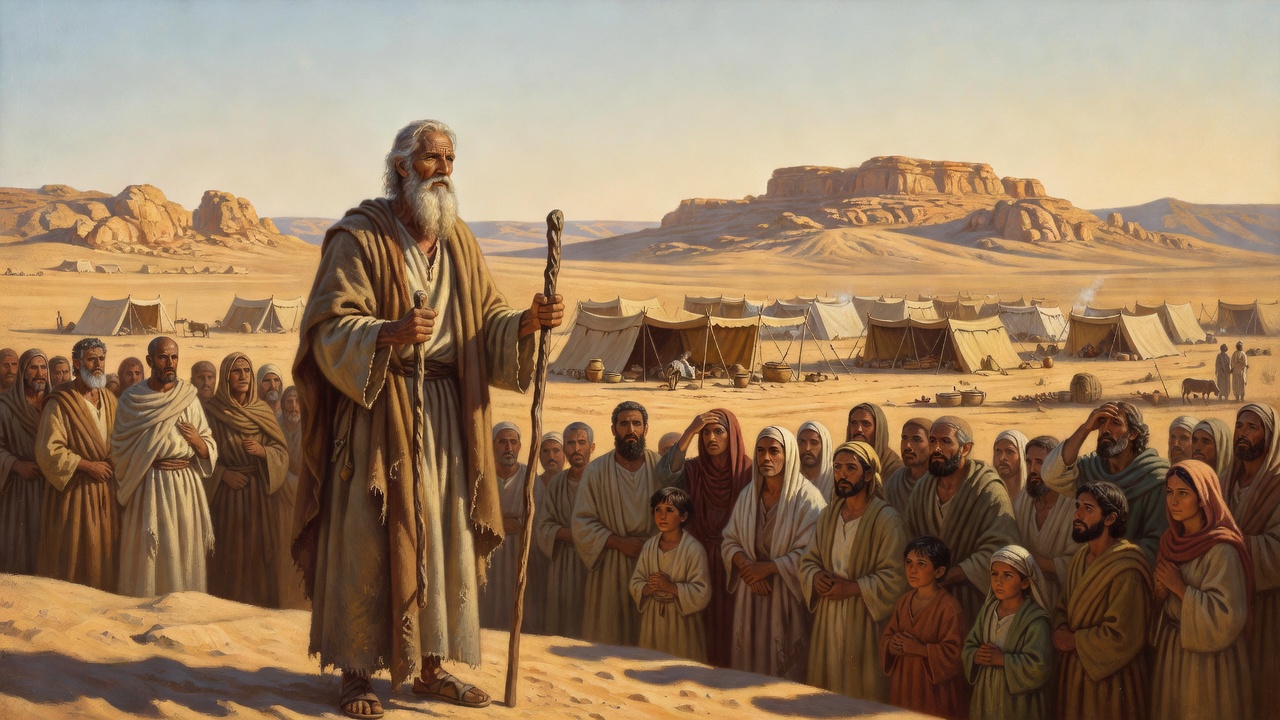
- Moses addresses Israel in the plains of Moab east of the Jordan in the fortieth year after the Exodus, shortly after defeating the Amorite kings Sihon and Og. The text notes that the journey from Mount Horeb to Kadesh-barnea was normally only eleven days, contrasting that short route with the decades of wandering caused by rebellion.Sources: the Bible text itself · Sihon · Og · Kadesh-barnea
- To manage disputes as the population grew, Moses established an organized judicial system by appointing respected tribal leaders over groups of thousands, hundreds, fifties, and tens. He charged these judges to show strict impartiality, hearing the small and great alike, and giving fair judgment to both native Israelites and resident foreigners.Sources: the Bible text itself
- Recalling the crisis at Kadesh-barnea, Moses describes how twelve scouts explored Canaan and returned carrying the fertile fruit of the land. However, widespread fear of fortified cities and tall warriors led the congregation to rebel, prompting God's oath that none of that generation except Caleb and Joshua would enter the promised land.Sources: the Bible text itself · Caleb · Joshua · Kadesh-barnea
Notes written with AI assistance from open sources (Theographic Bible Metadata, CC BY-SA 4.0; Easton’s Bible Dictionary, public domain) and reviewed before publishing.
Places in this chapter
- Arabah · 30.417, 35.151 · verses 1, 7
- Jordan · Today: Jordan River · 31.761, 35.558 · verses 1, 5
- Paran · 30.303, 34.777 · verse 1
- Mount Horeb · Today: Jebel Musa · 28.540, 33.973 · verses 2, 6, 19
- Egypt · 30.129, 31.308 · verses 3, 27, 30
- Bashan · 32.781, 35.935 · verse 4
- Moab · Today: Moab 1 · 31.181, 35.701 · verse 5
- Canaan · 32.767, 35.333 · verse 7
- Euphrates · Today: Euphrates River · 31.004, 47.442 · verse 7
- Lebanon · 33.540, 35.584 · verse 7
- Negeb · 31.245, 34.841 · verse 7
- Shephelah · 31.692, 34.875 · verse 7
- Way of the Red Sea · Today: road between the Dead Sea and the Gulf of Aqaba · 29.727, 34.998 · verse 40
Only places identified with high confidence are shown (90% or more according to the scholarly sources compiled by OpenBible). Period map: DARE (Digital Atlas of the Roman Empire), CC BY 4.0; modern map: © OpenStreetMap contributors; places: OpenBible.info (CC BY 4.0).
Credits and license for this translation
Berean Standard Bible
The Holy Bible in English: Berean Standard Bible
Public Domain
Language: English
Contributor: BSB Publishing, LLC
2026-10-02
Source: http://ebible.org/engbsb/ · eBible.org