Jonah 1
Jona · Tap a verse to see its cross-references.
About this book
About Jonah
- Jonah, whose name means “a dove,” was the son of Amittai of Gath-hepher and a prophet of Israel. Easton's Bible Dictionary (1897) holds that he wrote the book himself. His ministry is placed very early in the reign of Jeroboam II: he was contemporary with Hosea and Amos, or possibly earlier, and so may have been the oldest of the prophets whose writings survive.Sources: Jonah · Amittai · Easton: Jonah, Book of
- The book professes to tell what actually happened to the prophet. Some critics have read it as a parable or allegory rather than history, because miracle is so prominent and the form is narrative rather than prophecy, or because they deny miracles altogether. Easton's Bible Dictionary (1897) instead treats it as history, attaching great weight to the mention of Jonah in Matthew 12:39-40 and Luke 11:29.Sources: Easton: Jonah, Book of
- Jonah was commissioned to go to Nineveh, described as a great and populous city and the flourishing capital of the Assyrian empire, but he sailed from Joppa, Judea's chief seaport, to flee toward Tarshish. Where Tarshish lay is disputed: some place it in the east, on the Indian coast, some identify it with Carthage, and Easton's dictionary takes it to be a Phoenician port in Spain.Sources: Easton: Jonah, Book of · Nineveh · Joppa · Tarshish
- Easton's outline has four movements: the divine commission, disobedience, and punishment; Jonah's prayer and deliverance; a second commission, the Ninevites' repentance, and God's sparing mercy; and Jonah's anger at that mercy, followed by a rebuke. The same dictionary notes that Nineveh was spared for more than a century after his mission.Sources: Easton: Jonah, Book of
- As a prophet of Israel, Jonah foretold the restoration of the kingdom's ancient borders. A biographical note presents him both as a missionary to Nineveh and as a type of the Son of man. The book of Nahum is taken up almost entirely with denunciations of that city, and Zephaniah also predicts its destruction.Sources: Jonah · Nineveh
Notes written with AI assistance from open sources (Theographic Bible Metadata, CC BY-SA 4.0; Easton’s Bible Dictionary, public domain) and reviewed before publishing.
Jona Te Rop Selal Dini Dalen SUBU
1Tei vabwaleh ba SUBU te doptop mini Jona niah tei nutsun Amitai nuhu, 2“Ko van li vini kawu ah Niniva bi ko bep seresere dalek mini nii, igo nam gita ba noo lelian mwegapkapmwa tokol.” 3Tehu ba Jona mo rop selal dini saalean non SUBU, bi mwegam ban Tases. Tesip Jopa ba butdihi aga ah batvan Tases, bi mwe gele halan lin nuhu nemarop selal dini SUBU. Bi ram rop ban Tases.
4Rat temlu nae, ba SUBU mwasro bwera leng, bi teh mwegapkawu niah teleli ba aga tewelwel naa neewoowoo. 5Goah rat um li aga nong ratemtatsi bos bi ram dangro bwabwalehlak mini noo takaa nii nuhu rama beetsi nii. Ram gabarani leut ah tedi li aga le teh, nuhu nema leli ba aga nemamdeptep. Jona tesip mwasi bwalken aga bi mamtsuu ah temtsuu. Tebam muililngi apma nga ah tekap.
6Atsi ah teli aga mwisip ben Jona bi bamta. Bep mini nuhu “Ko mamtsuu gavak? Ko dumre bi nedangro mini nom takaa. Ko mwatkoh ba mwan rorongtani kik bi baamwesa kidi.”
7Goah rat um li aga rabep nuhu “Tabonhi dopmi dais, bi atsi ah mwan neiah lin ba ni nae niah bibi butsun too tekapmwa ahee.” Rat gam bonhi dais nong ba mwaiah li Jona. 8Ram uhleli ini nuhu “Ko vep mini gema nuhu itan ah mweleli too tekapmwa ahee vali kidi. Kom um le apmah? Bi kotepma ibeh? Kotepma li vini apmah, bi kom sokmasen atsi apma nii?”
9Jona bep nuhu “Nana Hibru, bi nam dangro nokon SUBU, Takaa nan ut le bini niah teleli teh bi ut li tan.”
10Rat vaviruu salsal i apma ah Jona tevep. Bi ram uhleli ini nuhu “Kot leli apmah?” Rat teililngi nuhu Jona terop selal dini non SUBU igo te vep mwasi mini nii. 11Naanong ba teh temu gapkawu ngate. Bi ram uhleli ini nuhu “Kama leli apma naanong mini kik ba teh nematpo roonga?”
12Jona bep nuhu “Karu bonhi nana vale teh, ba teh mwan gabis bamul. Nam mwaililngi nuhu bwera leng ahee niah mwahi gimi ba bibi butsun ah nana.”
13Goah rat um li aga ram lel dopmi nuhu rama vilis i aga mwesak ut, ba teh mumu gapkawu ngate. 14Ram dangro mini SUBU, rabep nuhu “ SUBU, kon ba lel tean ba gema kamatmate uu mwasan non atsi ahee. Kon ba lel tean ba kam selkakte metenan atsi woswosan ahee, uugo apma ah kom mwalngi ba mwan dapmak nae.” 15Ram selkani Jona, bi ra bonhi mwisip le teh. Entorah te was le teh bi teh mwatpo roonga bamul tekeni sileng. 16Entorah rat gita tedapmak ba ratemtak bahngi SUBU, bi ram leli noo sekakan mini SUBU. Bi rabwatle ini mini nuhu ranei non atsi nii.
17SUBU mwasro bwera ik, bi modolmi Jona. Jona tetpo le tsinen bwera ik nong tei ren katsil bi bung katsil.

Did you know?
Jonah Flees from the Lord
- Jonah, the son of Amittai from Gath-hepher, is also recorded in 2 Kings 14:25 as a prophet active in the northern kingdom of Israel during the reign of Jeroboam II. God instructed him to travel east to Nineveh, the prominent and populous capital of the Assyrian empire, to preach against its wickedness.Sources: Jonah · Amittai · Nineveh · the Bible text itself
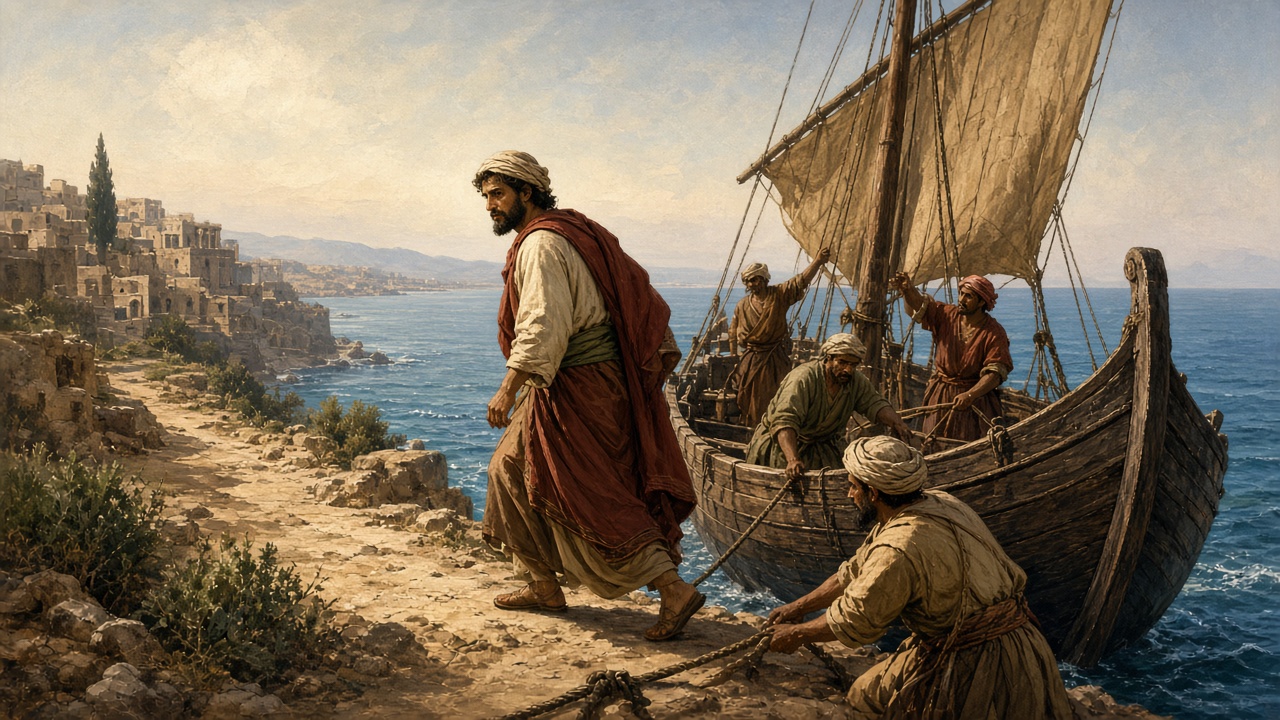
- Rather than traveling northeast overland to Nineveh, Jonah journeyed down to the Mediterranean seaport of Joppa to board a ship for Tarshish. Tarshish is traditionally identified as a Phoenician trading port located far to the west in southern Spain, representing the exact opposite direction.Sources: Joppa · Tarshish · the Bible text itself
- The sailors aboard the cargo ship came from polytheistic backgrounds, each calling out to his own deity during the violent tempest. After throwing the ship's cargo overboard to lighten the vessel, they turned to the ancient practice of casting lots to determine who was responsible for the calamity.Sources: the Bible text itself
Notes written with AI assistance from open sources (Theographic Bible Metadata, CC BY-SA 4.0; Easton’s Bible Dictionary, public domain) and reviewed before publishing.
Places in this chapter
Only places identified with high confidence are shown (90% or more according to the scholarly sources compiled by OpenBible). Period map: DARE (Digital Atlas of the Roman Empire), CC BY 4.0; modern map: © OpenStreetMap contributors; places: OpenBible.info (CC BY 4.0).
Credits and license for this translation
Jona
The Book of Jonah in the Apma language of Vanuatu
Jona long lanwis Apma
copyright © 2019 Pioneer Bible Translators
Language: Apma
Translation by: Dick Bule & Morrie Tabi
This translation is made available to you under the terms of the
Creative Commons Attribution-Noncommercial-No Derivatives license 4.0.
You may share and redistribute this Bible translation or extracts from it in any format, provided that:
You include the above copyright and source information.
You do not sell this work for a profit.
You do not change any of the words or punctuation of the Scriptures.
Pictures included with Scriptures and other documents on this site are licensed just for use with those Scriptures and documents.
For other uses, please contact the respective copyright owners.
2024-04-27
Source: http://ebible.org/app/ · eBible.org